 By Alex
 What Should I Learn First to Build AI Agents? A Practical Learning Roadmap
If you want to build AI agents, learn the ideas in the right order: what an agent is, how LLMs use tools, how APIs and prompts work, then memory, orchestration, guardrails, and evaluation.
If you want to build AI agents, learn the concepts in the order they actually depend on each other. The fastest path is not "pick a framework and start wiring things together." The fastest path is: understand what an AI agent is, learn how an LLM uses tools, get comfortable with APIs and prompts, then add memory, orchestration, and evaluation only after a simple agent already works.
Definition: The first things to learn for building AI agents are the agent mental model, tool use, prompts, and APIs — not advanced orchestration.
Example: A beginner learns more from building one support-triage agent with one inbox tool than from copying a five-agent demo they cannot debug.
Key takeaway: Learn the layers in sequence: fundamentals first, complexity later.
Business impact: Teams that learn in the right order reach a usable first agent faster and spend less time rebuilding a messy prototype.
What should you learn before writing any agent code?
Before writing code, learn what makes an agent different from a chatbot, because that distinction decides what you are actually building. OpenAI defines an agent as a system that uses an LLM to manage workflow execution and tools to act on the user's behalf, while OpenAI's developer track reduces it to three essentials: instructions, guardrails, and tools. The practical takeaway is that your first lesson is not syntax; it is the mental model that an agent is a goal-driven system with actions and limits. If you skip that and think only in terms of "smarter chat," you will build something that talks well but does not complete work.
The Yowox Agent Learning Order
The simplest roadmap is to treat agent learning as six layers, where each layer unlocks the next one:
- Agent mental model — goal, tools, guardrails, and completion.
- LLM basics — prompts, context windows, structured outputs, and reasoning limits.
- Tool use and APIs — how the agent reads data and takes action.
- Single-agent workflow design — plan, act, verify, escalate.
- Evaluation and guardrails — measuring whether the agent actually works.
- Advanced systems — memory, RAG, MCP, and multi-agent orchestration.
This order matters because advanced topics only make sense once you understand the simpler agent underneath them. A beginner who studies multi-agent patterns before tool calling is learning architecture before learning the parts it is made of.
Should you learn LLM fundamentals first or jump into frameworks?
Learn LLM fundamentals first, because every framework is only an abstraction over the same small set of moving parts. Anthropic's guidance on building effective agents is unusually direct here: the most successful teams tend to use simple, composable patterns instead of starting with heavy abstractions, and developers should understand the underlying code if they do use a framework. That advice matters because many "framework problems" are really prompt, tool, or context problems wearing a framework mask. The practical takeaway is to learn prompts, context limits, tool schemas, and failure modes before you trust a framework to hide them.
What LLM concepts matter most for your first agent?
The LLM concepts that matter first are not model-training theory but operating behavior: how a model follows instructions, how context windows limit what it can remember in the moment, how structured output makes downstream steps safer, and why reasoning quality changes with task complexity. OpenAI's building-agents track frames the core primitives as models, tools, state or memory, and orchestration, which is a useful checklist for what to understand conceptually before chasing implementation details. The practical takeaway is to stop at the level where you can answer four questions clearly: what model is doing the reasoning, what tools it can call, what state it carries, and what logic decides the next step.
Why should tool use and APIs come before memory and multi-agent systems?
Tool use and API literacy should come before memory and multi-agent systems because agents become useful only when they can act on real systems, and that is the first engineering bottleneck most builders hit. An agent without tools is mostly a thought engine; an agent with one cleanly designed tool can already classify, fetch, update, route, or notify. OpenAI's practical guide separates tools into data tools, action tools, and orchestration tools, which is a good beginner way to think about what an agent actually needs. The practical takeaway is to learn how to read API docs, make requests, handle errors, and return structured outputs before worrying about long-term memory or agent teams. Background: AI agent reliability shifts from prompts to schemas. See also Python or n8n for AI Agents?.
If you need the broader architecture around those tools, the AI automation stack explained is the best companion article after this one.
What should your first real project look like?
Your first real project should be one narrow agent with one clear success condition and one or two tools, because that setup teaches the whole loop without hiding mistakes inside complexity. Good starter projects include triaging inbound support tickets, enriching inbound leads, classifying documents, or routing requests to the right person. Those projects force you to define the task clearly, connect one real system, add a verification step, and inspect failures — which is exactly the learning sequence you want. That is also why how to get started with AI agents recommends a bounded task instead of a department-wide automation ambition.
A useful rule is this: if you cannot explain how your first agent succeeds or fails in one sentence, the project is too broad for learning.
When should you learn memory, RAG, and MCP?
Learn memory, RAG, and MCP after a simple tool-calling agent works, not before. Memory matters when your agent needs continuity across steps or sessions. RAG matters when the agent needs fresh or private knowledge beyond what the base model already knows. MCP matters when you want a cleaner, reusable way to expose tools and resources to the agent instead of writing one-off connectors. These are important topics, but they solve second-order problems: they improve a working agent more often than they rescue a poorly understood first one. More on this: Microsoft's Five-Step Guide to Building AI Agents. See also Self-hosted no-code tools for LLM apps, RAG and agents.
That ordering also reduces confusion. Beginners often use "memory" to compensate for unclear prompts, or "multi-agent" to compensate for a bad tool design, when the real issue is still in the simpler layer below.
Do you need to learn multi-agent orchestration early?
No. Learn multi-agent orchestration only after a single agent is clearly hitting a real limit, because multi-agent systems increase coordination cost, debugging difficulty, and failure surface. Anthropic's workflows-versus-agents distinction is useful here: many tasks are better handled by a predictable workflow or a single agent than by several agents negotiating with each other. The practical takeaway is to earn complexity, not assume it. If one agent with one good prompt and a few well-designed tools can do the job, adding more agents is usually a learning distraction rather than a capability gain.
What should you learn before shipping anything real?
Before shipping, learn evaluation and guardrails, because a working demo and a reliable agent are not the same thing. OpenAI's practical guide explicitly recommends establishing evals and using the strongest model first to create a baseline before optimizing for cost or latency. That advice matters because beginners often optimize too early and measure too late. The practical takeaway is to collect real examples, define what a correct result looks like, add human review where risk is real, and test edge cases before calling the system "done." If you skip that step, you are not learning to build agents — you are learning to stage demos. More on this: Best free courses to learn AI.
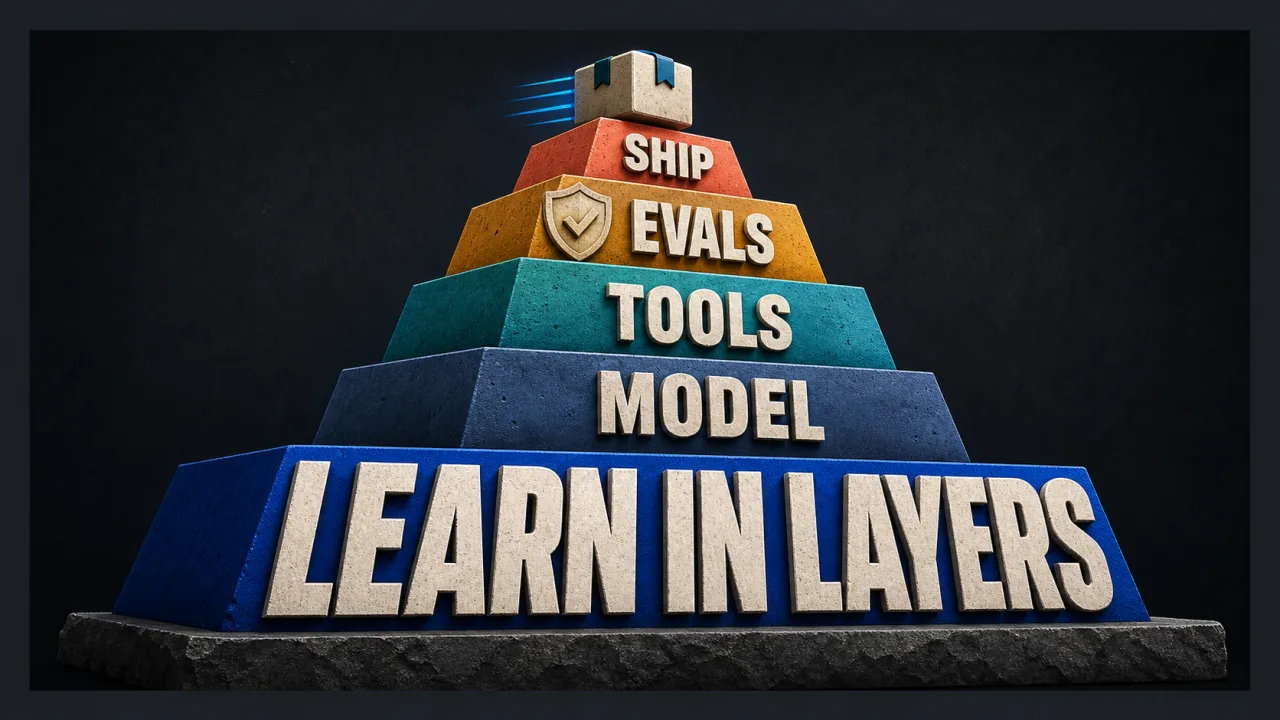
This is also where common beginner mistakes with AI agents becomes relevant, because the most expensive mistakes usually appear after the first demo works. The AI agent skills pyramid maps the same journey by capability layer — useful for checking which skills you actually need at each stage.
The shortest practical curriculum
If you want the shortest useful curriculum, learn in this order and build one small project along the way:
| Phase | Learn this first | Why it comes here |
|---|---|---|
| 1 | What an agent is | Prevents you from building a chatbot and calling it an agent |
| 2 | Prompts, context, structured outputs | Gives you control over model behavior |
| 3 | APIs and tool calling | Lets the agent act on real systems |
| 4 | Single-agent workflow design | Teaches plan, act, verify, escalate |
| 5 | Evaluation and guardrails | Turns a prototype into something trustworthy |
| 6 | Memory, RAG, MCP, multi-agent patterns | Solves scaling and sophistication later |
The point is not to memorize a long syllabus. The point is to move from one working layer to the next without using advanced concepts to mask weak fundamentals.
Want help choosing the right first project or deciding whether to build or buy? Get in touch.
Frequently asked questions
Do I need to learn Python before building AI agents?
Not always, but learning one scripting language makes the path much smoother. Python is the most common starting point because many agent libraries and examples use it first, while JavaScript or TypeScript is a good alternative if you already build web products there. The key point is not mastering every language but becoming comfortable enough to call APIs, read documentation, and glue tools together.
Should I learn a framework like LangGraph before learning raw APIs?
Usually no. Most beginners learn faster by understanding the basic agent loop and direct model or tool calls first, because that makes framework behavior easier to debug later. A framework can speed up implementation, but if you start there without the underlying mental model, you may copy a pattern you cannot fix when it breaks.
What is the biggest mistake beginners make when learning agents?
The biggest mistake is jumping straight to multi-agent systems, memory stacks, and framework comparisons before learning what a single agent is supposed to do. A single tool-calling agent with a clear task teaches more than a complicated demo with five moving parts. Complexity hides weak fundamentals instead of solving them.
When should I learn MCP, RAG, and multi-agent orchestration?
Learn them after you understand the basics of a single agent: model, instructions, tool use, and evaluation. MCP matters when you need a clean, reusable way to connect tools. RAG matters when your agent needs fresh or private knowledge. Multi-agent orchestration matters only when one agent stops being enough for the workflow.
What should I build first while learning AI agents?
Build one narrow agent that uses at least one real tool and has a clear success check: for example, classify inbound leads, draft first-response support emails, or summarize a document and route it to the right place. That kind of project teaches prompting, tool use, error handling, and evaluation all at once without overwhelming you.
Alex
Founder & Lead AI Writer
Alex is the founder of Yowox and lead AI writer since 2024, breaking down complex information into clear, actionable insights for thousands of readers every day. Alex has built AI automation systems for businesses since 2024, focusing on AI agents, workflow automation, and business process optimization.
Save hours. Save thousands.
Practical guides, real workflows, and the latest AI and automation news that matters — straight to your inbox.