 By Alex
 Best free courses to learn AI
A practical shortlist of genuinely free AI courses, organised by learner goal: AI literacy, machine learning, deep learning, and hands-on building.
The best free AI course depends on what you want to do with AI, not on the biggest university name. For AI literacy, start with Elements of AI; for classical machine learning, use the Machine Learning Crash Course; for deep learning, choose fast.ai or MIT 6.S191; and for short, practical exercises, use Kaggle Learn. That route avoids the common mistake of starting an advanced neural-network course before learning what a model is supposed to solve.
Definition: A free AI course gives you access to the learning material and exercises without requiring a paid subscription; a certificate may still cost extra.
Example: A business operator can begin with AI concepts, while a developer can go directly to machine learning exercises or a project-first deep-learning course.
Key takeaway: Pick one course that matches your current level, finish a small exercise, and only then move to the next layer.
Business impact: Role-based learning reduces wasted training time and gives a team a shared vocabulary before it starts buying tools or automating work.
Which free AI course should you choose?
The quickest way to choose a free AI course is to match the course's output to your goal: understanding AI, training models, building deep-learning systems, or practising in a notebook. The shortlist below uses official course pages and separates open learning access from optional paid certificates, because a platform's "free trial" is not the same as a course that remains free. Choose one row, complete its first exercise, and resist collecting six unfinished tabs.
| Course | Best for | What you will practise | Starting level |
|---|---|---|---|
| Elements of AI | Non-technical AI literacy | AI concepts, limits, social impact, practical exercises | Beginner |
| Google Machine Learning Crash Course | ML foundations | Regression, classification, data, neural networks, embeddings, LLMs | Beginner to intermediate |
| CS50's Introduction to AI with Python | Serious coding foundations | Search, logic, optimisation, machine learning, language, projects | Intermediate |
| Practical Deep Learning for Coders | Building working models | Computer vision, NLP, tabular data, recommendations, deployment | Developers |
| AI for Beginners | A broad structured curriculum | Neural networks, TensorFlow, PyTorch, ethics, labs and quizzes | Beginner to intermediate |
| Kaggle Learn | Short hands-on practice | Code, data, machine learning, deep learning, explainability | Beginner to intermediate |
The table is a route map, not a leaderboard. Elements of AI is the clearest first stop for a non-technical learner; the ML course and CS50 AI are better when the goal is understanding how systems work; fast.ai is better when the goal is a working model; and Kaggle is better when the learner needs short feedback loops. Use the course that produces the next useful artefact, not the one with the most impressive badge.
What is the best free AI course for complete beginners?
Elements of AI is the best first course for a complete beginner because it removes the programming prerequisite while still explaining what AI can and cannot do. The University of Helsinki and MinnaLearn describe it as a free, self-paced course that combines theory with practical exercises, and the introductory course explicitly requires no complicated mathematics or programming. Start there if terms such as model, training, prediction, and neural network are still blurry; move to a coding course only after you can explain the problem an AI system is solving.
Elements of AI also offers a separate Building AI course for learners who want to move from concepts toward algorithms, with basic programming recommended. That makes the pair useful as a staged path: first learn the vocabulary and limits of AI, then inspect the mechanisms behind it. Do not treat completion as proof that you can deploy an AI system; treat it as the foundation for choosing the next technical course.
Which free course teaches machine learning fundamentals?
Google's Machine Learning Crash Course is the strongest free technical starting point for machine learning because it combines explanations with interactive exercises across the core model-building loop. The current curriculum covers linear and logistic regression, classification metrics, numerical and categorical data, overfitting, neural networks, embeddings, large language models, production ML systems, AutoML, and fairness. Work through the modules in order if you are new to ML, and use the exercises to test whether you can explain a model's error rather than just reproduce its output.
Google's prerequisites matter: the course recommends Python, NumPy, pandas, algebra, linear algebra, and statistics, with calculus optional for advanced topics, and its programming exercises run in Colaboratory. If those prerequisites are unfamiliar, complete the data basics in Kaggle Learn first; if they are comfortable, Google MLCC is a compact bridge from terminology to model mechanics. The course is not a full software-engineering curriculum, so add a project after the modules instead of assuming the lessons alone make you production-ready.
Is Harvard CS50 AI worth taking for free?
Harvard's CS50 AI is worth taking for free when you already know Python and want algorithms rather than prompt tips. Harvard publishes seven weeks of OpenCourseWare that anyone can take for free, and the course uses hands-on projects to cover graph search, logic, optimisation, machine learning, large language models, and other AI foundations. The official prerequisite is CS50x or at least one year of that language, so beginners should not mistake the free price for a beginner difficulty level.
CS50 AI is especially useful for learners who want to understand why an intelligent system chooses an action: search and representation make that question concrete before the course reaches machine learning and language. The learning materials are free, while Harvard and edX present verified certificates as a separate enrollment path. Use CS50 AI when you want a demanding project portfolio and can commit to debugging code, not when you only need a two-hour overview.
Which free course is best for building deep-learning models?
fast.ai's Practical Deep Learning for Coders is the best free project-first course for a developer who wants to build before studying every equation. The course has nine lessons of roughly 90 minutes and covers models for computer vision, natural language processing, tabular analysis, and collaborative filtering, plus deployment. fast.ai says some coding experience is required, but specialised hardware and university-level mathematics are not; the course points learners to free resources for building and deploying models.
The fast.ai teaching order is deliberate: learners work with a useful model early, then go deeper into PyTorch, fastai, Hugging Face, and the underlying mathematics. That makes the course motivating but not effortless. Bring a real small dataset or a narrowly defined problem, keep a record of errors, and do not confuse a notebook that runs with a model that is reliable for users.
Is Microsoft AI for Beginners a complete free curriculum?
Microsoft's AI for Beginners is the broadest structured option in this list because it packages 12 weeks and 24 lessons with quizzes, practical lessons, and labs. The curriculum introduces symbolic approaches, neural networks and deep learning, TensorFlow and PyTorch, neural architectures for images and text, multi-agent systems, and AI ethics. Choose it when you want a syllabus with more breadth than a short crash course; choose Google MLCC or Kaggle when you want a faster route into model evaluation.
Microsoft's curriculum is open on GitHub and offers a large set of community translations, including Russian, but the Yowox recommendation remains to study the English source when you can because current library terminology changes quickly. The curriculum is intentionally not a complete business-AI course or a replacement for classical machine-learning study, so pair it with one small project and a separate evaluation habit.
What can you learn from Kaggle for free?
Kaggle Learn is the best free supplement when you need short, browser-based practice rather than a single long course. Kaggle says its courses are provided at no cost and now offer certificates; the Intro to Machine Learning course estimates three hours and covers model basics, data exploration, a first model, validation, overfitting, random forests, and competitions. The Intro to Deep Learning course estimates four hours and uses TensorFlow and Keras to teach neurons, neural networks, gradient descent, and overfitting.
Kaggle's short-course format is useful between larger courses because each lesson ends with an exercise and the next course is explicit about prerequisites. Start with the programming basics if you cannot read a notebook, then move to Intro to Machine Learning, and only after that try Intro to Deep Learning or explainability. The goal is not to collect certificates; it is to create a sequence of small, inspectable experiments that reveal what you do not yet understand.
Which free AI learning path should you follow?
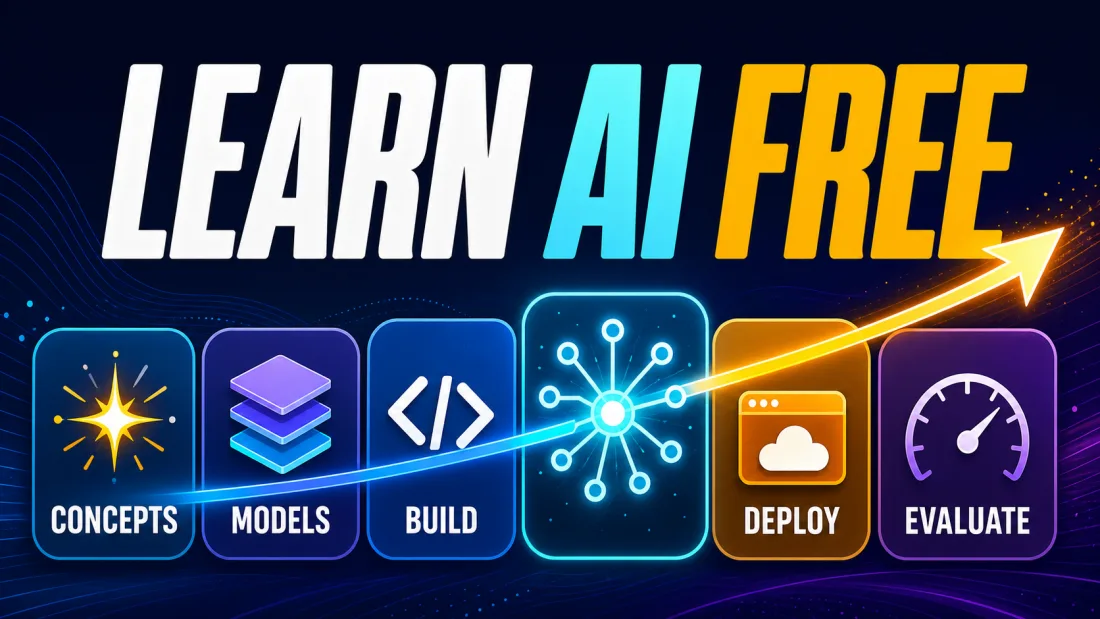
A practical free AI learning path has four stages: concepts, machine learning, one project, and evaluation. Spend the first stage on Elements of AI; use Kaggle to fill data gaps; choose Google MLCC or CS50 AI for foundations; then use fast.ai, Microsoft AI for Beginners, or a Kaggle deep-learning course for a project. This order follows the dependency between concepts, code, models, and evidence instead of treating every course as interchangeable.
| Goal | Start here | Add next | Stop when you can |
|---|---|---|---|
| Understand AI at work | Elements of AI | One Kaggle exercise | Explain a model's limits and a safe use case |
| Build ML models | Kaggle Learn | Google MLCC | Compare a baseline with a validated model |
| Build AI software in Python | CS50 AI | fast.ai | Ship a small project and inspect its failures |
| Learn broad deep learning | Microsoft AI for Beginners | MIT 6.S191 or fast.ai | Explain the data, model, metric, and deployment boundary |
If your target is AI agents rather than model training, follow the fundamentals with what should I learn first to build AI agents and start with one tool-using workflow. What is an AI agent? clarifies the system boundary before you choose frameworks, while the AI agent skills guide helps separate problem decomposition from the technical skills that come later.
How do you know a free AI course is worth finishing?
A free AI course is worth finishing when it leaves you with a testable skill, not just a longer vocabulary list. After each module, write one sentence describing the task, the input, the model or method, and the success check; then build the smallest example that could fail. A learner who can compare a baseline, explain an error, and state where human review belongs has gained more than a learner who watched a longer playlist without producing evidence.
Use this completion test before starting another course: can you explain the course's main concept without repeating its marketing language, reproduce one exercise from a blank notebook, and name one limitation that would matter in a real workflow? If not, repeat the exercise or narrow the project. Once you can, choose the next course by the gap you can name — concepts, programming, model mechanics, deep learning, or deployment — rather than by a generic list of "top AI courses."
Free courses are enough to build a strong foundation, but a business workflow still needs clear scope, data boundaries, evaluation, and an owner for exceptions. If you want help turning a finished learning project into a bounded automation plan, talk to Yowox.
Frequently asked questions
What is the best free AI course for a complete beginner?
Elements of AI is the safest starting point for a learner with no technical background because it explains what AI can and cannot do without requiring complicated mathematics or programming. It is self-paced and combines theory with practical exercises. After that foundation, choose a technical course only if you want to build models or write AI software rather than simply understand the technology.
Which free AI course is best for learning machine learning?
The Machine Learning Crash Course is the strongest next step for a learner who wants the mechanics of machine learning: regression, classification, data preparation, neural networks, embeddings, large language models, production systems, and fairness. It is more technical than an AI-literacy course, so NumPy, pandas, algebra, and statistics make the material easier to follow. Use Kaggle's shorter courses first if those prerequisites are not yet comfortable.
Can I learn AI for free without a powerful computer?
Yes. Many free courses use browser-based notebooks or hosted exercises rather than asking you to train models locally. Google's course uses Colaboratory for programming exercises, while fast.ai points learners to free computing resources for building and deploying models. A local GPU is useful for experimentation later, but it is not a sensible prerequisite for starting with AI fundamentals or introductory machine learning.
Are free AI courses really free if the certificate costs money?
Course access and certification are separate products on some platforms. Harvard's CS50 AI course is available free through its OpenCourseWare, while a verified edX certificate is an optional paid path. This guide therefore labels learning access rather than promising a free credential. Check the current enrollment page before paying, especially when a platform advertises a free trial instead of permanent access to the course materials.
Should I learn generative AI or machine learning first?
Start with AI fundamentals, then choose based on what you want to do. If you need to use AI responsibly at work, an AI-literacy course is enough to begin. If you want to build models, learn machine learning and Python before deep learning. If you want to build applications around existing models, learn APIs, tool use, evaluation, and workflow design after the fundamentals rather than trying to train a foundation model yourself.
Alex
Founder & Lead AI Writer
Alex is the founder of Yowox and lead AI writer since 2024, breaking down complex information into clear, actionable insights for thousands of readers every day. Alex has built AI automation systems for businesses since 2024, focusing on AI agents, workflow automation, and business process optimization.
Save hours. Save thousands.
Practical guides, real workflows, and the latest AI and automation news that matters — straight to your inbox.