 By Alex
 What Skills Do I Need to Build AI Agents?
Building an AI agent takes less programming than most people assume, and more problem decomposition than most people expect. Here's the actual skill breakdown, from the base everyone needs to the production-reliability skills only some teams do.
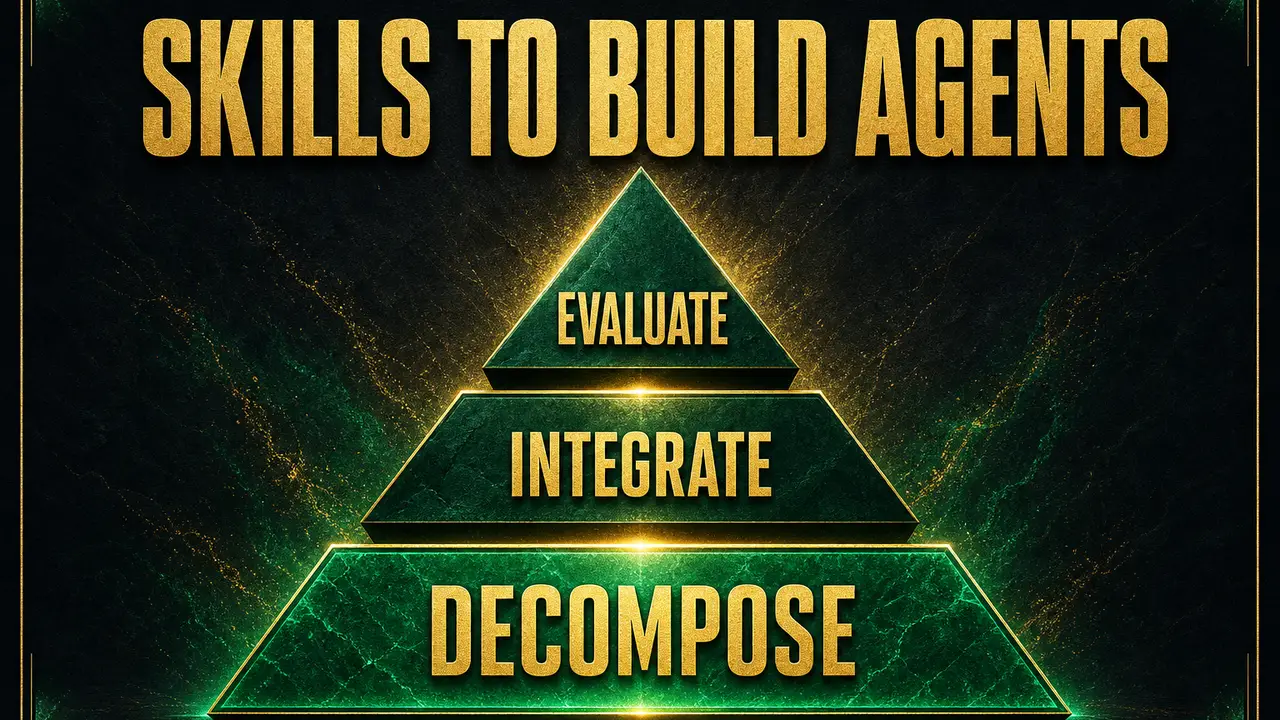
Building an AI agent takes less programming than most people assume, and more problem decomposition than most people expect. The base skill — turning a vague goal into a narrow, well-defined, testable task — matters for everyone building or overseeing an agent, technical or not; the more specialized skills (API integration, evaluation, reliability engineering) only matter once you're past that first step. If you'd rather work through the same material as a step-by-step sequence, see what to learn first to build AI agents. The tooling is opening up as well, with Grok Build opening its agent harness.
Definition: The skills needed to build an AI agent split into three layers — a foundational one everyone needs, a practical one builders need, and a production one only some teams need.
Example: Someone with no coding background can define "draft a reply to refund-status emails, flag anything unclear for a human" clearly enough for an engineer or a no-code tool to build against; that's the hard, valuable part.
Key takeaway: Coding is one layer of this, not the whole skill set — and it's not the layer most projects actually get stuck on.
Business impact: Knowing which layer your team is missing tells you whether to hire an engineer, buy a tool, or just get better at defining the task before either.
What's the most important skill for building AI agents?
Problem decomposition and clear instruction-writing sit at the base of the skill pyramid because they're needed by literally everyone involved, whether or not they touch any code — and they're also the layer most people skip past on the way to picking a tool or a framework. OpenAI's own guide to building agents makes the same point directly: a capable model, well-defined tools, and clear instructions matter more than architecture choices, and all three of those depend on this same underlying skill. Someone who can turn "help with customer support" into "draft a reply to refund-status questions, flag anything else for a human" has already done the hardest, least transferable part of the job — a skill worth building deliberately before worrying about which framework or model to use.
What technical skills do you actually need to build one yourself?
Once you're past defining the task, the next layer is genuinely technical: connecting the agent to real tools and data, which in practice means basic API integration and enough scripting ability to wire things together. Python is the dominant language across current agent frameworks and tooling, making it the most broadly useful single language to learn for this specifically; JavaScript or TypeScript is the practical second choice for agents embedded in a web product. If the agent needs to read your own data reliably, some working understanding of retrieval and of connection standards like MCP — the protocol that standardizes how an agent talks to a given tool or data source — becomes relevant here too, since it's increasingly how that integration work actually gets done rather than a one-off custom connector.
Do you need to code at all?
Not always. Plenty of current agent products and no-code or low-code platforms are built specifically so a non-engineer can connect a trigger, an AI step, and an action without writing code, which is exactly why buying rather than building is often the right call for a first attempt — it substitutes a vendor's engineering for your own. Coding starts to matter once the task needs something a ready-made tool doesn't support, or once you're connecting several internal systems with specific reliability requirements a generic product wasn't built around.
Why does an agent that works in testing sometimes fail in production?
Because getting an agent to work once against a handful of test cases and getting it to work reliably against real users at scale are two different problems, and the skill gap between them is exactly what separates a demo from a shipped product. An agent that looks correct on the cases you happened to try can still fail unpredictably on the ones you didn't — which is why the top of the skill pyramid is evaluation and reliability engineering: building a habit of testing against edge cases, not just confirming the happy path works, the same discipline behind avoiding the "no human checkpoint" mistake covered elsewhere. This is also the layer where most individual builders should stop and buy or hire rather than push through alone — reliability engineering for a live system is a specialized, ongoing skill, not a one-time build step.
What skills matter if you're evaluating a tool instead of building one?
The base-layer skill still matters most — you can't judge whether a vendor's agent product actually solves your task if you haven't defined that task clearly enough to test it against. Beyond that, evaluating an agent tool is mostly a vendor-diligence skill: understanding its data-handling and permissions model, checking whether it supports open connection standards like MCP so it isn't a dead end for future integrations, and having a real, narrow test case ready rather than judging by a sales demo. None of that requires the technical layers above it — which is exactly why non-technical teams can make a good build-vs-buy call without becoming engineers first, as long as they've done the base-layer work properly.
Frequently asked questions
Do I need to know how to code to build an AI agent?
Not necessarily. Many current agent products and no-code platforms let non-engineers connect a trigger, an AI step, and an action without writing code. Coding matters once you're building something custom beyond what an off-the-shelf tool supports, or connecting many internal systems with specific reliability requirements.
What's the single most important skill for building AI agents?
Turning a vague goal into a narrow, well-defined, testable task — problem decomposition, not programming syntax. An agent can only be built well against clear instructions and a clear boundary of what it should and shouldn't do; that clarity is a thinking skill, not a technical one, and it's the skill most people skip past.
What programming language should I learn to build AI agents?
Python is the dominant language across current agent frameworks and tooling, making it the most broadly useful choice if you're learning one language specifically for this. JavaScript/TypeScript is the practical second choice for agents embedded in web applications.
Why do agents that work in testing fail in production?
Because working once against a handful of test cases and working reliably against real users at scale are different engineering problems. An agent that looks correct in a demo can still fail unpredictably on edge cases it was never tested against — the skill gap here is building an evaluation habit, not just getting a first version to run.
What skills matter if I'm buying an agent tool instead of building one?
Vendor and tool evaluation, not programming. That means knowing what to ask about data handling and permissions, understanding whether a tool supports open standards like MCP for connecting to your other systems, and being able to define the narrow task clearly enough to judge whether a given product actually solves it — the same problem-decomposition skill needed to build one, one layer up.
Alex
Founder & Lead AI Writer
Alex is the founder of Yowox and lead AI writer since 2024, breaking down complex information into clear, actionable insights for thousands of readers every day. Alex has built AI automation systems for businesses since 2024, focusing on AI agents, workflow automation, and business process optimization.
Save hours. Save thousands.
Practical guides, real workflows, and the latest AI and automation news that matters — straight to your inbox.