 By Alex
 Grok Build Opens the Agent Harness
SpaceXAI has open-sourced the Rust harness, terminal UI and tool layer behind Grok Build, making the mechanics of a coding agent inspectable and extensible.
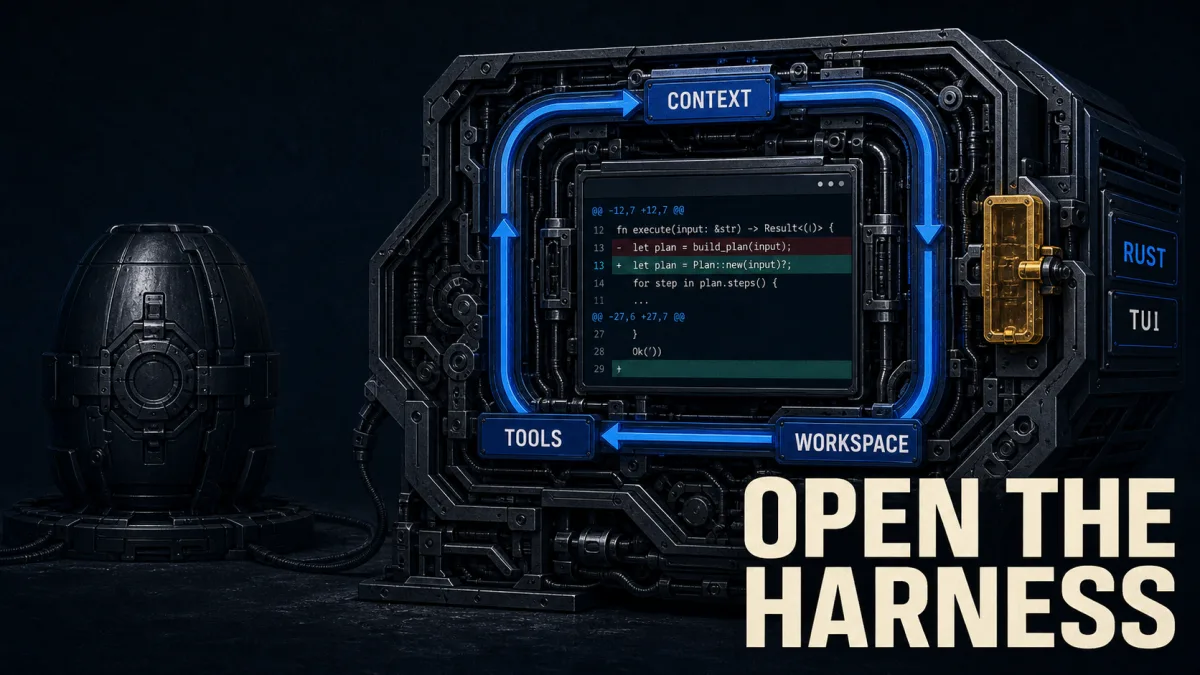
SpaceXAI has open-sourced the machinery around its coding agent—not just another terminal wrapper. Grok Build’s release exposes the Rust harness, fullscreen terminal UI, tool layer and extension points that turn a model into an agent able to inspect a repository, edit files, execute commands and manage longer tasks.
The important distinction is that this is an open-source harness, not an open release of Grok model weights. The value of the announcement is therefore in inspectability and control: developers can see how context is assembled, how responses become tool calls, and how those calls reach a workspace.
Definition: Grok Build is SpaceXAI’s terminal-based coding agent and the open-source harness behind its
grokCLI.Example: A team can run the interactive TUI while developing, use headless mode in CI, or embed the agent in an editor through ACP.
Key takeaway: The open-source boundary is the agent runtime and developer experience, not the underlying model itself.
Business impact: Teams get a more inspectable starting point for coding automation, but they also inherit responsibility for tool permissions, credentials, sandboxing and evaluation.
What SpaceXAI published
In its official announcement, SpaceXAI describes Grok Build as a coding agent and TUI whose source is now available for inspection and extension. The release covers four connected areas:
- The agent loop: assembling context, calling a model, parsing its response and dispatching tool calls.
- The tools: reading and editing code, searching, and running commands.
- The terminal UI: rendering, input handling, plan review and inline diff viewing.
- The extension system: skills, plugins, hooks, MCP servers and subagents.
That list is more consequential than a feature checklist. A coding agent is not only a prompt sent to a model. It is a policy-and-execution system that decides what context enters the request, which actions are available, how results return to the model and how a human reviews changes.
The public GitHub repository is primarily Rust and is licensed under Apache 2.0 for first-party code. The repository also separates third-party notices and vendored components, a detail teams should read before treating the whole tree as having one uniform license.
The harness is the product surface
A useful way to understand Grok Build is to place the model inside a larger loop:
Workspace → context assembly → model response → parse → tool dispatch → workspace
The model proposes the next step. The harness determines what the model can see and what it can do. It may read a file, apply an edit, run a command, inspect the result and continue—or stop for human review.
That is the same distinction that separates an AI agent from a basic chatbot. The agent is defined not only by generated text, but by its ability to observe a working environment, choose actions and continue through feedback.
Open-sourcing this loop gives developers a chance to inspect implementation details that are usually hidden behind an API. They can ask practical questions:
- Which files and instructions enter the model context?
- How are tool arguments validated?
- What happens when a command fails?
- Are edits shown as a diff before they are accepted?
- How are long-running tasks persisted or resumed?
- Where do plugins and MCP servers get their permissions?
Those questions are not academic. They determine whether a coding agent behaves like a useful collaborator or an opaque process with access to a repository and shell.
Three ways to use Grok Build
The release presents three distinct surfaces rather than one terminal experience.
| Surface | Best fit | What changes |
|---|---|---|
| Interactive TUI | Human-led development | The developer sees prompts, plans, tool activity and diffs in a fullscreen interface |
| Headless mode | Scripts and CI | An agent task can run without an interactive terminal and produce machine-readable output |
| Agent Client Protocol | Editor integration | Other applications can embed or communicate with the agent through a shared protocol |
This separation matters because the same agent needs different controls in each environment. A developer may approve a file edit interactively. A CI job needs deterministic logs, clear exit behavior and a restricted workspace. An editor integration needs a stable protocol and predictable lifecycle.
The Grok Build documentation describes the interactive, headless and ACP paths, as well as custom model configuration. It also shows that the tool is designed to work with a model selected through configuration rather than treating the default model as the only possible backend.
Open harness, separate model layer
The most important boundary in the announcement is also the easiest to misunderstand. Open-sourcing Grok Build does not mean that every component of the Grok coding stack is now open.
| Layer | What the release changes | What still needs verification |
|---|---|---|
| Agent harness | Source is available for inspection and extension | Runtime behavior, update cadence and contribution policy |
| Terminal UI | TUI code and interaction model are visible | Usability and compatibility across terminals |
| Tool layer | File, shell and search mechanisms can be studied | Permission model, sandboxing and safe defaults |
| Model | The harness can call a configured model | Weights, model terms, API access and local inference support |
| Extensions | Skills, plugins, hooks, MCP and subagents are exposed as concepts | Trust boundaries and supply-chain controls |
That distinction is healthy for developers. It makes the open-source claim more precise: teams can reuse, audit or adapt the runtime while choosing whether to use a hosted model, a custom endpoint or local inference.
It also prevents a common procurement mistake. A repository under Apache 2.0 does not automatically make the entire product stack self-hostable, cost-free or independent of the vendor. The model, authentication, hosted services, telemetry and third-party dependencies each require their own review.
Why the tool layer deserves scrutiny
The tool layer is where a coding agent crosses from text generation into operational software. Reading and editing files can change source code. Shell access can install packages, modify environments or delete data. Web search can bring untrusted content into the context. MCP servers can connect the agent to external systems.
The open repository makes those paths easier to inspect, but inspection is not the same as safety. Before allowing an agent into a production or regulated repository, a team should map:
- allowed filesystem roots and write locations;
- command execution and approval behavior;
- environment variables and credential exposure;
- network access and web-content handling;
- extension installation and update paths;
- audit logs for prompts, actions and outputs;
- rollback behavior when an agent makes a bad change.
A good first experiment is a disposable repository with synthetic secrets, explicit network limits and a test suite that catches destructive edits. The objective is not merely to see whether the agent can complete a task. It is to learn which actions it attempts when the task is ambiguous or a tool fails.
Local-first changes the deployment conversation
SpaceXAI says Grok Build can run local-first: compile the tool, point it at local inference and drive the configuration from a local file. That is a meaningful direction for teams that care about data boundaries or custom model routing.
But “local-first” should be read as an architectural option, not a turnkey guarantee. The complete deployment still depends on:
- an inference server or model endpoint;
- hardware capable of serving the selected model;
- a license that permits the intended use;
- secure storage for credentials and configuration;
- network and filesystem controls;
- observability for the agent’s tool calls.
A local harness can reduce dependence on a hosted application while increasing the amount of infrastructure a team must operate. For organizations comparing hosted coding agents with self-managed systems, the right calculation resembles build-versus-buy analysis for AI agents: include engineering, security, maintenance and failure-handling costs, not only API spend.
Why the extension system matters
Skills, plugins, hooks, MCP servers and subagents are becoming the vocabulary of agent customization. Grok Build’s decision to expose these extension points in the open-source harness reflects where coding agents are heading: from one general-purpose assistant toward a programmable workspace.
That flexibility can produce useful specialization. A team might add repository-specific checks, connect a documentation index, route a review task to a subagent or require a hook before a commit is created.
It also creates a supply-chain problem. An extension can change what the agent sees, what tools it calls and where data travels. Teams should treat extensions like executable dependencies, with version pinning, code review, provenance and least-privilege credentials.
The strongest open-source outcome would not be an ecosystem full of clever plugins. It would be a runtime where developers can understand the extension contract well enough to build reliable ones—and disable them confidently when they are not needed.
What to watch next
Grok Build’s first open-source commit is a starting point, not the end of the story. The useful signals over the next few releases will be:
- how quickly the repository tracks the internal codebase;
- whether the public API and extension interfaces remain stable;
- how tool permissions and approvals evolve;
- whether headless mode becomes dependable in CI;
- how ACP integrations behave in real editors;
- what documentation and tests cover the risky execution paths;
- whether external developers can contribute or only inspect the code.
The repository currently states that external contributions are not accepted, so “open source” here primarily means source availability, licensing and inspectability rather than a fully open governance model. That is still valuable, but it is a narrower promise than community-led development.
The practical conclusion
SpaceXAI’s Grok Build release is significant because it opens the part of a coding agent that most directly shapes behavior: the harness around the model. Developers can inspect context assembly, tool dispatch, UI review and extension loading instead of treating those mechanics as a black box.
The release does not settle whether Grok Build is the best coding agent, whether local deployment is economical or whether its model is suitable for a sensitive codebase. Those questions require hands-on evaluation under controlled conditions.
What it does change is the starting point. Teams interested in coding agents now have another public runtime to study, compare and potentially adapt. The next advantage will belong less to whoever has the most impressive demo and more to whoever can make the agent loop observable, permissioned and reliable in the workflows that matter.
FAQ
Is Grok Build the same as the Grok model?
No. Grok Build is the coding-agent harness and terminal experience. It assembles context, invokes a configured model and dispatches tools. The harness and model are separate layers with separate licensing, access and operational questions.
Can I use a custom model with Grok Build?
The documentation describes custom model configuration through a user-level configuration file with a model identifier, base URL, display name and environment key. Compatibility and tool behavior still depend on the selected model and endpoint.
Is Grok Build safe to run on a production repository?
Not by default. Any agent with file-editing and shell tools should first be tested in a disposable environment. Before production use, review permissions, credentials, network access, extension provenance, approval flows, logging and rollback procedures.
Frequently asked questions
What did SpaceXAI open-source with Grok Build?
SpaceXAI open-sourced the Grok Build coding agent harness and terminal UI, including the agent loop, tool layer, TUI, CLI surfaces and extension system. The repository is published under Apache 2.0; this is the harness around a model, not a release of Grok model weights.
What can Grok Build do?
Grok Build is a terminal-based coding agent that can understand a codebase, edit files, run shell commands, search the web and manage long-running tasks. It supports an interactive fullscreen TUI, headless scripting and CI, and embedding through the Agent Client Protocol.
Does open-sourcing Grok Build make it fully local?
The codebase can be compiled and configured for local-first operation, and its configuration supports custom models and base URLs. Local operation still depends on the model, inference server, hardware, licenses and the tools a team enables.
Alex
Founder & Lead AI Writer
Alex is the founder of Yowox and lead AI writer since 2024, breaking down complex information into clear, actionable insights for thousands of readers every day. Alex has built AI automation systems for businesses since 2024, focusing on AI agents, workflow automation, and business process optimization.
Save hours. Save thousands.
Practical guides, real workflows, and the latest AI and automation news that matters — straight to your inbox.