 By Alex
 How CrashStealer Turns macOS Trust Signals into Credential Theft
Jamf Threat Labs' analysis shows how a polished installer, Apple-like naming and hidden persistence can combine into a macOS credential-theft chain.
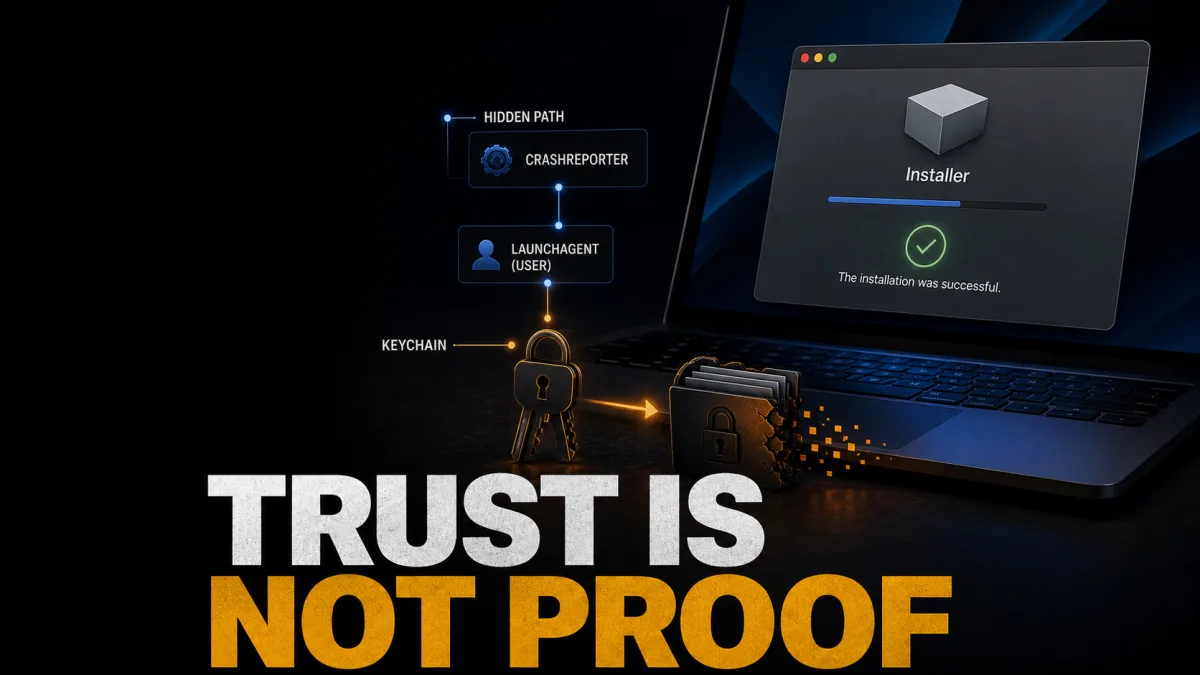
CrashStealer shows how macOS malware can borrow trust from familiar Apple conventions without being an Apple component. Jamf Threat Labs describes a signed and notarized installer that delivers a native C++ infostealer, which then adopts crash-reporter names, searches for high-value data and establishes persistence.
Definition: CrashStealer is a macOS infostealer that disguises its payload as a crash-reporting component.
Key takeaway: The strongest detection signal is the chain: trusted-looking installer, hidden execution path, Apple-like identity, sensitive-data access and persistence.
Business impact: Security teams should correlate signing and notarization with runtime location and behavior instead of treating either as proof that an application is safe.
The lure looks like a real product
The original Jamf Threat Labs analysis preserves the product-style landing page used before the installer stage. It presents Werkbit as a polished meeting platform with a prominent install action, making the next step feel like ordinary software setup rather than a security decision.
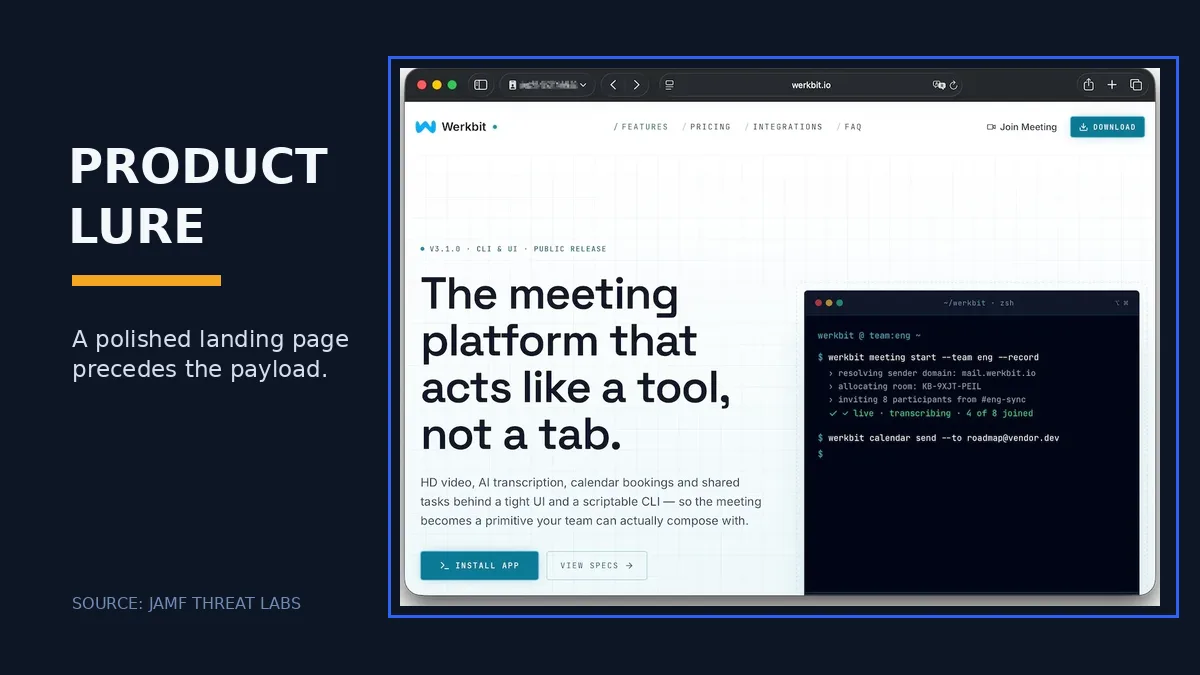
Original Jamf Threat Labs image, editorially reframed for readability: the product-style lure used before the installer.
The entry point is a disk image called Werkbit Setup containing Werkbit.app; its executable is named veltod. Jamf reports that the dropper is a universal binary with a Developer ID signature, hardened runtime and a stapled notarization ticket. The disk image is signed as well.
Trust signals do not validate the next stage
A polished setup window and a signed artifact make a sensitive launch feel routine. But the dropper retrieves more content, stages CrashReporter.dmg, copies an application into a hidden temporary directory and launches it. It also removes extended attributes and applies an ad-hoc signature to the installed payload.
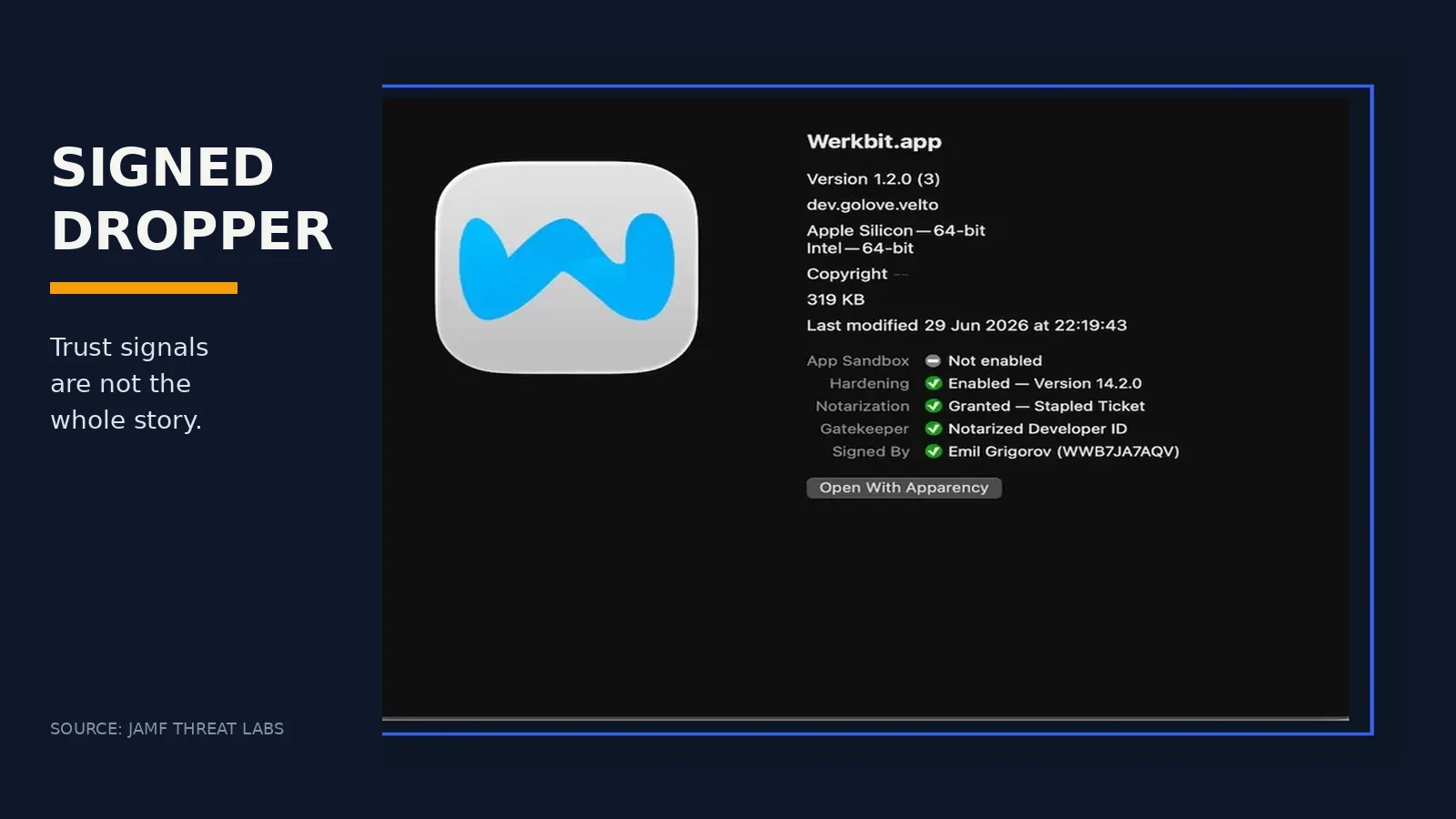
Original Jamf Threat Labs image, editorially reframed: signing and notarization metadata from the first-stage app.
This produces a practical detection rule: do not stop at the first signature check. A signed installer that fetches and re-signs a second-stage application deserves chain analysis, especially when the application claims to be a system component.
Apple-like names are part of the camouflage
The payload presents itself as CrashReporter.app and uses the bundle identifier com.apple.crashreporter. It later creates a user LaunchAgent named com.apple.crashreporter.helper. Those names are designed to blend into process lists and persistence inventories.
Execution location breaks the illusion. Jamf observed the payload running from a hidden path under /private/tmp/.CrashReporter/, while a persistent copy is placed under a user cache directory. A process with a familiar system name that starts from a hidden temporary folder is not behaving like a normal operating-system service.
A permission request should be evaluated in context as well. Signer, parent process, execution path and requested scope matter more than a display name that sounds like a system utility.
What data does the stealer target?
CrashStealer searches for browser credentials, cryptocurrency wallets, password-manager material, keychain data and files in user folders or removable volumes where permissions allow. It validates the victim’s login password locally before harvesting and encrypts collected files with AES-GCM before exfiltration.
Encryption complicates content inspection, but it does not hide the preparation stage. Endpoint telemetry can still reveal broad file enumeration, keychain access, archive creation, suspicious process ancestry and outbound traffic. If activity is confirmed, response must include credential rotation and session revocation, not only application deletion.
A practical hunting model
Treat these as a correlated sequence rather than isolated indicators:
| Signal | Why it matters |
|---|---|
| Notarized installer retrieves another binary | The trust boundary does not end with the first-stage signature. |
CrashReporter-like app runs from hidden /private/tmp | The path conflicts with the claimed system identity. |
| Apple-like LaunchAgent appears under a user directory | Familiar naming may be impersonation. |
| New process reads browser or keychain stores | The behavior matches credential collection. |
| Hidden archives and outbound connections follow collection | The endpoint may be staging and exfiltrating data. |
What defenders should change
First, make application identity multi-dimensional. Record signer, Team ID, bundle identifier, executable path, parent process and notarization result together. A familiar bundle identifier should never override an unexpected path or signer.
Second, alert on user-level persistence that imitates Apple naming. A LaunchAgent called com.apple.crashreporter.helper deserves path and signature validation before it is treated as routine.
Third, correlate sensitive-store access with process novelty. A browser or keychain read is not automatically malicious, but a newly launched, unsigned or ad-hoc-signed process doing it from a hidden directory is a high-value combination.
Finally, design response playbooks around secrets. If CrashStealer-like activity is confirmed, isolate the Mac, preserve evidence, reset exposed credentials, revoke sessions and assess cryptocurrency wallets or other high-value accounts separately.
The larger macOS security lesson
CrashStealer does not need to defeat every macOS security control. It needs one convincing first launch and enough familiar names to delay investigation. The defense is to connect what macOS tells you about trust with what the process actually does afterward.
A reliable question is simple: what did this apparently legitimate installer cause to execute, where did it run, what did it read and how did it persist? That question is more resilient than any single filename, signature or domain—and it is the difference between recognizing a crash reporter and recognizing a crash-reporter disguise.
FAQ
Is CrashStealer a macOS vulnerability?
The report describes malware delivered through a deceptive installer, not a demonstrated kernel or platform vulnerability.
Should all GitHub downloads from Macs be blocked?
Usually not. GitHub has legitimate development uses. Correlate the download with shell execution, hidden staging, signature changes, persistence or sensitive-data access instead.
Frequently asked questions
What is CrashStealer?
CrashStealer is a macOS infostealer that disguises its payload as a crash-reporting component while targeting sensitive user data.
Does notarization prove that a Mac app is safe?
No. It is a trust signal for a submitted artifact, not a guarantee about later payloads or behavior.
What should defenders hunt for?
Hunt for Apple-like names running from hidden paths, new user LaunchAgents, sensitive-store access and suspicious process ancestry.
Alex
Founder & Lead AI Writer
Alex is the founder of Yowox and lead AI writer since 2024, breaking down complex information into clear, actionable insights for thousands of readers every day. Alex has built AI automation systems for businesses since 2024, focusing on AI agents, workflow automation, and business process optimization.
Save hours. Save thousands.
Practical guides, real workflows, and the latest AI and automation news that matters — straight to your inbox.