 By Alex
 Build vs Buy: Custom AI Agents or Off-the-Shelf Tools?
A practical decision guide for choosing between ready-made AI tools, configured platforms, thin custom layers and fully custom AI agents.
The build vs buy decision for AI agents is not a choice between "custom everything" and "subscribe to a tool." The practical choice is where the workflow needs ownership. Buy standard capability, configure where the platform fits, and build only the custom layer that creates measurable advantage or removes expensive manual workarounds.
Definition: Build vs buy for AI agents is the decision between using a ready-made AI tool, configuring an agent platform, building a thin custom integration layer, or creating a fully custom AI agent.
Example: A company might buy a meeting-notes tool, configure a support agent builder, and build a custom lead qualification agent because its CRM rules and scoring logic are unique.
Key takeaway: Buy commodity workflows; build where the workflow, data, integrations, or advantage are specific to your business.
Business impact: The right decision reduces time-to-value without locking the business into a tool that cannot run the real workflow.
Is build vs buy the wrong question for AI agents?
Build vs buy is the wrong question when it hides the workflow underneath. The better question is: which layer of this AI agent workflow must the business own? A 2026 build-vs-buy decision-support paper frames the decision as a structured trade-off across strategic, technical, cost, and risk factors; AI agents make that trade-off sharper because the system must reason, use tools, and operate inside live business processes.
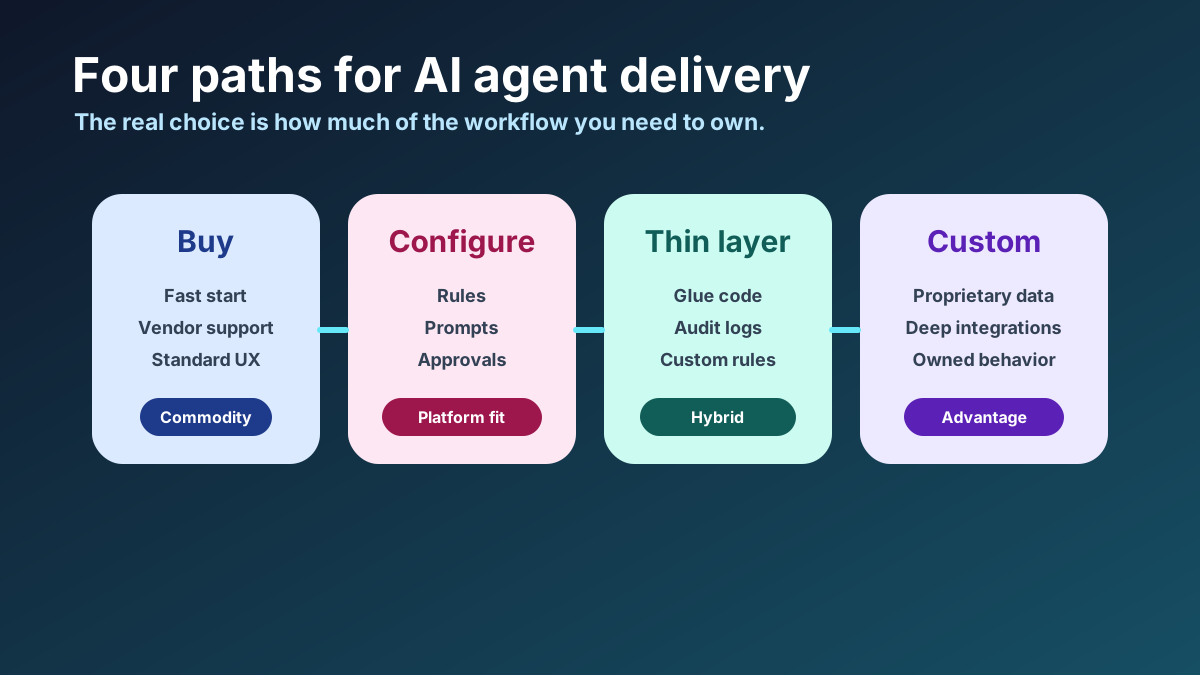
Most AI agent decisions fall into four options:
| Option | Use it when | Watch out for |
|---|---|---|
| Buy | Workflow is standard and integrations are built in | Vendor lock-in, missing edge cases |
| Configure | Platform fits 70-90% of the process | Platform limits, hidden workarounds |
| Build a thin layer | Core tool exists but workflow glue is unique | Maintenance ownership |
| Build custom | Workflow is proprietary, high-value, or deeply integrated | Higher build cost and long-term support |
When should you buy an off-the-shelf AI tool?
Buy an off-the-shelf AI tool when the workflow is common and the product already supports the systems you use. Meeting notes, generic email drafting, basic website chat, simple knowledge search, and standard helpdesk copilots are often good buy candidates. The business gets speed, vendor support, a user interface, and a roadmap without owning the full stack.
Buying is strongest when the workflow does not create strategic advantage. If every competitor can do the same task the same way, a product is usually enough. The business should spend custom effort on workflows that change conversion, retention, fulfillment speed, or operating cost in a way competitors cannot easily copy.
When should you configure an AI agent platform?
Configure an AI agent platform when the process is mostly standard but needs your rules, labels, prompts, approval steps, and data sources. This is the middle path between buying a narrow tool and building a custom system from scratch. The platform handles authentication, deployment, basic orchestration, and UI; your team configures the workflow logic.
Configuration is attractive for a first project because it shows whether the workflow is actually automatable. The risk is mistaking configuration for ownership. If the workflow eventually needs custom permissions, detailed evaluation, unusual API calls, or source-controlled logic, a configured platform may become the prototype rather than the final architecture.
When should you build a thin custom layer?
Build a thin custom layer when a bought tool is useful but does not connect cleanly to the real workflow. The custom layer might route data between CRM and helpdesk, enforce approval rules, call a scoring service, normalize messy input, or write audit logs the product does not provide. This option often gives the best economics: the business buys the commodity capability and builds the part that makes it operational.
This is where many AI agent projects should start. The business avoids rebuilding authentication, hosting, model access, and standard UI, but still owns the workflow glue that determines whether the automation saves time. For the production layers behind that glue, see The AI Automation Stack: Models, Orchestration and Integrations Explained.
When should you build a custom AI agent?
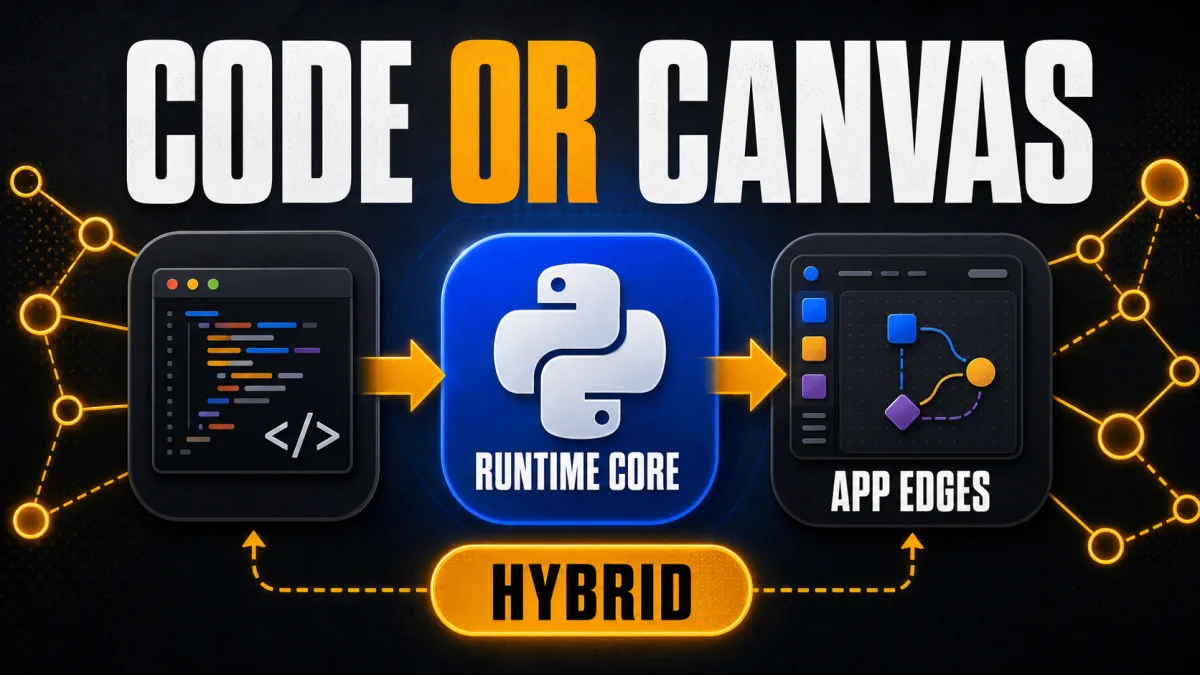
Build a custom AI agent when the workflow is specific, valuable, and hard to express inside a generic product. Good build candidates use proprietary data, touch several systems, require custom permissions, need detailed logging, or encode business logic that competitors should not share. A custom AI agent is strongest when it sits close to how the business actually wins. See also Python or n8n for AI Agents?.
A 2026 paper on how agentic AI changes enterprise software economics argues that AI shifts the make-or-buy calculation but does not make custom software automatically better for every category. That make-or-buy caution is the right frame for AI agents: custom AI agents make sense when ownership matters, not when the team simply wants to avoid a subscription.
The Yowox Build-Buy Matrix
The Yowox Build-Buy Matrix uses two questions: how standard is the workflow, and how much advantage does it create? Standard, low-advantage workflows should usually be bought. Standard, high-advantage workflows should usually be configured and measured. Unique, low-advantage workflows should usually be simplified before automation. Unique, high-advantage workflows are the strongest custom-agent candidates.
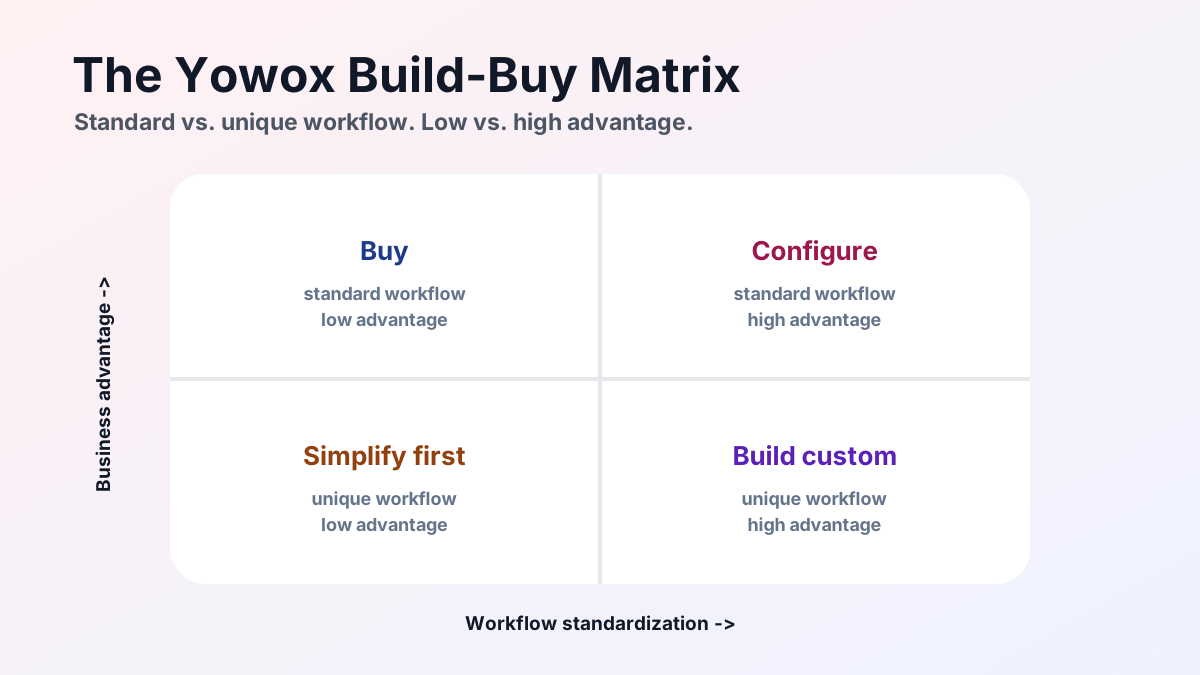
This matrix prevents two common mistakes. The first mistake is overbuilding: spending custom engineering time on a commodity workflow. The second mistake is underbuilding: forcing a high-value proprietary workflow into a generic tool until the team recreates the missing pieces manually outside the product.
What hidden costs should you compare?
The build-vs-buy comparison should include total operating cost, not just subscription price or build estimate. Buying has hidden costs: integration gaps, seat pricing, vendor lock-in, workflow mismatch, export limits, security review, and manual workarounds. Building has hidden costs too: maintenance, monitoring, evaluation, prompt and tool updates, infrastructure, documentation, and ownership when the process changes.
| Cost area | Buy risk | Build risk |
|---|---|---|
| Integration | Tool may not support your exact systems | You must maintain every connector |
| Governance | Vendor controls roadmap and data boundaries | You own security and auditability |
| Workflow fit | Team adapts to the product | Team must define the process clearly |
| Speed | Fast start, slower edge-case fixes | Slower start, faster custom changes |
| Ownership | Less control | More responsibility |
What should you decide before choosing a vendor or custom build?
Decide the workflow contract before choosing a vendor or custom build. The workflow contract should name the input, output, owner, systems touched, approval rules, failure cases, baseline cost, and success metric. Without this, both options look plausible and neither can be evaluated honestly.
This is why build-vs-buy follows workflow selection. First choose a workflow worth automating, then decide how much of that workflow needs ownership. For choosing the workflow itself, use 7 Business Workflows You Should Automate First.
A practical decision path
Start with the cheapest reversible test that can answer the real question. If an off-the-shelf tool can run the workflow with real data and acceptable review, buy or pilot it. If the tool almost fits but misses one important integration or rule, build a thin custom layer. If the workflow depends on proprietary data, unusual decisions, and deep system access, scope a custom AI agent.
The key word is reversible. A 30-day pilot, a limited user group, and a single workflow metric are safer than a large vendor contract or a custom build with no baseline. The first decision should create evidence for the next decision, not lock the company into a bet it cannot evaluate.
What is the best first build-vs-buy test?
The best first build-vs-buy test is one workflow, one tool or prototype, and one success metric. For lead qualification, the test might be: can the system enrich 100 inbound leads, score them using our criteria, write CRM summaries, and reduce manual research time without lowering sales quality? For support, the test might be: can the system triage 200 tickets with an acceptable review rate?
If the bought tool passes, keep it. If it fails only because one integration or rule is missing, consider a thin layer. If it fails because the workflow is too specific for the product's assumptions, custom build becomes a stronger case. That sequence is more reliable than debating "build or buy" before the workflow has touched real data.
Want help choosing the right build, buy or hybrid path? Get in touch.
Frequently asked questions
Should a business build or buy an AI agent?
A business should buy or configure an AI tool when the workflow is standard, the required integrations are already supported, and speed matters more than owning the exact system. A business should build a custom AI agent when the workflow is specific, touches proprietary data, spans several systems, or creates measurable advantage. Many teams should choose a hybrid path first: buy the commodity layer, then build the thin custom layer that connects it to the real workflow.
What is the biggest hidden cost of buying an AI tool?
The biggest hidden cost of buying an AI tool is workflow mismatch. A tool can look cheap until the team spends hours reshaping work around it, exporting data manually, duplicating records, or living with missing approval rules. Subscription price is only one part of the decision. The real cost includes integration work, manual workarounds, vendor lock-in, data access limits, security review, and the operational time needed to keep the tool useful.
What is the biggest hidden cost of building a custom AI agent?
The biggest hidden cost of building a custom AI agent is ownership. A custom agent needs maintenance, monitoring, prompt and tool updates, security controls, testing, and someone responsible when the workflow changes. Building can be the right decision when the workflow is core to the business, but it is not a one-time project. A custom AI agent should have an owner, a support path, and a clear reason it is worth maintaining.
Is a no-code AI agent builder enough?
A no-code or low-code AI agent builder can be enough for a narrow, standard workflow with supported integrations and moderate risk. It is usually not enough when the workflow requires deep custom permissions, unusual data sources, complex validation, or business-specific logic that must be versioned and tested. The practical test is simple: if the builder can read, decide, act, and prove results inside your actual workflow, it may be enough.
What is the safest build-vs-buy approach for a first AI project?
The safest first approach is usually a controlled pilot with one workflow. Define the workflow contract, try an off-the-shelf or configured tool if one fits, and build only the missing layer if the gap is clear. Do not commit to a large custom build or a long vendor contract before the team has measured the workflow with real data. The goal is to learn where the standard product ends and where custom value actually begins.
Alex
Founder & Lead AI Writer
Alex is the founder of Yowox and lead AI writer since 2024, breaking down complex information into clear, actionable insights for thousands of readers every day. Alex has built AI automation systems for businesses since 2024, focusing on AI agents, workflow automation, and business process optimization.
Save hours. Save thousands.
Practical guides, real workflows, and the latest AI and automation news that matters — straight to your inbox.