 By Alex
 The AI Automation Stack: Models, Orchestration and Integrations Explained
A practical map of the seven layers behind business AI automation: workflow, context, models, orchestration, tools, guardrails and monitoring.
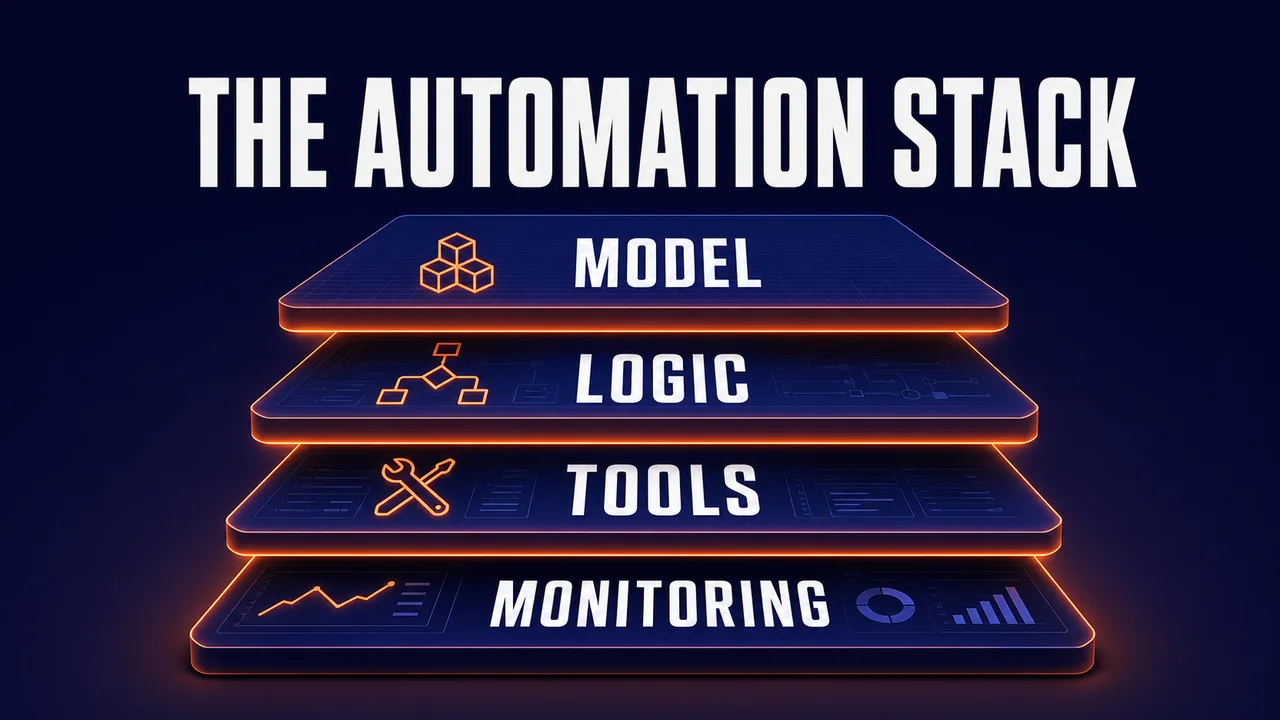
An AI automation stack is the system around the model that lets AI complete real business work: it reads context, decides the next step, calls tools, follows rules, and proves what happened. The model matters, but the model is only one layer. For a business owner, the useful question is not "which AI model is best?" but "which stack can safely complete this workflow end to end?" That stack is quietly becoming the product itself — the argument in AI is not a product anymore, it's the infrastructure under everything.
Definition: An AI automation stack is the full architecture behind a business AI workflow: workflow contract, context, model, orchestration, tools, guardrails, and monitoring.
Example: A support automation stack reads a ticket, retrieves order data, chooses whether to draft or send a reply, updates the CRM, and logs the result for review.
Key takeaway: The model generates the intelligence; the stack turns that intelligence into a repeatable business process.
Business impact: A complete AI automation stack reduces manual work because it removes the lookup, decision, action, and reporting steps together, not just the writing step.
What is the AI automation stack?
The AI automation stack is the set of layers that connects an LLM to a business workflow. A standalone LLM can generate text, classify a message, or reason about a prompt, but the AI automation stack gives that model trusted context, controlled tool access, business rules, and feedback loops. This is why the same model can be a toy demo in one setup and a useful operations system in another: the surrounding stack determines whether the model can act safely on real work.
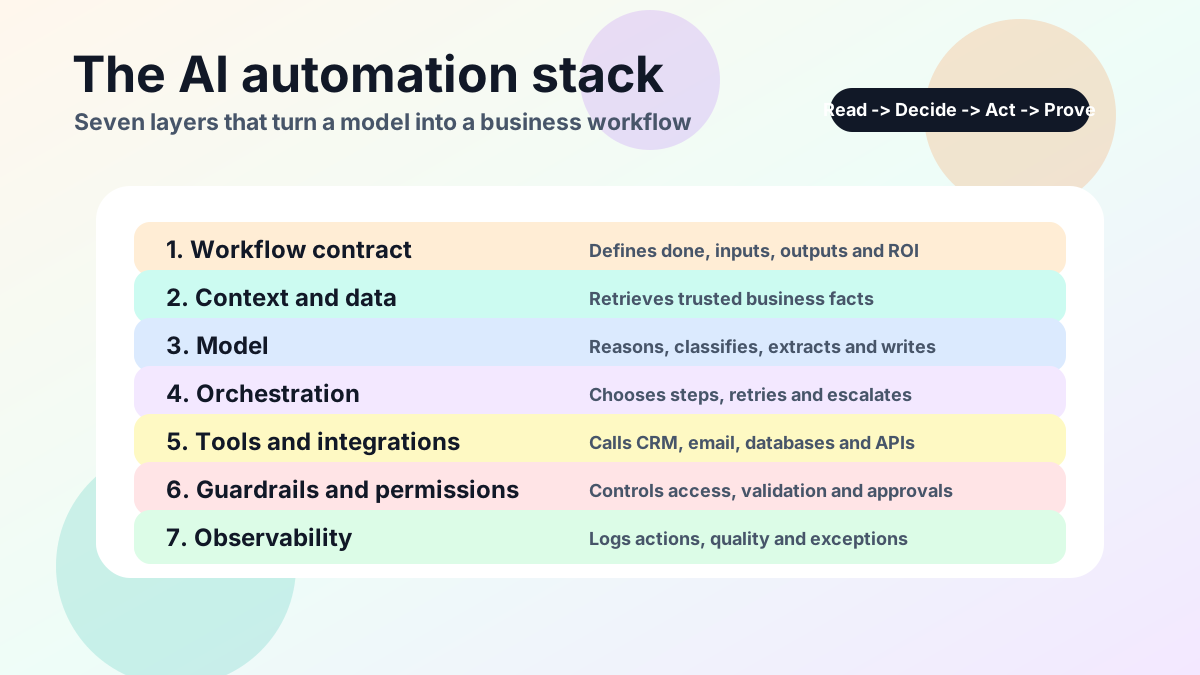
The Yowox Seven-Layer AI Automation Stack
The Yowox Seven-Layer AI Automation Stack is a practical way to scope any automation before touching tools. The seven layers are: workflow contract, context and data, model, orchestration, tools and integrations, guardrails and permissions, and observability. If one layer is missing, the system may still look impressive in a demo, but it will be hard to trust in production.
| Layer | What it answers | Business risk if missing |
|---|---|---|
| Workflow contract | What job should AI complete? | Vague demo, no measurable ROI |
| Context and data | What does AI need to know? | Confident answers from stale or incomplete information |
| Model | Which reasoning/generation engine fits the task? | Too expensive, too slow, or not accurate enough |
| Orchestration | What happens next after each step? | One-shot responses instead of completed workflows |
| Tools and integrations | Which systems can AI read or write? | AI can advise, but cannot finish the task |
| Guardrails and permissions | What is AI allowed to do? | Unsafe actions, privacy issues, unclear accountability |
| Observability | How do we know it worked? | No way to debug, improve, or prove value |
Why does the workflow contract come before the model?
The workflow contract comes first because it defines what "done" means. Before choosing GPT, Claude, Gemini, LangChain, n8n, Zapier, or a custom agent, the business needs to define the input, expected output, systems touched, allowed actions, escalation rules, and success metric. A workflow contract turns "use AI for support" into a testable process such as "classify inbound refund tickets, check order status, draft a reply, and escalate exceptions where confidence is below 85%."
This layer is where most AI automation projects either become concrete or stay vague. If the workflow contract is narrow, the AI automation stack can be simple and measurable. If the workflow contract is broad, the stack needs more context management, stronger permissions, and more human review because the system has more ways to fail.
How do context and data change the output?
Context and data decide whether the AI automation stack is answering from generic knowledge or from the business's actual reality. Context can include CRM records, order history, support policies, previous messages, pricing rules, knowledge-base articles, and uploaded documents. For document-heavy workflows, retrieval-augmented generation (RAG) is often the context layer: the system retrieves relevant information before asking the model to answer or act.
The key design choice is not "use a vector database" by default. The key design choice is which source is authoritative for each fact. A support policy might live in Notion, order status might live in Shopify, and lead stage might live in HubSpot. The AI automation stack should retrieve each fact from the system that owns it, not from a copied document that goes stale.
What does the model layer actually do?
The model layer turns context and instructions into reasoning, text, classification, extraction, or a tool-use decision. A larger model may be useful for ambiguous tickets, long documents, or complex planning, while a smaller model may be better for cheap high-volume classification. The right model is the cheapest model that clears the quality bar for the specific workflow, not the newest model in the market.
Model choice should also follow latency and cost budgets. A lead scoring workflow that runs in the background can tolerate slower reasoning; a live chat handoff cannot. The AI automation stack should define these budgets early, because model selection, prompt design, retrieval size, and number of tool calls all affect the final cost per completed task.
What does orchestration do in an AI automation stack?
Orchestration decides the next step after each model response. In a simple stack, orchestration may be a fixed workflow: classify, retrieve, draft, wait for approval. In an agentic stack, orchestration may let an AI agent choose which tool to call, retry after a failed API response, ask for missing information, or escalate to a human. IBM describes AI agent orchestration as coordinating specialized agents inside one system; for a small business workflow, the same principle often starts with one agent and a few explicit branches.
This is the layer that separates a helpful AI answer from a completed automation. OpenAI's function calling documentation describes tool calls as the bridge from model output to external data and actions, while MCP defines a broader protocol for connecting AI applications to external systems. In practical terms, orchestration is where the stack says: "The model asked to check order status; call the order API, pass back the result, then decide whether to send or escalate."
Which tools and integrations matter most?
The most important tools are the systems the workflow already depends on. For sales, that might be CRM, email, calendar, enrichment data, and a lead scoring sheet. For support, that might be helpdesk, order system, knowledge base, refund rules, and Slack. For finance, that might be invoice inbox, accounting software, vendor database, and approval workflow.
MCP matters because it points toward a more standardized connection layer: MCP's own documentation defines it as an open standard for connecting AI applications to data sources, tools, and workflows. But a business should not wait for every system to support MCP before automating. The near-term goal is simpler: give the AI automation stack controlled, logged access to the few tools required for one workflow.
What guardrails does production AI automation need?
Production AI automation needs guardrails for identity, permissions, validation, and escalation. Identity means every action has a known actor: the user, the agent, or a service account. Permissions define what the AI automation stack can read, draft, send, update, or delete. Validation checks whether the output follows the expected format or business rule. Escalation tells the system when to stop and ask a human.
This is where business risk is reduced. A support AI agent can draft a refund message without permission to issue refunds. A lead qualification workflow can enrich and score leads but require human approval before changing pipeline stage. A document-processing system can extract invoice fields but route low-confidence totals to accounting. Guardrails make the automation useful without pretending every edge case should be autonomous.
How should the stack be monitored?
An AI automation stack should be monitored with three ledgers: an action log, an evaluation log, and an exception log. The action log records what the system read, decided, called, and changed. The evaluation log records whether the output was accepted, edited, rejected, or corrected. The exception log records where the system stopped, failed, retried, or escalated.
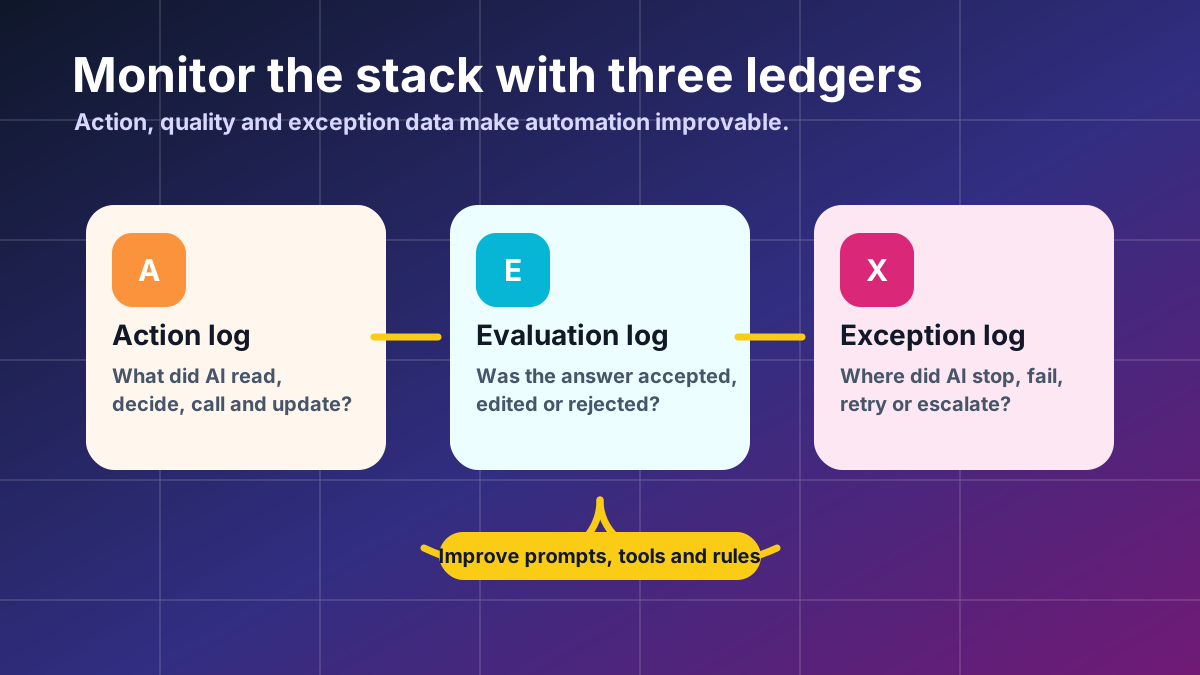
Google's Agent Platform documentation treats production agents as systems that need runtime, context management, evaluation, tracing, logging, monitoring, identity, and governed connectivity. That production-agent checklist is the right mental model for smaller projects too. Even a lightweight AI automation stack needs enough visibility to answer three questions: did the task complete, was the result accepted, and where did the system fail?
AI automation stack vs. AI agent vs. RPA
An AI automation stack is the architecture, an AI agent is one possible behavior inside that architecture, and RPA is a rule-based automation style that can sit beside it. A stack can run a non-agentic extraction workflow, a supervised AI agent, a fixed RPA workflow, or a combination of all three. The choice depends on how variable the work is.
| System | Best for | Weakness |
|---|---|---|
| RPA | Stable screen/API workflows with predictable rules | Breaks when the process changes or input is ambiguous |
| AI agent | Variable tasks that require reasoning, tool use, and escalation | Needs strong guardrails and monitoring |
| AI automation stack | The full production system around either approach | Takes planning before it becomes useful |
For a deeper distinction between agents and basic chat interfaces, see What Is an AI Agent, and How Is It Different From a Chatbot?. For deciding which workflows should be automated first, see 7 Business Workflows You Should Automate First.
What should a business build first?
A business should build the smallest complete AI automation stack for one workflow. "Smallest" means narrow scope: one input channel, one or two data sources, a limited set of tool actions, clear approval rules, and one success metric. "Complete" means every layer exists: contract, context, model, orchestration, tools, guardrails, and monitoring.
The first version should prove that the stack can complete one real job repeatedly. For example, an inbound lead qualification stack might read a form submission, enrich the company, score fit, write a CRM summary, and notify sales when the score passes a threshold. Once that workflow is reliable, the business can expand the stack to more sources, more actions, or a higher autonomy level.
A quick diagnostic: is your AI automation stack complete?
Use this four-question test before shipping an AI workflow. Can the AI automation stack read the right business context? Can it decide the next step under defined rules? Can it act through controlled tools? Can it prove what happened afterward? If the answer to any of those is no, the stack is still a prototype.
This test is also a useful buying filter. If a vendor only talks about model quality, the solution may still require your team to solve data access, integration, permissions, and monitoring. If a vendor can explain how the system reads, decides, acts, and proves results, the conversation is closer to real automation.
Want help mapping your first AI automation stack? Get in touch.
Frequently asked questions
What is an AI automation stack?
An AI automation stack is the full set of layers needed to turn an AI model into a working business system. The stack usually includes a clear workflow contract, trusted context and data, an LLM, orchestration logic, tool and API integrations, permissions and guardrails, and observability. The model is only one part. The stack around the model decides whether the automation can read the right information, take the right action, prove what happened, and improve safely over time.
Is an AI automation stack the same as an AI agent?
No. An [AI agent](/posts/what-is-an-ai-agent/) is one possible behavior inside an AI automation stack. The stack is the broader system: data access, model calls, orchestration, tools, permissions, logs, monitoring, and human review. A simple AI automation stack might run a fixed extraction workflow with no agentic planning at all. A more advanced stack might include an AI agent that decides which tools to call, verifies the result, and escalates edge cases to a human.
Which layer should a business build first?
A business should build the workflow contract first, before choosing a model or agent framework. The workflow contract defines the exact job, input, output, systems touched, error cases, approval rules, and success metric. Without that contract, the project turns into a vague AI demo: impressive in a test window, but hard to trust in production. Once the contract is clear, model choice and integration architecture become much easier.
Why do AI automation projects fail even when the model is good?
AI automation projects fail when the surrounding stack is weak. A strong model cannot compensate for missing CRM access, stale data, unclear permissions, no escalation path, or no monitoring. In production, the common failure is not that the LLM cannot write a good response; it is that the system cannot reliably fetch the right context, choose the right action, log the action, and recover when something unexpected happens.
Do small businesses need the full AI automation stack?
Small businesses need the same layers, but not the same complexity. A narrow support or lead qualification workflow can start with one data source, one model, a simple orchestrator, two or three tool calls, basic approval rules, and a lightweight log. The principle is the same as in a larger company: keep the stack complete enough to be reliable, but scoped tightly enough that the first version is affordable and easy to measure.
Alex
Founder & Lead AI Writer
Alex is the founder of Yowox and lead AI writer since 2024, breaking down complex information into clear, actionable insights for thousands of readers every day. Alex has built AI automation systems for businesses since 2024, focusing on AI agents, workflow automation, and business process optimization.
Save hours. Save thousands.
Practical guides, real workflows, and the latest AI and automation news that matters — straight to your inbox.