 By Alex
 What Is MCP and Why Is Everyone Talking About It?
The Model Context Protocol standardizes how AI applications connect to tools and data — and it's gone from an Anthropic project to a Linux Foundation standard backed by OpenAI, Google, and Microsoft in under two years.
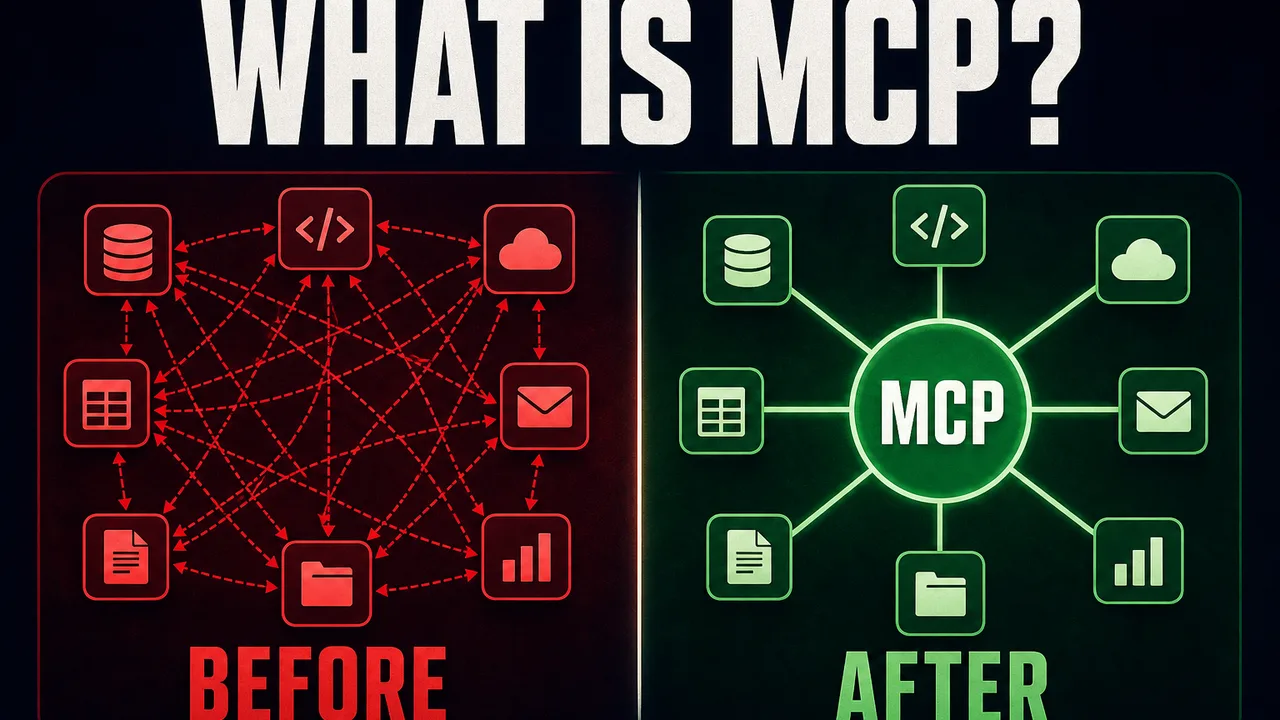
MCP — the Model Context Protocol — is the open standard that lets an AI application connect to external tools and data through one shared format instead of a custom integration for every pairing. Anthropic introduced it in November 2024 to solve a specific problem it described plainly: capable models were "trapped behind information silos and legacy systems," each new data source requiring its own bespoke connector. For what wiring one up actually feels like in practice, see Firecrawl into Claude via MCP: the honest breakdown.
Definition: MCP is an open standard for connecting AI applications to external tools and data sources through one shared protocol, replacing one-off custom integrations.
Example: Without MCP, connecting three different AI apps to four different tools takes 12 separate custom connectors; with MCP, each app and each tool implements the standard once, cutting that to 7 total connections.
Key takeaway: MCP went from an Anthropic-only project to a Linux Foundation standard backed by OpenAI, Google, and Microsoft in about 13 months — an unusually fast, broad convergence for a technical standard.
Business impact: An AI agent built to speak MCP can plug into any tool that also speaks MCP, without custom integration work for every new connection — this is what makes agents genuinely practical to connect to real business systems at scale.
What problem does MCP actually solve?
Before MCP, connecting an AI application to a tool or data source meant writing a custom integration for that exact pairing — and that integration had to be rebuilt again for every new AI application or every new tool added to the mix. MCP replaces this N×M integration problem with a single shared protocol: an AI application implements MCP once as a "client," a tool or data source implements MCP once as a "server," and any MCP client can then talk to any MCP server without a bespoke connector for that specific pair. This is commonly compared to USB-C: a single physical standard that any compliant device can plug into, rather than a different cable for every device-and-accessory combination.
How does MCP actually work?
An MCP setup has three parts: a host (the AI application itself, like a chat app or coding assistant), an MCP client living inside that host, and one or more MCP servers that each expose a specific tool or data source. The flow runs in two steps: discovery, where the client asks a server what tools and resources it offers and gets back a description the underlying model can read, and execution, where the model decides to use one of those tools, the host tells the client to call it, the server performs the action, and the result gets fed back into the model's context. Client and server communicate over JSON-RPC 2.0, an existing, well-established message format — MCP standardizes the conversation structure, not the network transport itself.
Why did MCP suddenly go from Anthropic's project to an industry standard?
The short version: the largest AI providers converged on it within about six months of launch, then Anthropic gave up sole control of it. OpenAI adopted MCP across its Agents SDK, Responses API, and ChatGPT desktop app by March 2025, Google DeepMind confirmed MCP support in Gemini the following month, and Microsoft and GitHub joined MCP's steering committee with Windows 11 support in May 2025. Then, in December 2025, Anthropic donated MCP to the Agentic AI Foundation, a directed fund under the Linux Foundation co-founded with Block and OpenAI and backed by Google, Microsoft, AWS, Cloudflare, and Bloomberg — a deliberate move to keep the protocol "neutral, open, and community-driven" rather than controlled by the company that invented it. That governance shift is a big part of why MCP is dominating conversation now specifically: it turned a single vendor's project into connective infrastructure nobody owns, which is exactly the property that makes competitors comfortable building on top of it.
How big is MCP's adoption right now?
By the numbers, MCP's growth looks less like a typical developer tool and more like foundational internet infrastructure: monthly SDK downloads reached roughly 97 million by March 2026, up from about 100,000 at its November 2024 launch, and independent registries list well over 10,000 active public MCP servers. For comparison, the widely-used React JavaScript library took roughly three years to reach 100 million monthly downloads — MCP reached comparable scale in about 16 months. That pace is itself part of the story: it's a rare case of the entire industry's major AI providers standardizing on the same low-level protocol instead of each maintaining incompatible ones.
Does a business need to care about MCP directly?
Mostly indirectly, through the tools it already uses. If your team is connecting AI agents to a CRM, inbox, or spreadsheets, the practical benefit of MCP is that a growing share of that connection work is becoming "does this tool already have an MCP server" rather than "how do we build this integration from scratch" — a meaningfully different starting point for the build-vs-buy decision on any given tool connection. MCP is one layer of what's covered more broadly in the AI automation stack explained; understanding that MCP exists mostly matters for asking vendors and internal engineering teams the right question — "does this support MCP" — rather than needing to implement the protocol by hand.
Frequently asked questions
What does MCP stand for?
MCP stands for Model Context Protocol, an open standard Anthropic introduced in November 2024 for connecting AI applications to external tools and data sources — things like a CRM, a file system, or a database — through one shared connection format instead of a custom integration for every pairing.
Who created MCP, and who controls it now?
Anthropic created and introduced MCP in November 2024. In December 2025, Anthropic donated MCP to the Agentic AI Foundation, a directed fund under the Linux Foundation co-founded with Block and OpenAI, with Google, Microsoft, AWS, Cloudflare and Bloomberg also supporting it — making MCP a vendor-neutral standard rather than something one company owns.
Which AI companies actually support MCP?
OpenAI adopted MCP across its Agents SDK, Responses API, and ChatGPT desktop app by March 2025. Google DeepMind confirmed MCP support in Gemini models the following month. Microsoft and GitHub joined MCP's steering committee and added Windows 11 support in May 2025 — the three largest AI model providers besides Anthropic itself all support the same protocol.
How widely used is MCP right now?
MCP reached roughly 97 million monthly SDK downloads by March 2026, up from about 100,000 at its November 2024 launch — faster growth than the React JavaScript library took to reach the same download scale. Independent registries list well over 10,000 active public MCP servers as of early 2026.
Does a business need to build its own MCP server?
Not necessarily. Many popular tools — CRMs, project trackers, cloud storage — already ship an MCP server built by the vendor or the community, so connecting an AI agent to them may just mean pointing it at an existing server rather than building one from scratch. Building a custom MCP server matters most for internal or proprietary systems nobody else has already connected.
Alex
Founder & Lead AI Writer
Alex is the founder of Yowox and lead AI writer since 2024, breaking down complex information into clear, actionable insights for thousands of readers every day. Alex has built AI automation systems for businesses since 2024, focusing on AI agents, workflow automation, and business process optimization.
Save hours. Save thousands.
Practical guides, real workflows, and the latest AI and automation news that matters — straight to your inbox.
! Here’s the Honest Breakdown.](/images/posts/firecrawl-claude-mcp-honest-breakdown/cover.webp)