 By Alex
 AI is Not a Product Anymore. It’s the Infrastructure Under Everything.
The “AI feature” era is giving way to an infrastructure era, where orchestration, data, evaluation, governance, compute and reliable operations determine whether intelligent systems create value.
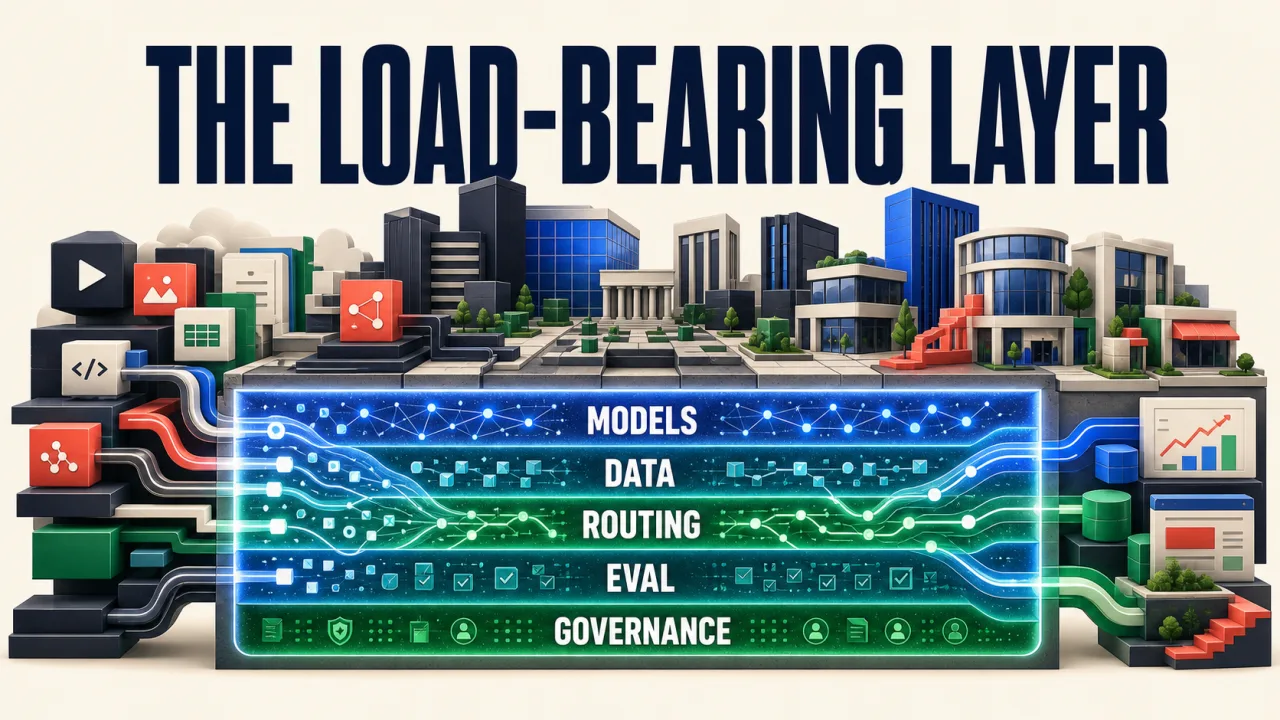
The most important AI shift may be the one that produces the least impressive demo.
AI is moving from something companies add to a product toward something many products depend on underneath: model access, data retrieval, orchestration, evaluation, security, governance and the physical systems that make inference possible.
That is the argument in Towards AI’s analysis, “AI is Not a Product Anymore. It’s the Infrastructure Under Everything”. The useful part of the thesis is not the slogan itself. It is the change in what teams must build and operate once a model call affects real work.
Definition: AI infrastructure is the shared technical and organizational layer that lets models and agents operate reliably inside products and workflows.
Example: A support system classifies a request, retrieves current account context, routes the task to the right model or tool, checks the result and escalates when confidence or policy requires it.
Key takeaway: The model is one dependency; the production system around it determines whether the capability is useful.
Business impact: Teams that invest in routing, data quality, evaluation and governance can change models and use cases without rebuilding the business every time the model market shifts.
The category error: treating infrastructure like a feature
A feature has a clear surface. It can be enabled, measured and compared with other features. An AI summary button, chatbot or image generator often begins that way.
But once AI is embedded in customer support, sales operations, compliance review, logistics, software delivery or internal decision-making, it stops behaving like a decorative product module. It becomes a dependency that other parts of the organization assume will be available and reliable.
The distinction is operational:
| Feature mindset | Infrastructure mindset |
|---|---|
| “Where can we add a model?” | “Which capabilities should depend on a shared AI layer?” |
| Optimize a demo or isolated task | Optimize reliability, cost, safety and changeability |
| One team owns a prompt and integration | Multiple teams use governed shared services |
| Success means output looks useful | Success means outcomes remain measurable in production |
| Failure is a bad response | Failure can be an outage, data incident or incorrect action |
Treating AI as infrastructure does not mean every company needs a giant platform team or a private model. It means the organization recognizes that model behavior, data movement and agent actions need production discipline when they become load-bearing. Related reading: OpenAI’s new flagship model deletes files on its own, people keep warning.
The layer underneath the layer
A practical AI infrastructure stack is not one product. It is a set of controls and services that make model-powered work repeatable.
Model access and routing
A model gateway can standardize authentication, retries, timeouts, rate limits, logging and provider selection. It can route simple classification to a cheaper model and reserve more expensive reasoning for tasks that need it.
The value is not hiding which model is used. The value is making that decision explicit and changeable. If a provider changes pricing, availability or behavior, a team should be able to test an alternative without rewriting every application integration.
Orchestration and agent harnesses
As systems move from one model call to multi-step work, something must manage state, tool calls, handoffs, retries and stopping conditions. That coordination layer is often called orchestration or an agent harness.
A harness can make an agent useful, but it can also make failure propagate faster. A planner that selects the wrong tool, a memory layer that stores stale context, or a retry policy that repeats an unsafe action can turn a small model error into an operational incident.
A reliable agent workflow therefore needs explicit boundaries:
- Planner: propose a constrained sequence of steps.
- Router: select an approved capability or tool.
- Tool layer: execute deterministic, validated operations.
- Verifier: check outputs against rules, tests or evidence.
- Escalation: hand the task to a person when risk or uncertainty is high.
An AI agent uses tools and feedback to pursue a goal. Infrastructure makes that loop inspectable instead of leaving it inside an opaque prompt.
Data plumbing
The model cannot reason over information it does not receive in the right form at the right time. Current, well-defined and permissioned data often matters more than another small improvement in model fluency.
That means infrastructure teams need to care about source systems, freshness, schema, metadata, retrieval, access control and deletion. A retrieval system that returns an old policy can be more dangerous than one that returns no policy, because its confidence may be difficult for a user to recognize.
Data quality also affects evaluation. If the input distribution changes, a previously successful workflow can degrade without a model version changing. Monitoring data drift and retrieval quality is part of operating the AI system, not an optional research exercise.
Governance is architecture, not paperwork
When AI was confined to experiments, governance could be a review document that appeared near the end of a project. When an agent can access a database, draft a customer response, change code or trigger a business process, governance must be designed into the system.
The most useful governance questions are concrete:
- What data may enter each model or provider?
- Which tools may each agent call?
- What actions require human approval?
- What evidence must be recorded for a decision?
- How are prompts, policies, models and tools versioned?
- How can the team revoke access or roll back a behavior change?
- Who owns the outcome when an automated action causes harm?
This is why AI infrastructure cannot be separated cleanly from identity, security and operations. A model gateway without data boundaries is incomplete. An agent platform without tool permissions is unsafe by design. An evaluation dashboard without a deployment gate is merely an observation system.
The infrastructure era changes the definition of “done.” A prototype is not ready because it produces an impressive answer. It is ready when the team can measure its behavior, constrain its actions, explain failures and recover when assumptions change.
Local and cloud models are routing choices
The infrastructure framing also makes the local-versus-cloud debate less ideological.
Cloud models are useful when a workload needs frontier capability, broad knowledge, rapid access to new features or elastic capacity. Local or self-hosted models can be useful when privacy, offline operation, predictable cost or low latency matters more than maximum capability.
The production question is not “which side wins?” It is:
- which tasks can be handled locally;
- which data must stay within a controlled environment;
- which workloads need a hosted frontier model;
- how can the system fall back when a provider is unavailable;
- how are outputs evaluated across models?
A routing layer can choose among these options based on task difficulty, sensitivity, latency, cost and policy. That is an infrastructure decision, not a branding decision about which model the product “uses.”
Local deployment is not automatically private or reliable. It still requires patching, access control, model updates, monitoring, hardware capacity and data-handling rules. Cloud deployment is not automatically scalable or compliant. It still requires contracts, provider controls, regional decisions and failure planning.
Workflow automation becomes judgment plus control
Traditional automation is strongest when the conditions are explicit: if a field equals a value, trigger an action. That remains valuable because deterministic rules are easy to test.
AI adds a judgment layer for messy inputs. A system can interpret a customer message, classify an exception, retrieve relevant context and propose a next step even when the request does not match a fixed template.
That flexibility is also why the surrounding controls matter. A model may classify a request incorrectly, overgeneralize from incomplete context or treat an ambiguous instruction as permission to act. The right architecture combines flexible interpretation with deterministic boundaries.
A safe workflow might allow an agent to:
- read a defined set of documents;
- classify an incoming request;
- retrieve evidence with citations;
- draft a response;
- route the draft to a human for approval.
It might not allow the same agent to change permissions, issue refunds or send external messages without an additional check. The model provides judgment; the infrastructure decides where judgment stops.
Physical infrastructure is part of the AI product
AI infrastructure is also physical. Compute, networking, storage, power and cooling determine what can be offered at what cost and latency.
The software view tends to describe inference as an API call. The operational view sees a chain of hardware and facilities that must provide capacity under changing demand. High-density compute affects energy use, cooling requirements, data-center layout and regional availability. Those constraints influence model size, caching, batching, hardware selection and where workloads run.
This is one reason efficiency matters. A smaller specialized model that meets the task’s quality threshold may be a better infrastructure choice than a larger model used by default for every request. It can reduce cost and latency while making capacity easier to plan.
The same principle applies to architecture. A system that can run a low-risk step at the edge or on a local machine, retrieve sensitive data inside a controlled environment and call a hosted model only for a difficult transformation may be more resilient than one that sends every task to one provider. See also Apple Intelligence approved for launch in China with Alibaba’s Qwen AI and Baidu.
Evaluation turns infrastructure into a feedback system
The hardest part of AI operations is that quality is not captured by uptime alone. A service can return a response quickly and still be wrong, incomplete, unsafe or inconsistent with policy.
Evaluation therefore needs multiple layers:
| Evaluation layer | What it checks |
|---|---|
| Component tests | Whether a parser, retriever, tool or policy check behaves as expected |
| Scenario tests | Whether the full workflow handles representative cases |
| Safety tests | Whether data leakage, prompt injection and prohibited actions are contained |
| Outcome metrics | Whether the workflow improves resolution, accuracy, cost, time or another business result |
| Production monitoring | Whether behavior changes as inputs, users, models or providers change |
A model-as-judge can be one signal, but it should not be the only one. Deterministic checks, citations, tool results, policy rules and human review remain valuable because they test different properties.
Evaluation is what lets a team change the model on purpose. Without it, replacing a model or prompt is a production gamble. With it, the team can compare versions, run a canary, inspect regressions and roll back when necessary.
What small teams should build first
The infrastructure thesis does not mean a small company should begin by building a sprawling platform. It means the first useful investment should create repeatability around one real workflow.
Pick one bounded task
Choose an annoying, repetitive process with a clear input, measurable outcome and limited blast radius. Examples include classifying support requests, extracting fields from documents, preparing an internal summary or routing a known exception queue.
Define the authority boundary
Write down what the system may read, what it may propose and what it may execute. Add a human approval step for actions that affect money, permissions, customer commitments, safety or production code.
Capture a real evaluation set
Save representative examples, including difficult and failed cases. Test changes against the same set before you expand the workflow. If the team cannot tell whether performance improved, it is not ready to scale.
Add observability before complexity
Record model, prompt, tool, retrieval, latency, cost and outcome information at a level that respects privacy. A simple workflow with useful logs is more valuable than a multi-agent system nobody can debug.
Make the provider replaceable
Keep model calls behind a stable internal interface where practical. The goal is not to switch providers every week. The goal is to avoid making one vendor’s response format, memory model or policy behavior inseparable from your product.
The product is what the infrastructure makes possible
AI may still be sold as a feature, but organizations increasingly experience it as a dependency. The customer sees a faster answer, a resolved exception or a completed task. Underneath, a chain of models, data sources, tools, policies and physical systems produced that result.
That chain is where the durable work is happening. Models will change. Providers will change. Agent frameworks will be replaced. Data definitions, evaluation habits, access boundaries and operational discipline will determine whether those changes are manageable.
The useful question is no longer only, “What AI feature should we add?” It is: What shared intelligence layer should this organization be able to operate, measure and improve?
Teams that answer that question well will not necessarily have the most dramatic demo. They will have something more valuable: products that can become more intelligent without becoming impossible to govern.
Frequently asked questions
What does it mean to treat AI as infrastructure?
It means AI is managed as a shared, production-critical layer that supports many workflows, rather than as a standalone feature or isolated experiment. The layer includes models, routing, data pipelines, evaluation, observability, security, governance and fallback behavior.
Why is orchestration important for AI systems?
Orchestration routes work among models, tools, agents and data sources. It can choose an appropriate model for each step, preserve state, enforce limits, handle retries and record what happened. Without it, every product team rebuilds fragile model-call logic independently.
Is local AI part of the infrastructure trend?
Yes. Local and self-hosted models can be useful for repetitive, privacy-sensitive or latency-sensitive workloads, while cloud models remain valuable for difficult or changing tasks. The infrastructure question is how to route workloads safely across deployment options, not whether one location always wins.
What should a small team do first?
Start with one repetitive workflow that has a clear input, measurable outcome and bounded risk. Instrument it, add evaluation cases and a human fallback, then decide whether the result is reliable enough to expand. Do not begin with a complex multi-agent architecture simply because it sounds advanced.
Alex
Founder & Lead AI Writer
Alex is the founder of Yowox and lead AI writer since 2024, breaking down complex information into clear, actionable insights for thousands of readers every day. Alex has built AI automation systems for businesses since 2024, focusing on AI agents, workflow automation, and business process optimization.
Save hours. Save thousands.
Practical guides, real workflows, and the latest AI and automation news that matters — straight to your inbox.
! Here’s the Honest Breakdown.](/images/posts/firecrawl-claude-mcp-honest-breakdown/cover.webp)