 By Alex
 Apple Intelligence approved for launch in China with Alibaba’s Qwen AI and Baidu
China’s approval clears a path for Apple Intelligence through local AI partnerships, but it does not yet announce a consumer launch date or settle every implementation detail.
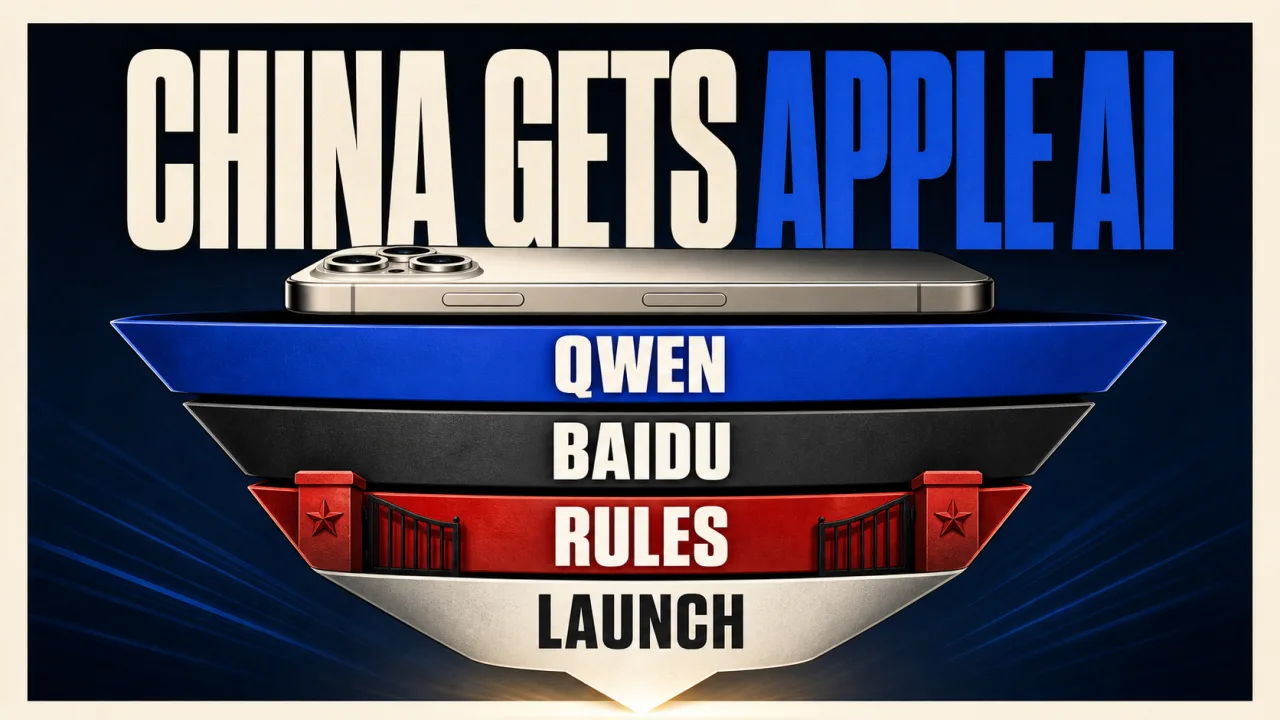
Apple Intelligence has cleared a major regulatory hurdle in China. China’s Cyberspace Administration approved Apple’s generative AI services, according to TechCrunch’s report, after Apple aligned its China strategy with local AI partners.
Alibaba has said its Qwen models will be integrated into Apple Intelligence experiences, including text and image understanding and generation. Baidu has separately confirmed that it is working with Apple on features for Chinese users.
The approval opens a path to launch. It does not yet mean that Apple Intelligence is available to Chinese customers, and it does not provide a public consumer release date.
Definition: Apple Intelligence in China is a regionally adapted generative AI service that combines Apple’s operating-system experience with local model and regulatory partners.
Example: Qwen could provide model capabilities inside Apple Intelligence experiences, while Baidu contributes to other features such as search or visual intelligence.
Key takeaway: Apple’s China AI strategy is becoming a partnership-and-compliance architecture, not simply a software switch.
Business impact: Global AI products increasingly need local model, infrastructure and regulatory partners to operate in tightly governed markets.
What the approval changes
Apple Intelligence features debuted in 2024 but were delayed in China. The regulatory approval removes one of the most visible barriers to offering the suite in the country.
For Apple, this is a long-awaited step in bringing its AI strategy to a major market. For Chinese users, it creates a route toward the writing, image and system-assistance features Apple has introduced elsewhere—although the China version will depend on what Apple and its partners actually ship.
Approval should therefore be read as permission to proceed, not as proof that every global Apple Intelligence feature will appear in the same form. Local content rules, model behavior, data handling, language quality and product integration can all affect the final experience.
The distinction matters because AI availability is not only a model question. It is also a question of who operates the service, where requests are processed, which data can move across systems and how outputs are governed.
Why Qwen is central
Alibaba confirmed that Qwen would be integrated into Apple Intelligence experiences. The company described capabilities including text and image understanding and generation, but did not provide a complete timetable or detailed consumer feature matrix in the reported statements.
Qwen gives Apple a local model partner with the ability to operate within the requirements of the Chinese market. It also gives Alibaba a high-profile distribution path: AI capabilities could reach users through Apple’s operating systems rather than through a separate Alibaba product.
That relationship is more than a simple cloud API purchase. If model capability is embedded into system experiences, the partners must coordinate on latency, quality, safety, updates, regional data handling and user expectations.
A system-level integration also raises a practical product question: how much of the Apple Intelligence experience is controlled by Apple’s operating system and user interface, and how much depends on the partner model behind it? Users may see Apple branding while the model and service path differ from the version offered in other markets.
Baidu adds a second layer
TechCrunch reported that a Baidu spokesperson confirmed the company is also working with Apple on developing Apple Intelligence features for Chinese users. Earlier reports had connected Apple with Baidu, and TechCrunch noted that Apple has also been linked to exploration of models from DeepSeek and ByteDance. Related reading: Apple’s M6–M8 Chip Roadmap Signals an AI-First Mac Strategy.
The involvement of more than one local partner suggests that Apple may not be treating “Apple Intelligence in China” as one model endpoint. Different capabilities may require different partners, especially when search, language generation, image understanding and system actions have different data and regulatory requirements.
That can improve specialization, but it also increases orchestration complexity. Apple must maintain a coherent user experience across multiple providers while ensuring that each capability has clear quality, privacy and safety boundaries.
| Layer | Responsibility to clarify |
|---|---|
| Apple operating systems | User interface, permissions and feature integration |
| Alibaba Qwen | Confirmed direction for text and image understanding and generation |
| Baidu | Confirmed work on Apple Intelligence features; exact public scope remains limited |
| Chinese regulators | Approval and compliance requirements for the service |
| Apple users | Visibility into availability, controls and data handling |
The table describes the reported roles without assuming a final architecture that Apple has not published.
China turns AI into a localization problem
Apple’s global AI strategy has been shaped by partnerships before. In China, the issue is more structural because foreign AI services must operate within local regulatory and data requirements.
That means Apple cannot simply enable the same model and cloud path used elsewhere. It needs an approved service configuration and domestic partners capable of supporting the required market operations.
Localization is not just translation. It can change the architecture and governance model underneath the product:
- the foundation model or model provider;
- hosting and data processing;
- content and safety controls;
- language and cultural behavior;
- user consent and privacy disclosures;
- operational support and incident response;
- the division of responsibility between global product and local partner.
The same pattern will matter to other global AI companies. A product can keep one brand and user experience while its underlying model, hosting and policy controls vary by market.
A strategic move for Apple in China
TechCrunch reported that Apple generated $20.5 billion in Greater China sales in its second quarter, up 28% from a year earlier. The company also recently regained the No. 2 position in China’s smartphone market after a shopping festival that included iPhone discounts.
Those figures do not prove that Apple Intelligence will drive sales. They do show why the market matters. Local smartphone competitors are adding AI features, and Apple’s delayed rollout left Chinese iPhone owners without the company’s global AI offering.
AI alone will not solve Apple’s competitive position in China. Hardware pricing, distribution, services, brand perception and local alternatives remain important. But missing a major software feature can make a premium device feel less complete when domestic competitors advertise AI as part of the phone experience.
The approval gives Apple a way to close that gap. Whether it produces a meaningful market benefit will depend on what ships, when it ships and whether users see enough value in the localized features to change buying or upgrade decisions.
What remains unknown
There is no confirmed consumer launch date
Regulatory approval is a prerequisite, not a release schedule. Apple and its partners have not publicly announced when Chinese users will receive the features described in the coverage.
The final feature set is not public
Alibaba has described Qwen’s integration in broad terms. Baidu confirmed work with Apple, but the exact split of responsibilities and the full set of features remain unclear.
Data handling needs a clear explanation
Users will need to understand which tasks run on-device, which use partner infrastructure, what data is sent for cloud processing and how long information is retained. The partner architecture makes these questions more important, not less.
Quality will determine adoption
A regulatory path can enable launch, but it cannot guarantee that Chinese-language responses, image features, search behavior and system actions meet Apple’s quality bar. Apple will need to make the experience feel integrated rather than like a collection of vendor services hidden behind one name.
The operating model is the story
The most interesting part of Apple Intelligence’s China approval is not merely that Apple found a local model. It is that the product illustrates how AI systems are assembled under regional constraints.
Apple owns the device, operating system and user experience. Alibaba contributes Qwen. Baidu contributes another part of the AI capability. Chinese regulators determine whether the service can operate. Users experience one product, but the system behind it is a negotiated stack.
That model will become more common as AI regulation, data localization and local language requirements diverge between markets. The future of global AI products may be less about deploying one universal model and more about preserving a consistent product contract across different regional implementations.
The hard part is maintaining trust while the internals change. Users should know what the assistant can do, where sensitive processing occurs, which provider handles a task and what controls remain available. Businesses should be able to audit the system without assuming that a familiar brand means a familiar data path.
The bottom line
Apple Intelligence’s approval in China is a meaningful step, but it is the start of a launch process rather than the launch itself. Alibaba’s Qwen is set to play a central role, and Baidu has confirmed a separate partnership effort. Together, those relationships give Apple a route through China’s regulatory and technical environment.
The outcome will depend on execution: a clear feature set, dependable Chinese-language experiences, transparent data handling and a release that feels like Apple Intelligence rather than a loose bundle of partner capabilities.
For the broader AI market, the message is direct. Global AI products are becoming regional systems. The model, the cloud, the rules and the product experience increasingly have to be designed together.
FAQ
Is Apple Intelligence already available in China?
No public consumer launch date was announced in the reported coverage. The regulatory approval clears a path for release but does not mean the features are immediately available.
What is Alibaba Qwen’s role?
Alibaba said Qwen models would be integrated into Apple Intelligence experiences, including text and image understanding and generation. The final feature list and schedule have not been fully announced.
What is Baidu’s role?
Baidu confirmed that it is working with Apple on Apple Intelligence features for Chinese users. The reported announcement did not establish a complete public division of responsibilities.
Why did Apple need local partners?
Apple Intelligence was delayed in China while the company worked through local regulatory requirements and model partnerships. A localized service configuration helps Apple operate within the market’s rules and technical environment.
Will the China version match Apple Intelligence elsewhere?
That is not yet clear. Model partners, regulations, data handling and language requirements may produce differences in available features, processing paths and behavior.
Frequently asked questions
What was approved for Apple Intelligence in China?
China’s Cyberspace Administration approved Apple’s generative AI services, clearing a regulatory path for Apple Intelligence. Apple is expected to work with Alibaba’s Qwen AI, while Baidu has confirmed work on features for Chinese users.
What will Alibaba’s Qwen do for Apple Intelligence?
Alibaba said Qwen would be integrated into Apple Intelligence experiences, including text and image understanding and generation. The complete feature list and release schedule have not been announced.
When will Apple Intelligence launch in China?
No consumer launch date was announced in the reported coverage. Regulatory approval is a prerequisite for release, not proof that users receive the features immediately.
Why is the China approval important to Apple?
Apple Intelligence features launched in other markets but were delayed in China. Local AI partnerships could help Apple offer a localized service while competing in an important smartphone market.
Alex
Founder & Lead AI Writer
Alex is the founder of Yowox and lead AI writer since 2024, breaking down complex information into clear, actionable insights for thousands of readers every day. Alex has built AI automation systems for businesses since 2024, focusing on AI agents, workflow automation, and business process optimization.
Save hours. Save thousands.
Practical guides, real workflows, and the latest AI and automation news that matters — straight to your inbox.