 By Alex
 Top 10: AI Infrastructure Platforms
AI Magazine’s Top 10 list spans GPUs, hyperscale clouds, specialised GPU providers and turnkey enterprise systems. Here is what the ranking actually says about the AI infrastructure stack.
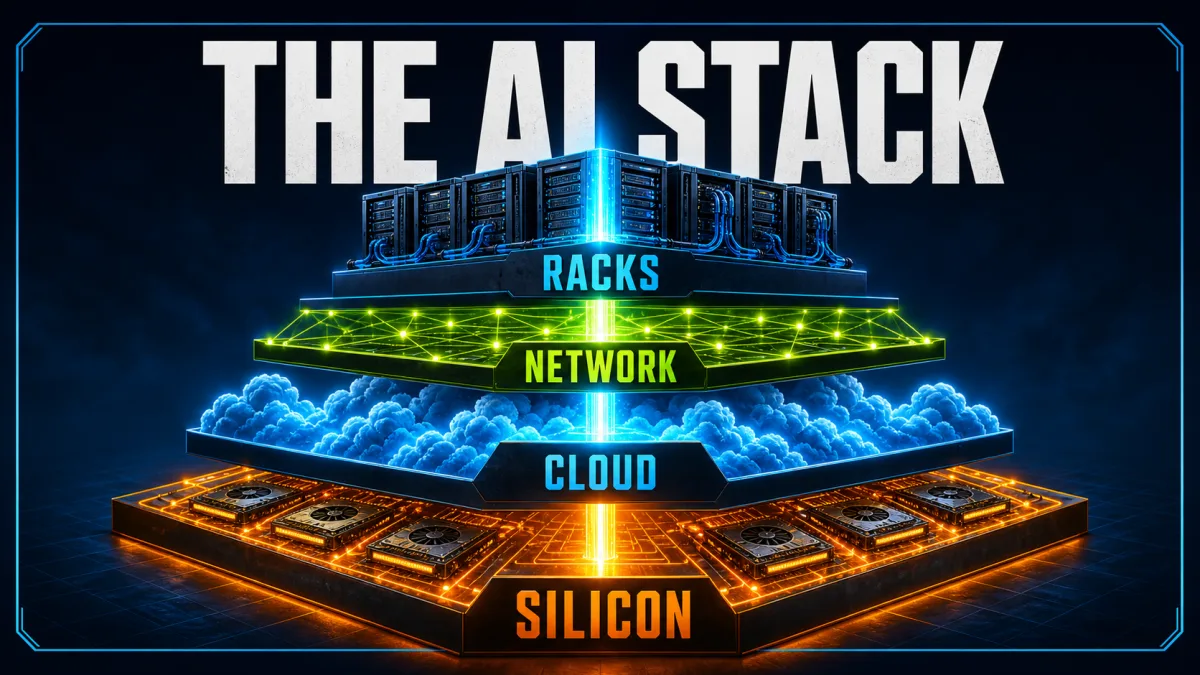
AI infrastructure is no longer a background procurement category. It is the physical and software layer that determines whether a model can be trained, served and governed at the scale a product requires. AI Magazine’s Top 10 AI Infrastructure Platforms, published July 8, 2026, captures that shift with a list that runs from NVIDIA silicon to hyperscale clouds, specialist GPU providers and turnkey enterprise systems.
The ranking is best read as an editorial market map, not a neutral benchmark. It does not give one reproducible workload, one cost model or one performance test across all ten companies. Instead, it identifies the infrastructure heavyweights AI Magazine believes matter across the stack: accelerators, interconnects, cloud capacity, model platforms, servers, storage and cooling.
Bottom line: NVIDIA is ranked first, but the list’s more important signal is structural: AI infrastructure is becoming a full-stack market. The winner of a model-training project may depend as much on networking, power, cooling, software integration and data governance as on the accelerator name on the server.
The Top 10 at a glance
| Rank | Platform | Primary layer in the list |
|---|---|---|
| 1 | NVIDIA | Accelerated computing, software and interconnect |
| 2 | AWS | Hyperscale cloud, custom silicon and model services |
| 3 | Microsoft | Azure cloud, supercomputing and enterprise AI |
| 4 | Google Cloud | TPU/GPU infrastructure and AI platform |
| 5 | Oracle | Bare-metal GPU clusters and OCI AI infrastructure |
| 6 | IBM | Governed, hybrid-cloud AI platform |
| 7 | CoreWeave | Purpose-built GPU cloud |
| 8 | Dell Technologies | Enterprise AI Factory systems |
| 9 | Hewlett Packard Enterprise | AI factory and converged HPC/AI systems |
| 10 | Supermicro | GPU servers, racks and liquid cooling |
The order is not a comparison of equivalent products. NVIDIA is primarily a platform supplier whose components appear inside many other entries. AWS, Microsoft and Google Cloud sell access to large-scale infrastructure and managed services. Dell, HPE and Supermicro help customers deploy systems closer to the enterprise data center. CoreWeave sits between the hyperscalers and hardware vendors as a cloud built around AI workloads.
1. NVIDIA: the stack beneath the stack
AI Magazine places NVIDIA at number one because its influence extends beyond the GPU itself. The company’s Blackwell architecture is presented as part of a broader system that includes accelerated computing, CUDA software, NVLink and data-center networking.
That is the strongest argument for NVIDIA’s position. A modern training cluster is a distributed machine. Its GPUs must exchange data quickly, its software must expose the hardware to frameworks and libraries, and its operators need telemetry and lifecycle tools. NVIDIA’s platform approach tries to make those layers work as one system rather than leaving every customer to integrate them independently.
The consequence is both technical and commercial. Developers get a mature software ecosystem and a large body of optimization knowledge. Infrastructure teams get reference architectures and rack-scale options. The trade-off is concentration: when the accelerator, software stack and interconnect are selected together, moving to another architecture can require changes well beyond swapping a card.
NVIDIA therefore belongs at number one in this list’s full-stack framing, even though its ranking should not be confused with the performance of every NVIDIA-based cloud or server configuration. The practical unit of evaluation is the complete system: GPU generation, memory, interconnect, compiler and libraries, workload scheduler, cooling and cost.
2. AWS: custom silicon inside a cloud ecosystem
AWS is ranked second because it combines an enormous general-purpose cloud with purpose-built AI components. Its Trainium platform describes a co-designed path from chip and server through network, software and services. AWS Neuron provides the developer stack for running workloads on Trainium and Inferentia, while the surrounding AWS services handle orchestration and managed ML workflows.
This is the hyperscaler advantage: an organization can connect compute to storage, identity, networking, orchestration and application services without building every control plane itself. AWS can also offer more than one accelerator path, including NVIDIA GPUs and its own chips, which gives teams another axis for cost and performance experiments.
The constraint is portability. A workload optimized around a custom compiler, runtime or managed service may be economical inside AWS while creating migration work elsewhere. AWS is a strong fit when the team already operates deeply in the ecosystem and wants infrastructure, platform services and production operations in one place. It is less obviously attractive when hardware portability or a uniform multi-cloud abstraction is the priority.
3. Microsoft: Azure as enterprise supercomputer
Microsoft takes third place with Azure AI infrastructure built around cloud scale, high-performance networking, accelerator choices and the services enterprises use to train and deploy models. Microsoft’s Azure Maia explanation shows the strategy clearly: custom silicon is designed alongside power, cooling, networking and software for Azure workloads.
Azure’s strength is not one chip. It is the integration of infrastructure with an enterprise cloud that already contains data, identity, security, governance and application services. The Azure AI infrastructure overview describes GPU virtual machines, accelerated networking, storage, management and AI services as parts of one production path.
That integration matters after a model leaves the research notebook. Training is only one phase; organizations also need private connectivity, data controls, monitoring, deployment automation and predictable access to capacity. Azure’s challenge is the same as other hyperscalers: the broadest service catalog can also produce the greatest architectural complexity.
4. Google Cloud: TPU differentiation and AI Hypercomputer
Google Cloud is fourth and stands out for its TPU strategy. Google describes AI Hypercomputer as an architecture that combines purpose-built hardware, open software and flexible consumption models. Its TPU documentation positions the accelerators as a foundation for training and inference, with support for PyTorch, JAX, vLLM and Kubernetes-based operations.
The technical proposition is vertical integration with an alternative accelerator path. Teams can use Google’s TPUs for workloads that fit the software and hardware model, while Google Cloud also offers NVIDIA GPU instances. That creates room to match the accelerator to the workload instead of treating GPUs as the only available unit of AI compute.
The practical question is software fit. TPU capacity is valuable when the framework, compiler path and model architecture are compatible. A team should test the real training or inference graph rather than assume that an accelerator with strong theoretical characteristics will produce the same operational result as a GPU cluster.
5. Oracle: bare metal and low-latency clusters
Oracle is ranked fifth for OCI AI infrastructure, with the list emphasizing bare-metal compute, low-latency networking and large GPU clusters. Oracle’s AI infrastructure portfolio describes GPU bare metal and virtual machines, RDMA cluster networking, storage and Supercluster configurations for training, inference and agentic AI workloads.
OCI’s differentiator is control over the machine boundary. Bare-metal instances avoid the virtualization layer for workloads that need predictable performance or direct access to large accelerator configurations. RDMA-based cluster networking addresses the communication problem that appears when a training job spans many nodes.
This makes Oracle relevant to teams that are sensitive to throughput, checkpointing and cluster economics rather than only looking for the broadest catalog of managed services. The counterweight is integration effort: the customer still needs to design workload management, data movement, observability and the application platform around the compute.
6. IBM: governance and hybrid AI
IBM’s sixth-place entry is less about raw accelerator scale and more about enterprise control. The watsonx platform architecture brings together watsonx.ai for model and application work, watsonx.data for data management and watsonx.governance for governance workflows.
That positioning matters because infrastructure decisions are constrained by data location, regulatory requirements, model lineage and operating-model boundaries. IBM’s platform can be consumed as a managed service, while IBM’s documentation also describes software deployment options where the customer supplies and maintains the hardware and platform foundation.
IBM therefore represents a different definition of infrastructure. The value is not only accelerator access; it is a governed path from data to model to deployment across cloud and hybrid environments. It is a fit for organizations that would trade some raw simplicity for policy, auditability and integration with existing enterprise systems.
7. CoreWeave: the AI-specialized cloud
CoreWeave is number seven and the specialist cloud in the list. Its AI data-center overview describes purpose-built facilities, large GPU clusters, high-speed networking, liquid cooling and infrastructure aimed at training and inference workloads.
The specialist model removes some general-cloud overhead. CoreWeave can design its scheduling, networking, storage and data-center operations around accelerator-heavy workloads instead of supporting every category of enterprise compute equally. Its documentation also exposes Kubernetes, bare-metal GPU instances, InfiniBand networking and capacity plans as core parts of the platform.
The trade-off is concentration of scope. A specialist provider may offer a more direct path to GPU capacity and cluster performance, but it does not automatically replace the broader identity, data, governance and application services of a hyperscaler. The right comparison is therefore not “CoreWeave versus cloud,” but “specialized compute layer versus the platform services a team needs around it.”
8. Dell Technologies: the enterprise AI factory
Dell is eighth, representing integrated enterprise infrastructure rather than public-cloud capacity. Its Dell AI Factory with NVIDIA combines compute, storage, networking, services and NVIDIA software into a modular path from desktop and pilot workloads to data-center deployment.
This model addresses a familiar enterprise problem: buying accelerators is easier than operating a validated AI system. Rack integration, storage paths, network topology, security, support and cooling can turn a promising pilot into a long infrastructure program. A factory-style offering packages more of those decisions into an installable system.
Dell’s proposition is strongest for organizations that need physical control, predictable support and a path from existing enterprise infrastructure to AI production. It is not necessarily the best fit for a team that wants instant, elastic capacity or a fully managed training environment. Physical deployment trades cloud convenience for control over locality, data and lifecycle.
9. Hewlett Packard Enterprise: converged HPC and AI
HPE is ninth with an emphasis on converged supercomputing, AI factories and enterprise or sovereign deployments. HPE’s AI Factory portfolio combines infrastructure, software, networking, services and operational control, while its Cray portfolio targets high-performance computing and AI workloads.
HPE’s place in the list shows that AI infrastructure is converging with established HPC concerns: dense compute, high-performance storage, interconnects, workload scheduling, power and cooling. For research institutions, public-sector deployments and enterprises with strict locality requirements, the system architecture and service model can matter more than access to a generic cloud instance.
The challenge is project complexity. A supercomputer-style deployment is a program of infrastructure, not a checkbox in a console. Teams need capacity planning, facility readiness, operating expertise and a clear workload pipeline before the hardware delivers its intended value.
10. Supermicro: the rack-scale building block
Supermicro closes the list at number ten with GPU servers and rack-scale systems. Its NVIDIA Blackwell solutions describe air- and liquid-cooled systems, integrated networking, rack-level deployment, management software and validation for large AI data-center projects.
Supermicro’s role is more concrete than a platform slogan: it supplies the machines, racks, cooling systems and integration work that make accelerator clusters physically deployable. That matters as GPU power density rises. Thermal design and serviceability become part of model economics because a cluster that cannot maintain performance or be repaired predictably is not useful capacity.
The buyer’s responsibility is correspondingly higher. A server vendor can provide a validated building block, but the organization still has to plan the data center, power, network fabric, storage, scheduling and software environment. Supermicro is most relevant when the team wants to own the infrastructure rather than rent it as a cloud service.
What the ranking says about the stack
The list becomes more coherent when grouped by the problem each layer solves:
| Layer | Entries | Core question |
|---|---|---|
| Accelerated platform | NVIDIA | Which silicon, software and interconnect make the cluster usable? |
| Hyperscale cloud | AWS, Microsoft, Google Cloud | How do we train and serve models alongside enterprise cloud services? |
| Specialized cloud | CoreWeave | How do we get AI-optimized GPU capacity and cluster operations? |
| Bare-metal cloud | Oracle | How much control and low-level performance does the workload need? |
| Governed enterprise platform | IBM | How do data, policy, governance and hybrid deployment fit together? |
| Integrated physical systems | Dell, HPE, Supermicro | How do we deploy and operate AI infrastructure in our own facilities? |
This is why “AI infrastructure platform” is an increasingly overloaded phrase. It can mean a chip-and-software ecosystem, a public cloud, a managed GPU cluster, a governance platform or a rack of liquid-cooled servers. Those products can compete at the margin, but they are not interchangeable.
Yowox’s earlier AI infrastructure overview makes the same architectural point from the application side: infrastructure includes the physical and operational controls that make model-powered work repeatable, not only a GPU allocation. The Top 10 list adds the market view by showing which companies are packaging each layer.
How to use the list without misreading it
Treat the ranking as a starting shortlist, then evaluate the workload. Training, fine-tuning, batch inference, real-time serving and agentic applications put different pressure on memory, network bandwidth, storage, latency and scheduling. A platform that is excellent for distributed pre-training may be unnecessarily complex for a small inference service; a flexible cloud instance may be a poor fit for a tightly coupled multi-node training run.
A responsible evaluation should record at least five things:
- Workload fit: accelerator memory, precision, framework support and model architecture.
- Scale behavior: GPU-to-GPU communication, storage throughput, checkpointing and failure recovery.
- Operational model: who owns provisioning, drivers, schedulers, monitoring, cooling and repairs.
- Data and governance: where data, weights, logs and prompts live, and which controls are available.
- Economics: not only hourly compute price, but utilization, egress, engineering time, power, cooling and idle capacity.
That last category is particularly important. A cheaper accelerator can lose its advantage if the team spends more on integration, debugging or underutilized capacity. A premium platform can be rational if it reduces operational risk and gets a valuable workload into production sooner—but that is a workload result, not a universal property of the vendor.
The practical verdict
AI Magazine’s Top 10 is valuable because it puts the full infrastructure stack in one frame. NVIDIA leads the silicon-and-software layer. AWS, Microsoft and Google Cloud compete on hyperscale capacity and integrated services. Oracle and CoreWeave target high-performance GPU deployment through different control models. IBM emphasizes governed hybrid AI. Dell, HPE and Supermicro address the physical systems that enterprises and research organizations must operate when cloud tenancy is not enough.
The ranking should not end the evaluation. It should improve the question. Instead of asking which company is “the best AI infrastructure platform,” ask which layer is currently limiting the workload: accelerator access, distributed networking, model software, data governance, physical deployment or operations. The right platform is the one that removes that bottleneck without creating a larger one elsewhere.
Frequently asked questions
What is the AI Magazine Top 10 AI infrastructure ranking?
It is an editorial list of ten companies providing specialised compute, networking, hardware or cloud platforms for enterprise AI workloads. The list ranks NVIDIA first, AWS second and Microsoft third, followed by Google Cloud, Oracle, IBM, CoreWeave, Dell, HPE and Supermicro.
Which company is ranked number one?
AI Magazine ranks NVIDIA number one, describing it as a full-stack computing platform spanning accelerator hardware, CUDA software and high-speed interconnects.
Does the list rank cloud providers only?
No. It mixes a silicon and software platform, hyperscale cloud ecosystems, an AI-specialised GPU cloud, enterprise AI platforms and server or rack-scale infrastructure manufacturers.
Why does AI infrastructure include cooling and networking?
Large-scale training and inference depend on more than accelerator FLOPS. GPU-to-GPU communication, storage, power delivery, thermal design and system software can determine whether a cluster is usable and economical in production.
Is this a buying recommendation?
No. The ranking is a useful market map, not a workload-specific procurement recommendation or an independently reproduced performance leaderboard.
Alex
Founder & Lead AI Writer
Alex is the founder of Yowox and lead AI writer since 2024, breaking down complex information into clear, actionable insights for thousands of readers every day. Alex has built AI automation systems for businesses since 2024, focusing on AI agents, workflow automation, and business process optimization.
Save hours. Save thousands.
Practical guides, real workflows, and the latest AI and automation news that matters — straight to your inbox.