 By Alex
 Top 10: AI Platforms in Media
AI Magazine’s editorial Top 10 spans foundation models, generative video, image creation, voice localisation, cloud infrastructure and production tools. Here is what the ranking says about the modern media stack.
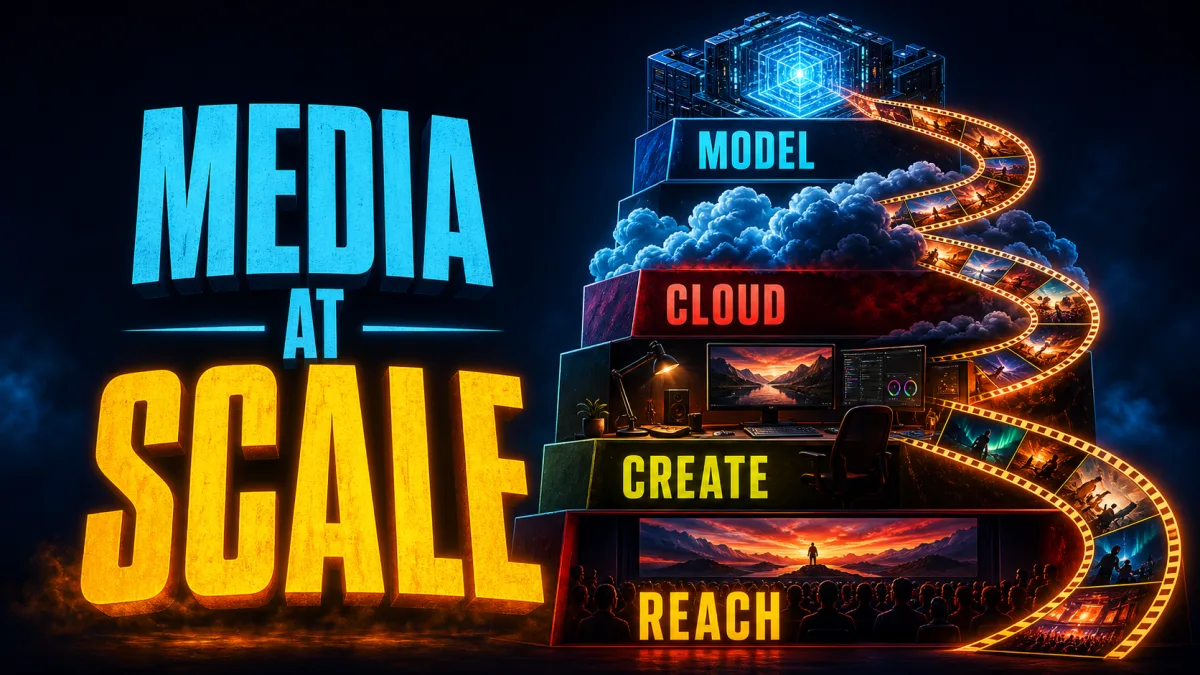
AI Magazine’s Top 10 AI Platforms in Media puts OpenAI, Google DeepMind and NVIDIA at the top, but the more useful story is the range of layers represented: foundation models, cloud services, creative applications, video generation, image creation and voice localisation. The ranking is editorial, not an independently scored benchmark.
Definition: An AI media platform is a model, service or creative environment that helps a media organisation create, transform, search, distribute or manage text, images, video or audio.
Key takeaway: The list describes a stack rather than a single category. Choosing a platform depends on whether the bottleneck is ideation, production, localisation, archive discovery, infrastructure or governance.
What is AI Magazine’s Top 10 AI Platforms in Media list?
The source article counts down the following platforms: OpenAI at number one, Google DeepMind at number two, NVIDIA at number three, Microsoft at number four, Adobe at number five, Amazon Web Services at number six, Anthropic at number seven, Runway at number eight, Midjourney at number nine and ElevenLabs at number ten.
| Rank | Platform | Media layer highlighted by the source |
|---|---|---|
| 1 | OpenAI | Foundation models, publisher partnerships and creative workflows |
| 2 | Google DeepMind | Multimodal research, video, audio and audience-facing products |
| 3 | NVIDIA | Accelerated computing, AI software and real-time 3D production |
| 4 | Microsoft | Azure AI, Copilot, translation and video intelligence |
| 5 | Adobe | Generative creative tools inside professional applications |
| 6 | Amazon Web Services | Bedrock model access and scalable media infrastructure |
| 7 | Anthropic | Long-context analysis and editorial assistance |
| 8 | Runway | Generative video and AI-assisted editing |
| 9 | Midjourney | Image ideation and visual pre-visualisation |
| 10 | ElevenLabs | Voice synthesis and multilingual dubbing |
This ordering should be read as AI Magazine’s editorial ranking. The article names companies, executives, locations and use cases, but it does not provide a shared evaluation protocol, revenue comparison, customer survey or apples-to-apples creative benchmark. A position in the list is therefore a signal of editorial attention, not proof that one platform will outperform another in every newsroom or studio.
1. OpenAI: the model-and-distribution layer
AI Magazine places OpenAI first because it sees the company as a catalyst for text, audio and video generation as well as a participant in the media business itself. The source points to newsroom and entertainment use cases, publisher licensing and the possibility of audience-facing commercial products.
The publisher relationship is not merely hypothetical. In its Financial Times partnership announcement, OpenAI describes attributed summaries, quotes and links to FT journalism in ChatGPT, alongside the FT’s use of ChatGPT Enterprise. That makes OpenAI’s media position broader than “a model that writes copy”: it includes discovery, attribution, product development and the economics of licensed content.
For a media organisation, the strategic question is whether OpenAI is being evaluated as a production assistant, an audience interface, a distribution channel or some combination of the three. Those are different procurement and editorial decisions.
2. Google DeepMind: multimodal research moving into products
Google DeepMind is second in the source list. AI Magazine highlights its research frontier, including high-fidelity video, audio synthesis, audience analytics and archive search. The important distinction is the bridge from research to consumer and creator products.
Google DeepMind’s Veo page describes a video-generation model designed for filmmakers and storytellers, with text-to-video, image-to-video and native audio capabilities. Its work on YouTube creators has also connected generative models with a distribution platform: the company described bringing Veo and Imagen to creators through Dream Screen, with generated content carrying identification signals such as SynthID.
That combination gives Google a different media profile from a standalone creative application. The relevant stack can include model research, cloud compute, creator tooling, platform distribution and provenance technology.
3. NVIDIA: the production and rendering substrate
NVIDIA appears third, and its role is less about being a single media app than supplying the compute and software layer underneath demanding workflows. AI Magazine groups its chips, AI Enterprise software and Omniverse environment into a foundational media platform.
NVIDIA’s Omniverse Enterprise overview describes APIs, services and SDKs for building generative-AI-enabled tools and applications, with OpenUSD and RTX rendering integrated into production workflows. Its media-and-entertainment material positions Omniverse for real-time collaboration, simulation, visual effects and virtual production.
That makes NVIDIA especially relevant when a studio’s constraint is not simply generating a first draft. Rendering, asset interchange, low-latency previews, multi-user collaboration and deployment support can decide whether a workflow survives contact with production.
4. Microsoft: enterprise media intelligence
AI Magazine places Microsoft fourth through the combination of Azure AI and Copilot. Its description focuses on translation, semantic video indexing, document synthesis and newsroom assistance.
Microsoft’s Azure AI Video Indexer documentation describes transcription, translation, language identification, speaker mapping and insight extraction from media. These are operational capabilities: turning a large archive into searchable, transcribed and localisable material rather than only generating new footage.
For broadcasters and publishers, that distinction matters. The highest-return application may be finding a moment in an archive, preparing captions, creating language variants or making a library accessible—not replacing the editor who decides what should be published.
5. Adobe: generative tools inside the creative suite
Adobe is fifth. AI Magazine’s case is built around Firefly’s integration with Photoshop, Premiere and Illustrator and its emphasis on commercially oriented creative production.
Adobe says its Firefly approach is based on training models on content where it has permission or rights, and describes Firefly as designed to be commercially safe. Adobe’s product announcements also connect Firefly with image, video, audio, editing and Content Credentials workflows.
The practical advantage is workflow continuity. A creative team may prefer a tool that lives inside the application where assets are already reviewed, revised and handed off. That does not remove the need for rights review: “commercially safe” is a product and contractual positioning, not a blanket answer for every input, edit, context or jurisdiction.
6. Amazon Web Services: model access and media operations
AWS takes sixth place through Amazon Bedrock. AI Magazine presents Bedrock as the managed backend for media networks that need access to foundation models, scalable workloads and enterprise controls.
AWS describes Amazon Bedrock as a platform for building generative-AI applications and agents at production scale, with model choice through a unified service and controls for security, privacy and governance. Its media examples include video analysis, metadata extraction, summarisation and content operations.
This is infrastructure rather than a single creative identity. A broadcaster could use Bedrock to assemble a workflow around transcription, retrieval, summarisation, compliance checks or archive discovery while selecting different models for different steps. The trade-off is that the organisation owns more of the orchestration, evaluation and operating model.
7. Anthropic: long-context editorial assistance
Anthropic is seventh. AI Magazine focuses on Claude’s use for research archives, transcripts, plot structures and editorial work, with safety and predictable generation as part of the appeal.
Anthropic’s long-context documentation explains how large inputs can support document synthesis, codebase analysis and context-aware agents. For media teams, that points to tasks such as comparing interview transcripts, extracting themes from research packets, checking a script against source material or organising a series bible.
Long context is not the same as factual reliability. A workflow still needs source grounding, quote checking, editorial review and clear boundaries around confidential material. The capability expands what can be placed in one working context; it does not make the model an editor of record.
8. Runway: generative video as an editing environment
Runway is eighth and represents a more focused creative category. Its official AI video generator combines generation from text, images or clips with editing actions such as changing a backdrop, relighting a shot, removing elements, extending footage and upscaling.
That product shape matters. Media production is not only “prompt in, finished video out”; much of the work is controlled revision of footage that already exists. Runway’s workflow therefore speaks to pre-visualisation, ad creative, mood reels, product reshoots, effects exploration and short-form sequences.
The correct test is not whether a platform can make an impressive isolated clip. It is whether a team can preserve character, continuity, rights, approvals, version history and creative intent across a real sequence.
9. Midjourney: fast visual exploration
Midjourney is ninth. AI Magazine describes it as a self-funded research lab whose image generation is used for visual conceptualisation, pre-visualisation, worldbuilding and design exploration.
Midjourney’s official getting-started guide describes the prompt-driven Create workflow and image references for composition, style, colour, characters and objects. That makes it a strong fit for the earliest visual phase: exploring possibilities before a production team commits to a shoot, set, storyboard or detailed design pass.
A concept image is not automatically a cleared production asset. Teams still need to review resemblance, rights, brand rules, continuity and the gap between a moodboard and a deliverable.
10. ElevenLabs: voice and localisation
ElevenLabs completes the list at number ten, representing the auditory layer. AI Magazine highlights context-aware voice synthesis for audiobooks, game dialogue, dubbing and voice agents.
Its official Dubbing v2 page says the system can localise content across 90+ languages and accents while conditioning on the source performance rather than only a transcript. It describes preserving emotion, timing, tone and speaker identity through an automated dubbing workflow.
This is a powerful distribution use case, but it is also a consent and identity use case. Voice rights, performer permissions, disclosure, cultural adaptation and human review remain part of responsible localisation—especially when a synthetic voice is close enough to a real person to affect trust.
What the ranking reveals about the media AI market
Media AI is splitting into layers
The list mixes model labs, clouds and creative applications because media workflows need all three. A newsroom may use a long-context model for research, a cloud service for indexing, a creative suite for assets and a separate voice tool for localisation. A studio may combine visual ideation, video generation, real-time rendering and archive search.
That is why a single “best AI media platform” claim is usually too broad. The useful question is: which layer of the production system is this platform improving, and what remains human-owned?
Distribution and provenance are becoming product features
The source includes OpenAI’s publisher relationships and Google’s creator ecosystem alongside generation tools. That signals a shift from isolated model demos toward media infrastructure: attribution, licensing, content credentials, watermarking, search, analytics, moderation and handoff all matter once AI output enters a public channel.
Editorial ranking is a starting map, not a buying decision
AI Magazine’s list is useful because it makes the market legible across categories. It is not enough to choose a vendor. A serious evaluation should define the workflow, test representative assets, measure quality and revision time, verify rights and retention policies, and document human approval points.
For a broader view of the systems beneath these applications, see Yowox’s Top 10: AI Infrastructure Platforms. The two lists fit together: media-facing models and creative tools sit on top of compute, cloud, networking and enterprise deployment choices.
Bottom line
AI Magazine’s Top 10 in Media is best read as a map of where AI enters the media chain. OpenAI and Google DeepMind represent model and distribution gravity; NVIDIA and AWS represent the infrastructure underneath; Microsoft and Anthropic emphasise enterprise intelligence; Adobe, Runway and Midjourney sit closer to creative production; ElevenLabs focuses on voice and localisation.
The ranking’s real lesson is not that number one replaces number ten. It is that media organisations are assembling a portfolio of specialised capabilities—and the durable advantage will come from connecting those capabilities to trusted editorial processes, rights-aware production and measurable audience outcomes.
Frequently asked questions
What is AI Magazine’s number-one AI platform in media?
AI Magazine ranks OpenAI first in its editorial list, followed by Google DeepMind and NVIDIA. The ranking is a published editorial selection, not an independent benchmark or universal procurement recommendation.
Which media tasks do the platforms cover?
The list covers text and research workflows, video and image generation, visual effects, audio and dubbing, cloud model access, video indexing, enterprise creative applications and AI infrastructure.
Is this a benchmark of media AI quality?
No. AI Magazine presents the list as a countdown of platforms reshaping storytelling, media production and content creation. It does not publish a common test set, scoring methodology or comparable performance table.
Alex
Founder & Lead AI Writer
Alex is the founder of Yowox and lead AI writer since 2024, breaking down complex information into clear, actionable insights for thousands of readers every day. Alex has built AI automation systems for businesses since 2024, focusing on AI agents, workflow automation, and business process optimization.
Save hours. Save thousands.
Practical guides, real workflows, and the latest AI and automation news that matters — straight to your inbox.