 By Alex
 Thinking Machines Releases Inkling: Open Weights, Closed-Scale Hardware
Thinking Machines has released Inkling, a 975-billion-parameter open-weights multimodal model. The important story is not the parameter count alone, but the combination of native audio and vision, controllable reasoning cost, fine-tuning, and infrastructure that most teams cannot run locally.
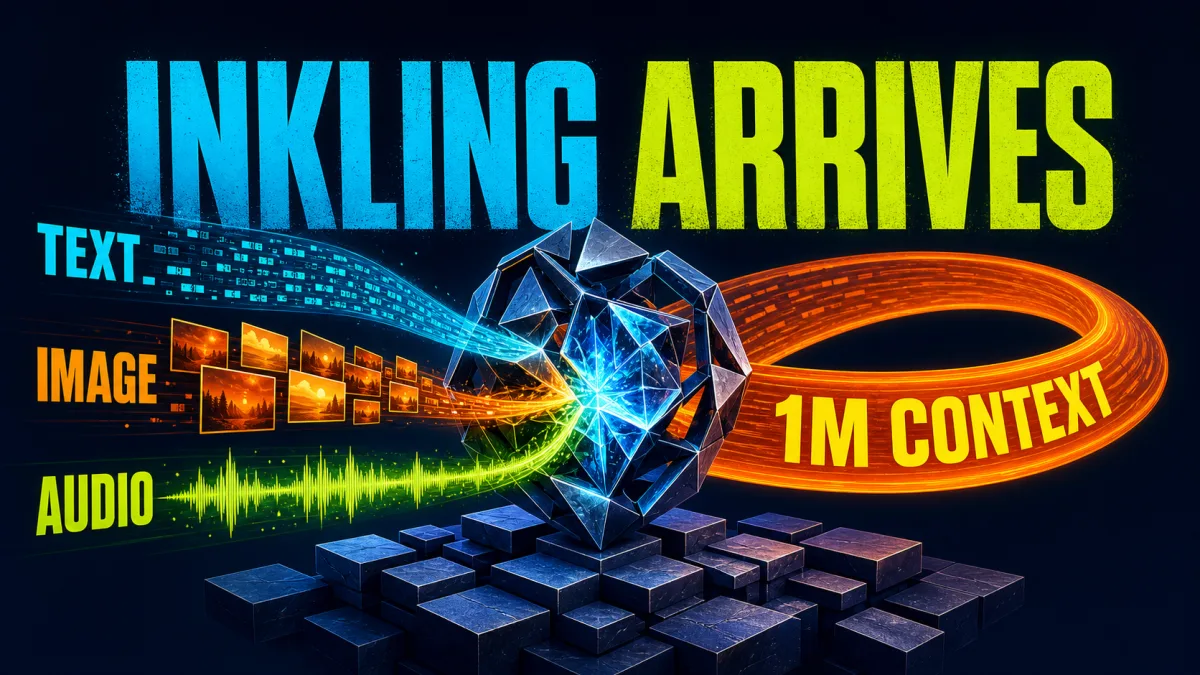
Thinking Machines Lab has released Inkling, a 975-billion-parameter open-weights model that natively accepts text, images and audio. The July 15, 2026 launch matters less as a parameter-count headline than as a concrete bet: give developers a broad model they can adapt, while selling the infrastructure for customization through Tinker.
Inkling is also a reminder that “open weights” and “easy to run” are different claims. The model is downloadable and licensed under Apache 2.0, but the published hardware requirements put the full checkpoint well beyond a typical workstation. The release is therefore most relevant to teams that need model control, multimodal input or domain adaptation — and can afford the engineering needed to operate it.
Definition: Inkling is a sparse Mixture-of-Experts model from Thinking Machines Lab with 975B total parameters and 41B active parameters.
Example: A developer can send Inkling text plus an image or audio recording, tune its reasoning effort, and adapt it to a domain through Tinker.
Key takeaway: Inkling is an open foundation for customization, not a plug-and-play replacement for every hosted frontier model.
Business impact: Companies can keep more control over model weights and adaptation, but they must budget for GPU memory, inference operations and downstream safety work.
What did Thinking Machines release?
Thinking Machines describes Inkling as a Mixture-of-Experts transformer trained from scratch on 45 trillion tokens spanning text, images, audio and video. The official Inkling announcement says the model has 975B total parameters, 41B active parameters and a context window of up to 1M tokens. Only a subset of the experts is active for each token, which explains why the total parameter count is much larger than the active count.
Inkling accepts text, image and audio inputs and generates text outputs. The model card lists general-purpose conversation, coding assistants, retrieval-augmented applications, agentic systems and tool use among its intended uses. That places Inkling inside the same broader system category as other models used in AI agents, but the model itself is only one component: an agent still needs tools, permissions, context management, validation and stop conditions.
Thinking Machines also released a preview of Inkling-Small, a 276B-parameter MoE model with 12B active parameters. The company presents the smaller model as a lower-cost and lower-latency option, with full weights to follow after testing. That pairing is strategically important because it shows the lab is not treating one giant checkpoint as the only product shape.
Why do the open weights matter?
Inkling’s open weights let developers download, inspect, fine-tune and integrate the model rather than consuming it only through a provider-controlled API. The Inkling model card lists Apache 2.0 as the license and points to Hugging Face distribution, Tinker access and third-party inference providers.
Open weights create practical options. A research team can test the model through hosted inference. An enterprise can evaluate a controlled deployment. A product team can adapt the base model to a domain-specific vocabulary, interaction style or tool environment. A regulated organization can also assess whether keeping inference inside its own infrastructure is preferable to sending every request to a closed API.
None of those options is automatic. Open weights do not reveal the original training data, guarantee reproducible quality after quantization, or make fine-tuning cheap. The deploying organization still owns access control, logging, data retention, safety testing and rollback decisions. It should evaluate the model on its own tasks instead of treating the release table as a production guarantee.
What can Inkling do with audio, images and long context?
Inkling’s native multimodality is one of its clearest differentiators. A single model interface can receive text alongside a document image, chart, screenshot or audio recording and produce a text response. The official release reports audio and vision evaluations, while the Hugging Face technical overview documents the model’s multimodal input path.
The 1M-token context window changes the size of the working set a system can present to a model. Possible applications include a large codebase, a long transcript with visual evidence, a collection of documents or a multi-step agent session. A larger context is capacity, not truth: irrelevant material, conflicting evidence and unsupported model outputs remain possible. Retrieval, filtering and permission checks still determine what enters the context.
Long context also has an infrastructure cost. The system must process the prompt and maintain attention-related state, so latency and memory can rise with realistic workloads. Teams evaluating Inkling should measure several context lengths, not just confirm that a request fits within the advertised maximum.
Is Inkling a benchmark winner?
Thinking Machines does not frame Inkling as the strongest overall model. It presents the model as a broad, balanced foundation whose value comes from multimodal inputs, controllable thinking effort and customization. The company reports results such as 97.1% on AIME 2026, 77.6% on SWE-bench Verified and 63.8% on Terminal Bench 2.1, but those figures are model-provider evaluations and should be read with their stated harnesses, checkpoints and settings.
The more operationally interesting feature is controllable thinking effort. Inkling exposes a way to trade reasoning depth against generated tokens, latency and cost. In the company’s comparison, Inkling reaches the same Terminal Bench performance as Nemotron 3 Ultra with roughly one-third as many tokens. That is a useful hypothesis for production routing, not a universal cost promise: actual economics depend on hardware, serving stack, prompt length, concurrency and the task mix.
A sensible evaluation should therefore compare Inkling with the current production model on a fixed set of real tasks. Track answer quality, tool-call validity, context handling, latency, memory, cost per completed task and the amount of human correction. A public benchmark can narrow the shortlist; it cannot choose the deployment for you.
What hardware does Inkling require?
Inkling is open to download but not lightweight to host. The model card says the BF16 checkpoint requires at least 2 TB of aggregate GPU VRAM, with example configurations of eight NVIDIA B300 GPUs or sixteen NVIDIA H200 GPUs. The NVFP4 checkpoint lowers the requirement to at least 600 GB, with example configurations using four B300 GPUs in W4A4 mode or eight H200 GPUs in W4A16 mode.
That requirement changes the meaning of “run it yourself.” For most teams, the first step will be an inference provider or Tinker rather than buying a cluster. Teams considering self-hosting should model total deployment cost, networking, tensor parallelism, KV-cache headroom, monitoring and spare capacity. The NVIDIA GB300 NVL72 specification illustrates the scale of the hardware class involved: a rack-scale system integrates 72 Blackwell Ultra GPUs and 36 Grace CPUs.
The hardware story is also part of Thinking Machines’ wider strategy. In March, the lab and NVIDIA announced a multi-year partnership targeting at least one gigawatt of next-generation Vera Rubin systems for model training and customizable AI platforms. That commitment is not the same thing as a promise that Inkling users receive one gigawatt of capacity, but it explains why the company can pursue model and fine-tuning infrastructure at frontier scale.
Why is Tinker central to the launch?
Thinking Machines is positioning Inkling as the base model and Tinker as the customization layer. The lab says developers can fine-tune Inkling on Tinker today, while the model’s open weights provide another route for teams that want to manage the deployment themselves.
The strongest public example of this strategy predates Inkling. In a joint Thinking Machines and Bridgewater report, the teams describe fine-tuning an open model on Bridgewater’s financial expertise. Their model reached 84.7% average accuracy on six financial-information tasks, compared with 78.2% for the best frontier baseline in their evaluation, and the authors reported lower inference cost. Those are the companies’ own results on a proprietary evaluation, not an independent benchmark, so the useful lesson is the method rather than a general claim that custom models beat frontier models everywhere.
The method is transferable in principle: start with a model, collect high-quality examples of the judgments a business actually needs, fine-tune, and test on held-out workflow cases. It is not free. Expert labeling, evaluation design, safety review and production monitoring are often harder than the first model call.
What does Inkling change for AI agents?
Inkling can serve as a model inside a multimodal agent, coding assistant or document workflow. Its audio and image inputs may reduce the need for separate preprocessing paths, while its context capacity can support larger working sets. Its reasoning-effort control may also let an orchestrator spend less compute on simple steps and more on difficult planning or tool-use decisions.
Inkling does not by itself make an agent reliable. A production agent still needs explicit tool schemas, permission boundaries, retries, evidence checks, state management and human escalation. Teams should test whether Inkling selects the right tool, passes valid arguments, handles tool failures and stops when it lacks evidence. Model capability is an ingredient; the surrounding AI automation stack determines whether a workflow is safe to operate.
What should developers do next?
Developers should evaluate Inkling in three stages. First, use a hosted route or Tinker to test the model on representative text, image and audio tasks. Second, measure the quality-cost curve at several reasoning-effort settings and context lengths. Third, compare the operational cost of self-hosting, a provider and a closed model before committing to a migration.
The decision should be based on the workflow, not the 975B headline. Inkling is a serious open-weight release with native multimodal inputs, a long context window and a clear customization thesis. It is also a large system that demands substantial hardware and engineering. For organizations with proprietary expertise and a reason to control the model layer, that trade may be compelling. For teams that only need reliable text generation, a smaller hosted model may remain the better choice.
Thinking Machines has not removed the hard parts of model operations. It has made a large, adaptable multimodal starting point available — and placed the real bet on whether organizations will turn their own expertise into model behavior.
Frequently asked questions
What is Inkling?
Inkling is a multimodal open-weights model from Thinking Machines Lab. It is a sparse Mixture-of-Experts transformer with 975 billion total parameters and 41 billion active parameters. It accepts text, images and audio, produces text outputs, supports up to a 1-million-token context window, and is intended for coding, agentic, tool-use, chatbot and retrieval-augmented applications.
Is Inkling the strongest AI model available?
No. Thinking Machines explicitly says Inkling is not the strongest overall model available, open or closed. The release is positioned as a broad, adaptable foundation for customization, with controllable thinking effort, native multimodal inputs and open weights. Its value depends on the workload, deployment cost and the quality of a team's own evaluation.
Can a normal workstation run Inkling locally?
Not in its full BF16 form. Thinking Machines' model card says the BF16 checkpoint needs at least 2 TB of aggregate GPU VRAM, while the NVFP4 checkpoint needs at least 600 GB. Those requirements imply a multi-GPU server, a cluster or hosted inference for most teams rather than a single desktop GPU.
How can developers customize Inkling?
Developers can download the weights from Hugging Face, use hosted inference providers, or fine-tune the model through Thinking Machines' Tinker platform. Customization still requires task-specific evaluation, data governance, safety controls, monitoring and human review. Open weights provide control; they do not remove the operational responsibility of deployment.
Alex
Founder & Lead AI Writer
Alex is the founder of Yowox and lead AI writer since 2024, breaking down complex information into clear, actionable insights for thousands of readers every day. Alex has built AI automation systems for businesses since 2024, focusing on AI agents, workflow automation, and business process optimization.
Save hours. Save thousands.
Practical guides, real workflows, and the latest AI and automation news that matters — straight to your inbox.