 By Alex
 Apple’s M6–M8 Chip Roadmap Signals an AI-First Mac Strategy
Bloomberg reports that Apple is reshaping its Mac silicon roadmap around AI, skipping high-end M6 chips for an M7 family while preparing a new generation of Macs and a possible touchscreen MacBook Pro.
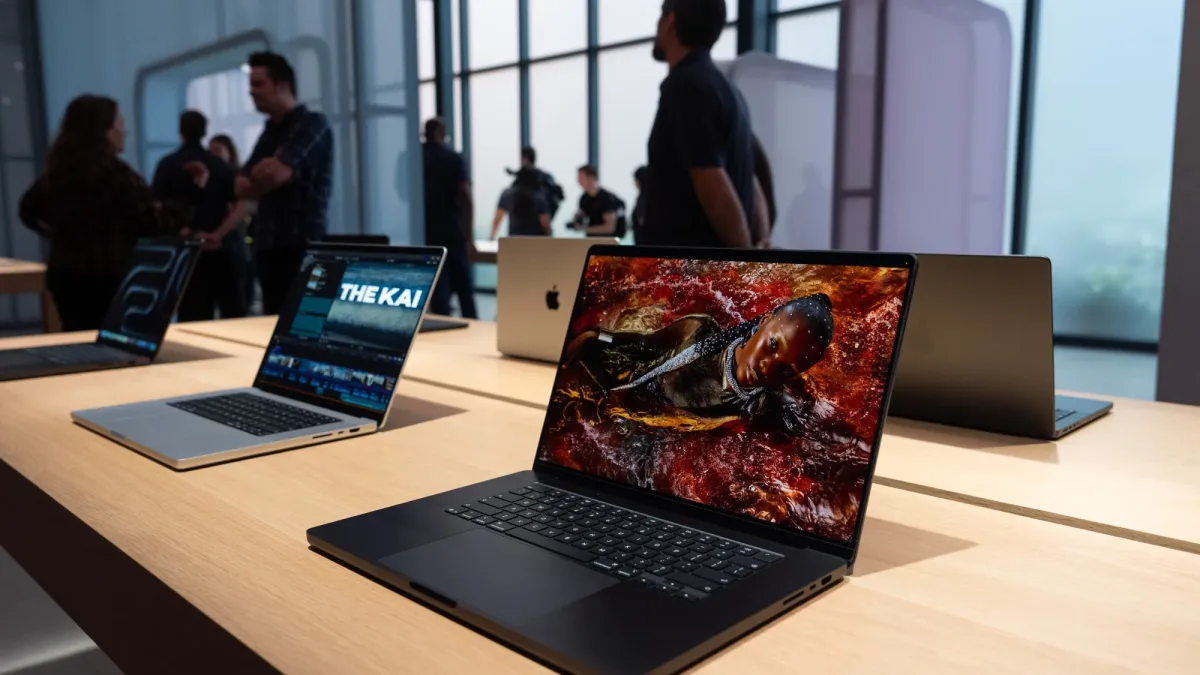
Apple is reportedly reorganizing its Mac silicon roadmap around AI rather than extending every chip tier on a predictable annual cycle. Bloomberg’s Mark Gurman says Apple plans a base M6 processor but will skip high-end M6 Pro, M6 Max and M6 Ultra versions, moving the next premium Mac chips to the M7 family instead.
What happened: Bloomberg reported a Mac chip roadmap that jumps from the current M5 generation to a base M6, then a high-end M7 family.
Why it matters: The change suggests Apple is treating AI capability and silicon iteration speed as more important than preserving a complete name-by-name chip lineup.
What is confirmed: Apple has not announced the M6–M8 roadmap, the rumored touchscreen MacBook or the reported release windows.
Bottom line: This is a report about Apple’s direction, not a product launch calendar; the strategic signal is more reliable than any individual rumored specification.
What does Bloomberg’s Apple chip report say?
In the July 12 edition of Power On, Bloomberg reports that Apple is preparing a new Mac chip strategy as it rebuilds its operations for the artificial-intelligence era. The reported plan is unusual because it does not simply add another set of Pro, Max and Ultra variants to the next numbered generation.
The key distinction is between the base M6 and the high-end M6 family. Apple is reportedly still planning a base M6 for entry-level Macs, potentially as early as 2026, while skipping M6 Pro, M6 Max and M6 Ultra. The higher-end transition would move directly to M7-branded chips.
That does not mean Apple is abandoning the M6 name. It means the name may describe different product segments on different schedules: an M6 for entry-level machines, and M7 for the next high-performance Macs.
Apple’s reported M6–M8 roadmap at a glance
The following table separates the reported direction from what Apple has actually confirmed publicly:
| Generation or product | Reported plan | Confirmation status |
|---|---|---|
| M6 | Base chip for entry-level Macs, potentially in 2026 | Reported; not announced by Apple |
| M6 Pro / M6 Max / M6 Ultra | High-end versions reportedly skipped | Reported; not announced by Apple |
| M7 | High-end family following the M5 generation, with Pro and Max variants expected in 2027 | Reported; timing and specifications unconfirmed |
| M7 Ultra | Higher-end chip reported for a later cycle, with an AI-server role discussed by secondary coverage | Reported rumor; not confirmed |
| M8 | Chip generation reportedly in development for 2028 | Reported; not announced by Apple |
| Touchscreen MacBook | OLED Mac notebook with touch input reported for a future high-end model | Reported by secondary coverage; not confirmed |
The roadmap is therefore best understood as a set of reported development priorities, not a guaranteed sequence of retail products. Apple can cancel, rename or delay any product before launch.
Why would Apple skip high-end M6 chips?
The strategic explanation is AI. Modern Mac chips already combine general-purpose CPU cores, graphics, memory bandwidth and dedicated neural-processing hardware. The next competitive question is how efficiently a Mac can run larger models, AI-assisted creative tools and other local workloads without relying entirely on a cloud service.
A company that believes a new architecture will deliver a bigger AI improvement may decide that an intermediate Pro or Max generation is not worth the engineering and manufacturing complexity. That is the logic implied by the report, although Apple has not publicly explained the decision.
The move would also give Apple a simpler message for premium Macs: the current high-end machines remain in the M5 generation, while the next major step is M7. That could make the product cycle harder to follow, but it may let the chip team prioritize a more substantial redesign.
For context, Apple’s current MacBook Pro page still presents the M5, M5 Pro and M5 Max as the available family and highlights on-device AI performance. It does not confirm the rumored M6, M7 or M8 products.
What is the rumored touchscreen MacBook?
The chip roadmap is connected to a larger reported redesign of Apple’s high-end laptop line. MacRumors summarizes reports of a future OLED Mac notebook with touch input, a thinner chassis and a Dynamic Island-style display cutout. The same coverage says the device could appear in 14-inch and 16-inch sizes and may be positioned as a separate high-end model.
This would be a notable change for the Mac. Apple has historically emphasized indirect input—keyboard, trackpad and mouse—rather than putting a touchscreen on a traditional clamshell Mac. A touch-friendly, not touch-first approach would let Apple add direct interaction without turning macOS into iPadOS.
The product name is also unsettled. “MacBook Ultra” is a reporting label, not an Apple announcement. The machine could launch as a new tier, replace part of the MacBook Pro lineup or change significantly before release.
How could the roadmap affect Mac buyers?
For people buying a Mac today, the immediate implication is limited: Apple’s current products remain the products Apple sells. A rumored M6 or M7 does not make an M5 Mac suddenly obsolete, and no purchase decision should depend on an unannounced specification.
The bigger question is timing. A buyer who needs a Mac now should compare the current M5 models against actual workload, memory needs and budget. A buyer who specifically wants an OLED display or touch input may reasonably wait for more concrete information, but should treat the rumored design as uncertain.
The reported schedule could also create an awkward transition. A base M6 Mac might arrive before premium models receive the newer high-end architecture. That would make the “newest” chip number less useful as a shortcut for overall performance: an M6 entry-level machine would not necessarily be a successor to an M5 Max system.
What does this say about Apple’s AI strategy?
Apple’s advantage has traditionally come from integrating hardware, operating systems and applications. An AI-focused silicon roadmap extends that approach: more capability can run locally, with lower latency and less dependence on remote servers. That matters for privacy, battery use and product differentiation, even when cloud models remain part of the experience.
But silicon alone does not determine an AI product’s success. Apple also needs useful software, model quality, developer support and a clear reason for people to use AI on a Mac. The chip roadmap suggests where Apple is investing; it does not prove that the resulting features will be compelling.
This is the same practical distinction that appears in what AI agents can actually do: a powerful model or processor creates potential, but the surrounding tools and workflow determine whether people experience a useful result.
What remains uncertain?
Several important details remain unconfirmed:
- Apple has not announced the M6, M7 or M8 Mac chips described in the reports.
- Release dates and product names may change.
- The performance, memory capacity and manufacturing processes of the rumored chips are not official specifications.
- The touchscreen MacBook’s final design, price and position in the lineup are unknown.
- The reported AI-server plans do not establish that Apple will sell a comparable product to customers.
The safest reading is that Apple is accelerating the strategic side of Apple silicon: the company may be willing to skip familiar chip tiers if a different architecture better supports its AI ambitions. Until Apple makes an announcement, however, the roadmap is useful as a signal—not as a shopping list.
Frequently asked questions
What is Apple reportedly changing in its Mac chip roadmap?
Bloomberg reports that Apple plans to introduce a base M6 chip while skipping higher-end M6 Pro, M6 Max and M6 Ultra versions. The report says the company is instead moving its high-end Mac silicon to the M7 family, with M8 already in development for a later cycle. These are reported plans, not an Apple product announcement.
Why would Apple skip the high-end M6 chips?
The reporting points to a shift in priorities toward artificial-intelligence performance and faster iteration. Skipping a full high-end M6 lineup could let Apple concentrate engineering resources on the M7 architecture, but the company has not publicly confirmed the reasoning or the final products.
Will the next MacBook Pro have a touchscreen?
MacRumors, citing the same broader reporting cycle, says Apple is preparing a high-end MacBook model with an OLED display and touch input, potentially under a MacBook Ultra name. The timing, design and product name remain unconfirmed; Apple’s current MacBook Pro page still lists the M5 family and does not announce a touchscreen model.
Is Apple officially confirming the M7 and M8 roadmap?
No. Apple has not announced the M7 or M8 Mac chip lineup described in the reports. The roadmap should be read as supply-chain and reporter sourcing, not as a public launch schedule. Product names, specifications and release dates can change before Apple makes an official announcement.
Alex
Founder & Lead AI Writer
Alex is the founder of Yowox and lead AI writer since 2024, breaking down complex information into clear, actionable insights for thousands of readers every day. Alex has built AI automation systems for businesses since 2024, focusing on AI agents, workflow automation, and business process optimization.
Save hours. Save thousands.
Practical guides, real workflows, and the latest AI and automation news that matters — straight to your inbox.