 By Alex
 Python or n8n for AI Agents?
A practical decision guide for choosing Python, n8n, or a hybrid architecture for AI agents based on control, integrations, state, and operational risk.
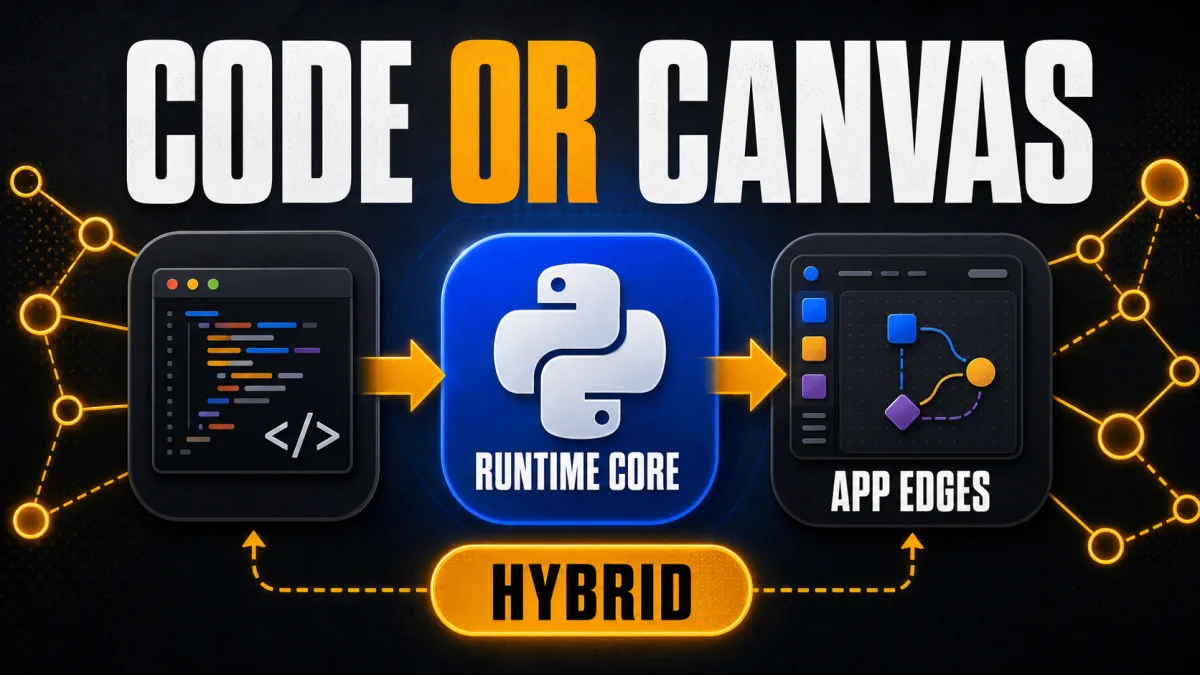
An AI agent should be built in Python when its hardest problem is custom logic, state, testing, or execution control; it should be built in n8n when its hardest problem is connecting business systems through a visible workflow. If both problems are substantial, use n8n at the edges and Python at the core instead of forcing one tool to do everything. This is a more useful answer than calling one platform universally “better” because the choice depends on the workflow's actual bottleneck.
Definition: Python is an application-development environment for custom AI-agent logic; n8n is a visual workflow automation platform that can connect an AI Agent node to models and tools.
Example: A support agent can use n8n to receive a message, call the CRM, request approval, and send a reply, while Python calculates a domain-specific risk score.
Key takeaway: Choose the tool that matches the workflow's hardest layer, not the tool with the shortest demo.
Business impact: A fit-for-purpose architecture reduces rework because integrations, agent logic, state, and approvals have clear owners from the first pilot.
What are you actually choosing for an AI agent?
The Python-versus-n8n decision is really a choice about where to place four kinds of control: integrations, decision logic, state, and operations. The distinction matters because an AI agent is not only a prompt; it must receive data, choose tools, preserve the right context, and handle failure. The practical takeaway is to score each kind of control before selecting a builder, rather than comparing screenshots or programming-language preferences.
The Workflow Gravity model makes that score concrete: integration gravity measures how many business systems and credentials the workflow touches; decision gravity measures how much custom branching and tool logic the agent needs; state gravity measures how long context and work must survive; and risk gravity measures approvals, audit trails, and failure consequences. A workflow with high integration gravity but low decision gravity leans toward n8n, while a workflow with high decision and state gravity leans toward Python. Use the model to identify the difficult layer before writing the first production task.
When should Python run the agent?
Python is the stronger fit when an AI agent's differentiator is custom behavior rather than connector setup. A Python implementation can organize domain-specific functions, data models, evaluation code, and service boundaries in ordinary source files; Python's standard asyncio library also provides concurrency primitives for high-level, structured network I/O. Choose Python when the agent must be shaped around a business process that cannot be expressed cleanly as a small set of visual nodes, and budget for owning the surrounding service.
Python is particularly useful when the agent needs a controlled execution graph instead of an opaque loop. LangGraph's documentation distinguishes predetermined workflows from dynamic agents and shows patterns for routing, tool calls, parallel work, persistence, streaming, and debugging in Python. That makes Python a practical choice for long-running or stateful agents where the team needs to inspect, test, and evolve the graph; the takeaway is to use a code-based runtime when execution behavior itself is a product requirement.
Python also wins when repeatable evaluation is part of the job, not a future improvement. The Python standard library's unittest framework supports test cases, fixtures, suites, runners, and test automation, so an engineering team can keep agent checks beside the implementation. This does not make an agent correct automatically, but it makes regression testing a normal development artifact; choose Python when every change needs a reviewable test and deploy path.
The cost of Python is ownership, not only coding time. A Python agent team must decide how to deploy the service, store secrets, expose tools, observe runs, retry failures, limit permissions, and keep dependencies current; the standard library capabilities above do not provide those production decisions for free. Python is therefore the right choice when control is worth the operational responsibility, not simply because a developer already knows the language.
When should n8n run the agent?
n8n is the stronger fit when an AI agent's main job is to move information across business systems. The official n8n AI Agent node connects a chat model and one or more tools, then lets the agent decide which tools to call; n8n requires at least one tool connection for the node. Choose n8n when the visible workflow — trigger, lookup, decision, action, and notification — is more important than custom runtime code. See also 10 Open-Source No-Code AI Platforms for Building LLM Apps, RAG Systems, and AI Agents.
n8n is also useful when a mixed team needs to inspect and change the workflow together. The n8n Tools Agent documentation describes tool calling, standard output formatting, streaming, intermediate steps, and human review for sensitive tool calls, while its built-in tool catalog covers common business applications and APIs. The practical takeaway is to prefer n8n when a visual map reduces coordination cost and a reviewer needs to see where an agent can act before the workflow is enabled.
Memory is where an n8n prototype can quietly become a production design problem. n8n's memory documentation separates simple current-session chat history from memory services and a Chat Memory Manager for more advanced handling; the page lists options including Redis and Postgres chat memory. Choose n8n confidently only after deciding whether the agent needs session context, durable cross-session memory, or task state that must survive a restart, because each requirement changes the workflow design.
n8n is not a shortcut around governance. A visual canvas can show which tool is connected, but the team still has to define permissions, approval thresholds, data retention, error paths, and ownership for the workflow; n8n's human-review capability is evidence that sensitive actions need an explicit gate, not proof that every action is safe by default. Use n8n for speed and visibility, then treat every tool connection as a production permission boundary.
Which platform handles the four control layers better?
The following table is a decision aid, not a benchmark. It maps the dominant difficulty to the environment that usually exposes the right control surface, then names the trade-off that should be tested in a pilot.
| Control layer | Python is usually stronger when | n8n is usually stronger when | Main trade-off |
|---|---|---|---|
| Integrations | The connector needs custom protocol or domain logic | The workflow uses supported business apps and APIs | Code control versus setup speed |
| Decision logic | Routing, tool selection, validation, or state transitions are complex | The agent follows a small, inspectable set of actions | Flexibility versus visual simplicity |
| State | Context must persist through long tasks, retries, or custom checkpoints | The need is limited to session memory or configured memory nodes | Ownership versus configuration |
| Operations | Tests, releases, observability, and deployment are engineering requirements | A team needs visible triggers, approvals, and handoffs | Runtime responsibility versus shared visibility |
A useful tie-breaker is the failure path, not the happy path. If a failed tool call should open a human task, update a record, notify a channel, and stop, n8n may make that path easier to inspect; if a failed step should resume from a typed checkpoint and run a custom recovery algorithm, Python usually gives more control. Draw the failure path before choosing the platform, because the failure path reveals the real architecture faster than a successful demo.
Is a hybrid Python-and-n8n agent architecture better?
A hybrid architecture is the strongest default when integration gravity and decision gravity are both high. n8n can own entry points, credentials, common application nodes, human approvals, and outbound notifications, while a Python service owns custom scoring, document processing, evaluation, or stateful agent logic; the two sides communicate through a small authenticated API. This split preserves n8n's visibility at the edges and Python's control in the core without pretending that one canvas or one codebase should own every concern.
The hybrid boundary must be narrower than the business process it serves. Define one request schema, one response schema, timeout and retry rules, authentication, idempotency behavior, and an owner for each side before adding a second call; otherwise the hybrid system becomes two loosely coupled debugging surfaces. Start with one Python capability behind one n8n workflow, measure where the boundary helps, and move only the layer that creates repeated friction.
What should you choose for a first AI-agent pilot?
Choose n8n first when the pilot is integration-heavy, the task is internal, the team benefits from a visual workflow, and the agent can be supervised through explicit approvals. Choose Python first when the pilot's value depends on custom reasoning, structured data processing, durable task state, or a testable execution graph. Choose hybrid when the pilot has one clear custom capability but many routine connectors; keep the first API boundary deliberately small.
Use this four-question test before committing: Where will the hardest rule live? What must survive a restart? Which actions require approval or an audit trail? Who will maintain the system after the demo? A “Python” answer to the first two and an “n8n” answer to the last two often points to a hybrid design; four “n8n” answers suggest a visual workflow, while four “Python” answers suggest a code-owned service. The takeaway is to make the decision from operating requirements, not from ideology about code or no-code.
Final recommendation: start with the bottleneck
Python and n8n solve different parts of the AI-agent problem. Python is the better home for custom execution, durable state, testing, and specialized processing; n8n is the better home for visible orchestration, business integrations, approvals, and fast collaboration. If the workflow needs both, use a hybrid boundary and make each side responsible for the layer it can control best.
The safest first move is a reversible pilot around one workflow, one success metric, and one failure policy. That approach follows the same principle as choosing the right build-versus-buy path: buy or configure the commodity layer, then build the missing part only when real workflow evidence shows that the gap matters. For the broader components around models, orchestration, and integrations, see the AI automation stack explained.
Need help choosing the right architecture for a business workflow? Get in touch.
Frequently asked questions
Is Python better than n8n for AI agents?
Python is usually the better fit when an AI agent needs custom state, complex branching, detailed tests, specialized data processing, or a long-lived production service. n8n is usually the better fit when the agent mainly connects business applications, needs a visual workflow, or must be changed by a mixed technical team. Neither tool is universally better. The right choice depends on where the difficulty lives: inside the agent's decision logic or at the boundaries between the agent and business systems.
When should I use n8n instead of Python for an AI agent?
Use n8n when the first version depends on connecting services such as email, CRM, spreadsheets, chat, HTTP APIs, or databases and the workflow is easy to explain as visible steps. n8n's AI Agent node connects a chat model to tools, while its workflow canvas makes triggers, integrations, approvals, and outputs visible. n8n becomes less comfortable when the agent needs deeply custom algorithms, unusual state transitions, or a large test suite that must live in normal source-control workflows.
When should I use Python instead of n8n for an AI agent?
Use Python when the agent's core value is custom reasoning, data transformation, evaluation, or control over execution. Python gives the team ordinary application code, reusable libraries, automated tests, and asynchronous I/O primitives for structured network work. Python also brings more responsibility: the team must build or select the runtime, integrations, observability, deployment path, and permission controls instead of receiving them through a visual automation platform.
Can Python and n8n be used together for AI agents?
Yes. A hybrid design commonly uses n8n for triggers, business-system connectors, approvals, and notifications, while a Python service handles custom agent logic, document processing, evaluation, or stateful orchestration. The boundary should be explicit: define the request and response schema, authentication, timeout, retry behavior, and ownership for each side. Start with one narrow interface rather than splitting an early prototype into many services.
Alex
Founder & Lead AI Writer
Alex is the founder of Yowox and lead AI writer since 2024, breaking down complex information into clear, actionable insights for thousands of readers every day. Alex has built AI automation systems for businesses since 2024, focusing on AI agents, workflow automation, and business process optimization.
Save hours. Save thousands.
Practical guides, real workflows, and the latest AI and automation news that matters — straight to your inbox.