 By Alex
 Why AI agents need a semantic layer, not just data access
AI agents do not need only access to data; they need an executable definition of what the data means. Why the semantic layer is becoming the control plane for trustworthy agentic analytics.
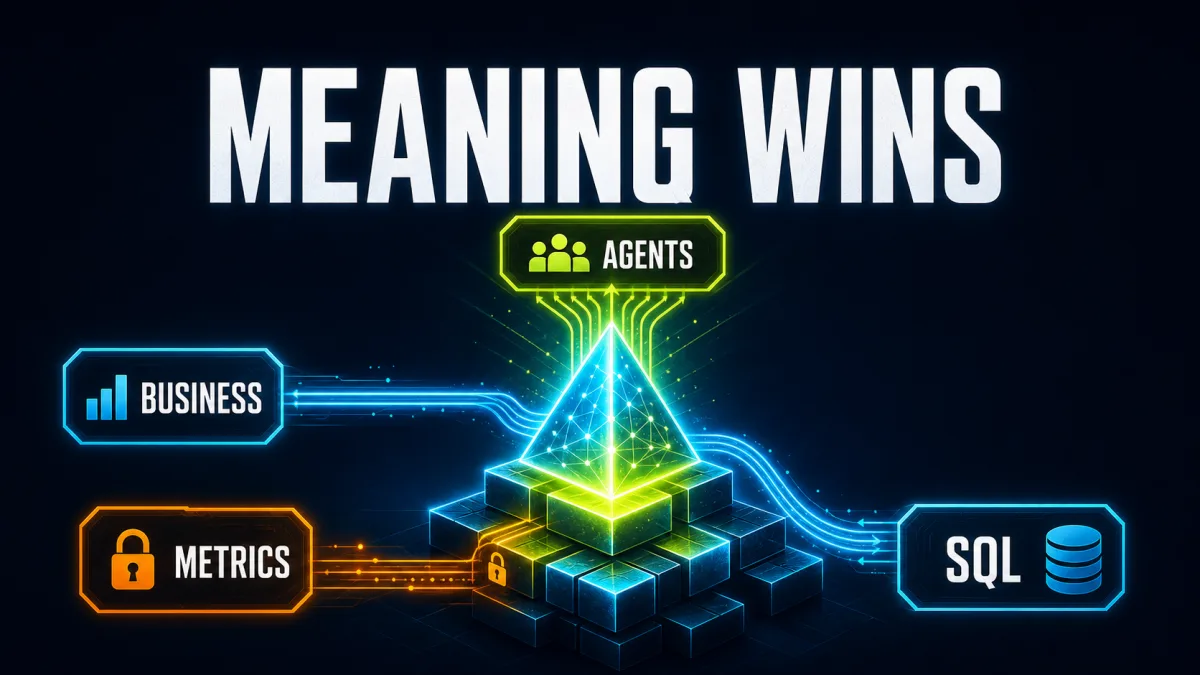
The semantic layer is becoming the control plane for agentic analytics. An AI agent can reach a warehouse, generate SQL and return a fluent answer without knowing what “revenue,” “active customer” or “churn” means in a particular business. The semantic layer supplies that missing agreement: entities, dimensions, measures, metrics, relationships, filters, terminology and access rules.
That is the central argument of the Towards AI analysis of the semantic layer: a feature once treated as a BI convenience is becoming an architectural boundary between raw data and autonomous action. The “battlefield” is not only about which vendor wins. It is about who owns the definitions an agent is allowed to use, where those definitions execute, and how a company proves that an answer was calculated under the right rules.
Bottom line: giving an agent database access is not the same as giving it business understanding. A semantic layer turns business meaning into a governed, executable contract.
Why raw schema access is not business understanding
A database schema tells an agent that a table has columns called customer_id, status, created_at and amount. It does not necessarily tell the agent which statuses count as active, whether amount includes refunds, which timestamp is authoritative, how customers join to subscriptions, or whether a metric is valid at a particular grain.
That gap creates a familiar analytics problem: two teams ask for the same KPI and receive different numbers. Humans may resolve the difference through institutional knowledge. An autonomous agent cannot reliably retrieve knowledge that was never encoded, and a plausible SQL query is not proof that its business interpretation is correct.
A semantic layer makes the interpretation explicit. It names the business object, maps it to physical data, defines reusable calculations and constrains the ways an agent can combine them. The result is not “AI understands the company” in a vague sense. It is a narrower and more useful promise: the agent can query a maintained model of what the company has agreed its data means.
What does a semantic layer actually contain?
A useful semantic layer usually has six building blocks:
| Building block | What it defines | Why an agent needs it |
|---|---|---|
| Entities | Business objects and join keys such as customer, order or subscription | Prevents arbitrary joins and clarifies grain |
| Dimensions | Attributes used to filter, group or slice data | Gives “by region” or “over time” a defined meaning |
| Measures | Basic aggregations such as count, sum or average | Provides reusable numeric primitives |
| Metrics | Business KPIs that combine measures, filters and formulas | Encodes the calculation rather than asking the model to invent it |
| Relationships | Valid paths between entities | Reduces incorrect joins and double counting |
| Glossary and context | Synonyms, ambiguity, descriptions and usage rules | Connects how people ask questions to how data is modeled |
Security and performance controls are part of the operational layer around these objects. Row-level access, allowed dimensions, query limits, caching and cost policies determine whether a semantically correct query is also an acceptable query.
The dbt semantic-model documentation describes semantic models as nodes connected by entities in a graph. MetricFlow uses that configuration to construct queries for metrics and dimensions, including joins required to reach a requested slice. This is an important detail: the semantic layer is not merely a glossary pasted into an agent prompt. It can be a query-planning and SQL-generation system.
Why agents make the semantic problem more urgent
Traditional dashboards constrain the questions a user can ask. The dashboard designer preselects metrics, filters and visualizations. Agents remove much of that interface boundary: a user can ask an open-ended question, and the system may decide which tables to use, which joins to make and which calculation to execute.
That flexibility increases the cost of ambiguity. A human analyst who chooses the wrong definition may be challenged in a meeting. An agent can repeat the wrong definition at machine speed, place it in a report, trigger a workflow or make a recommendation before anyone notices.
A semantic layer narrows the agent’s interpretation space without forcing every question into a fixed dashboard. It can expose approved metrics while still allowing users to choose valid dimensions, time grains and filters. The system becomes more flexible than a static report but more constrained than unconstrained text-to-SQL.
This is different from retrieval-augmented generation. RAG is useful for retrieving narrative context, documentation, policies and records. A semantic layer answers a different question: when the agent asks for a number, which entities, formulas, joins and restrictions make that number valid? A robust analytics agent may need both.
The move from embedded BI logic to headless semantics
Earlier semantic layers often lived inside a BI product. That approach could provide strong governance for the dashboards using it, but the definitions were harder to reuse outside the product’s runtime. Modern teams want the same metrics to serve dashboards, notebooks, APIs, applications and agents.
That pressure is driving a “headless” or decoupled direction: author semantic definitions as code or structured metadata, version them in a repository, expose them through APIs and let multiple consumers query the same contract. The benefit is portability and reviewability. The cost is that the organization now owns a semantic product rather than delegating every definition to a dashboard vendor.
The architectural choice is not simply centralized versus decentralized. The real questions are:
- Who owns the definition of each metric?
- Where is the source of truth stored?
- How are changes reviewed and versioned?
- Which consumers are allowed to use a metric?
- How do definitions map to the physical warehouse after schema changes?
- Can an agent discover ambiguity instead of guessing?
A semantic layer that is technically portable but politically ownerless will drift. A centralized layer that cannot serve the systems where decisions happen will be bypassed. The winning design is the one that makes the correct path easier than ad hoc SQL.
What makes a semantic layer executable?
A static glossary can explain that “active customer” means a customer with a qualifying event in a given period. An executable semantic layer goes further: it maps that definition to fields, filters, joins, time grain and query-generation rules.
That execution layer is what turns semantics into a control boundary. It can reject an invalid join, compile a metric into SQL, apply a default filter, limit available dimensions or route the request to a governed model. It can also return metadata to the agent so the model knows which terms are ambiguous and should trigger a clarification question.
Cube’s documentation illustrates this pattern through reusable cubes, measures, dimensions, filters and views. It also documents AI-specific context that can guide an agent toward a preferred measure or explain a business nuance without hiding the context from human maintainers. The important architectural principle is not the product name: agent-specific guidance should live beside the governed model and remain reviewable, rather than being scattered across prompts.
Why vendor control is part of the battlefield
The semantic layer sits between business meaning and data execution, so it creates strategic leverage. A platform that owns the semantic definitions may influence which warehouse, query engine, BI interface or agent framework is used next.
There are several competing centers of gravity:
- Warehouse-native semantics: definitions live close to storage, permissions and execution.
- Transformation-native semantics: definitions live alongside data models and version-controlled project code.
- Headless analytics semantics: one layer serves multiple warehouses, BI tools and applications.
- Application-owned semantics: a product encodes the definitions needed for one workflow or domain.
Snowflake’s current semantic-view documentation shows the warehouse-native direction: semantic views are schema-level objects that define business concepts, metrics and relationships, integrate with privileges and can be queried through Cortex Analyst. The advantage is governance and proximity to execution. The trade-off is potential coupling to the warehouse’s objects, APIs and permissions model.
The market will not be decided only by who has the nicest natural-language interface. It will be decided by who can make semantic definitions portable enough to be useful, governed enough to trust and executable enough to control cost and access.
The semantic layer as a safety boundary
An agent should not be allowed to infer every data rule from a prompt. A governed semantic layer can make several constraints deterministic:
- Definition control: only approved metrics are exposed as authoritative KPIs.
- Join control: relationships describe which paths are valid and at what grain.
- Filter control: default or mandatory filters prevent accidental scope expansion.
- Permission control: data access is evaluated before the agent receives results.
- Query control: cost, time range, row count and concurrency limits are enforced.
- Evidence control: the final answer can include the metric definition and generated query path.
This does not eliminate hallucinations. The agent can still misunderstand a question, select the wrong approved metric or describe a result badly. But it moves the highest-impact business rules out of free-form generation and into inspectable system components.
The boundary also needs to distinguish “no data” from “not authorized,” “metric undefined” from “metric equals zero,” and “ambiguous term” from “valid synonym.” These distinctions should be represented in the query and response contract rather than left to the model’s prose.
How should teams build a semantic mesh safely?
A semantic mesh is not a single giant glossary. It is a governed collection of domain-owned definitions that can be discovered and composed under shared rules. The implementation can be centralized or federated, but the interfaces must be explicit.
A practical rollout looks like this:
1. Start with questions, not tables
Collect the real questions people ask and the decisions those questions support. “What was revenue last quarter?” is not enough; record which revenue definition, currency, time zone, exclusions and organizational scope the business expects.
2. Define grain before metrics
Every entity and measure needs a clear grain. A metric that looks correct on a single table can be wrong after a many-to-many join. Make primary and foreign relationships explicit, and test that the generated query does not multiply rows unexpectedly.
3. Version definitions as code
Store models, metrics, glossary entries and relationships in a reviewable format. A metric change should produce a diff that a data owner can understand. Treat a semantic change like a code change: review it, test it and record who approved it.
4. Build a verified question set
For each important metric, keep representative natural-language questions and verified answers. Include ambiguous phrasing, alternative synonyms, time ranges, filters and adversarial cases. The set becomes a regression suite for both the semantic layer and the agent.
5. Separate planning from execution
The agent may interpret the user’s intent, but a deterministic semantic engine should compile the approved meaning into an executable query. Log the selected model, metric, dimensions, filters and generated SQL so an analyst can reproduce the answer.
6. Add cost and access guardrails
A correct query can still scan too much data or expose too much data. Apply row-level security, maximum ranges, query budgets, result limits and approval gates for sensitive domains. Measure cost as part of semantic-layer quality.
7. Monitor drift
Schemas change, business definitions change and users invent new language. Detect broken mappings, unused metrics, repeated clarification questions and agent attempts to bypass the semantic path. Feed those failures back into the model and glossary rather than silently adding prompt exceptions.
What the semantic layer cannot solve
A semantic layer does not repair bad source data, stale warehouse models or contradictory ownership. If two teams disagree about churn, encoding both definitions does not decide which one a board report should use. Governance still requires people who own the business meaning.
It also does not guarantee that an agent will answer well. The agent can choose the wrong metric among several valid ones, ask an unhelpful clarification question or produce a misleading narrative around a correct number. Evaluation must cover interpretation and explanation, not only SQL execution.
Finally, centralization can create a bottleneck. If every domain waits for one platform team to define every metric, teams will create unofficial copies. The semantic layer must make ownership and contribution easy while preserving shared validation and discoverability.
The real competitive advantage is shared meaning
The semantic layer is becoming important because agentic systems make the cost of inconsistent meaning much higher. Dashboards could hide semantic disagreement behind fixed charts. Agents expose the disagreement by asking new questions across departments, data products and workflows.
The strongest architecture will not be the one that gives an agent the broadest raw access. It will be the one that lets an agent explore a well-defined business model while keeping metric logic, joins, permissions, query cost and evidence visible to humans. Background: How are you giving AI agents access to postgress?.
That is why the semantic layer is a battlefield. It is where business language becomes executable data logic, where vendors can capture architectural gravity, and where organizations decide whether autonomous analytics is merely fluent—or actually trustworthy.
Frequently asked questions
What is a semantic layer?
A semantic layer is a governed translation layer between business language and physical data. It defines entities, dimensions, measures, metrics, relationships, filters, glossary terms and often permissions so different users and applications can query the same business concepts consistently.
Why does agentic AI need a semantic layer?
An agent can generate SQL from a database schema without understanding what the business means by revenue, active customer or churn. A semantic layer supplies the definitions, joins, constraints and approved calculations that make the agent's interpretation more deterministic and auditable.
Is a semantic layer the same as RAG?
No. RAG retrieves relevant text or records as context, while a semantic layer defines how business entities, metrics and relationships should be interpreted and queried. They can work together: RAG can retrieve policy or narrative context while the semantic layer governs quantitative answers.
Should semantic definitions live in the warehouse or a separate tool?
There is no universal answer. A warehouse-native semantic view can integrate closely with database privileges and governance, while a decoupled layer can serve multiple warehouses, BI tools and agents. The important properties are versioning, reviewability, deterministic execution and clear ownership.
How do you test a semantic layer for AI agents?
Start with a curated set of real business questions and verified SQL answers. Test metric values, joins, filters, permissions, ambiguous terms, query cost and regressions whenever definitions or underlying schemas change.
Alex
Founder & Lead AI Writer
Alex is the founder of Yowox and lead AI writer since 2024, breaking down complex information into clear, actionable insights for thousands of readers every day. Alex has built AI automation systems for businesses since 2024, focusing on AI agents, workflow automation, and business process optimization.
Save hours. Save thousands.
Practical guides, real workflows, and the latest AI and automation news that matters — straight to your inbox.