 By Alex
 What Is RAG? Retrieval-Augmented Generation Explained
Retrieval-Augmented Generation, or RAG, lets an AI model retrieve relevant information from your documents or databases before generating an answer. Here is how it works, when to use it, and why retrieval quality matters.
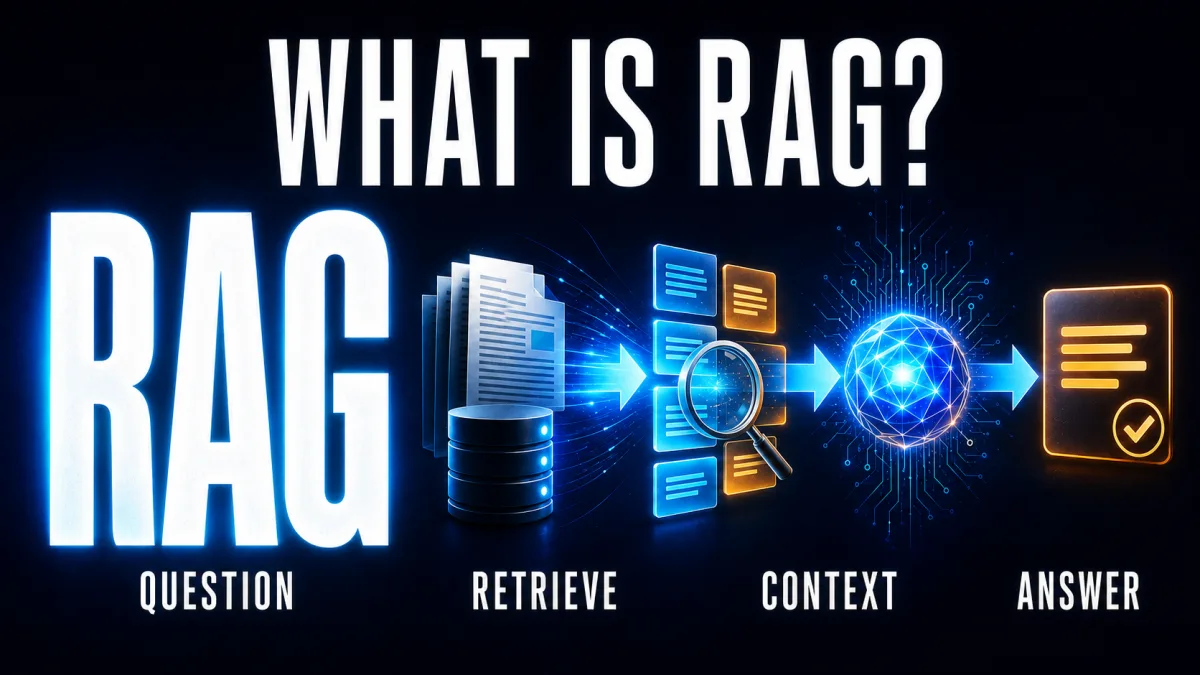
Retrieval-Augmented Generation (RAG) is a way to make an AI application answer from selected external information instead of relying only on what the language model absorbed during training. The application retrieves relevant passages from documents, databases, or a knowledge base, adds them to the model's context, and asks the model to generate a grounded response.
Definition: RAG combines information retrieval with generative AI so a language model can use relevant external sources when answering a question.
Example: A support assistant can retrieve the current refund policy and a customer's order record before drafting a response, rather than guessing from a general model's memory.
Key takeaway: RAG updates an AI application's knowledge by changing the searchable source layer, not by retraining the language model every time a document changes.
Business impact: RAG can make internal assistants more useful and auditable, but the quality of the final answer depends heavily on which sources the retrieval step selects.
Why do AI applications need RAG?
A language model can write fluent answers without having access to a company's private policies, current inventory, or the latest version of an internal procedure. A model's training data also has a cutoff, and the model may produce a confident answer when it lacks the right evidence. RAG addresses that knowledge gap by giving the model a controlled route to external information at inference time.
RAG combines search with generation, so a business can update a document collection without retraining the underlying model. That separation is useful for product catalogs, support policies, legal playbooks, and other sources where facts change more often than model behavior should.
RAG does not turn a language model into a database. The model still generates a probabilistic response, and the retrieval system can return incomplete, stale, or irrelevant context. The practical goal is not to make every answer automatically true; it is to make the evidence path explicit, measurable, and easier for the application to control.
How does a RAG pipeline work?
A typical RAG pipeline has four stages: ingestion, retrieval, augmentation, and generation. The stages are separate on purpose: teams can improve document processing or search quality without changing the language model itself.
1. Ingestion prepares the knowledge source
The ingestion stage collects source material such as PDFs, wiki pages, tickets, database rows, or product records. The system cleans the content, preserves useful metadata, splits long documents into retrievable chunks, and creates an index. For semantic search, each chunk is converted into an embedding — a numerical representation of its meaning — and stored with metadata such as document type, owner, date, and permission scope.
Chunking is not a cosmetic preprocessing step. A chunk that is too large may contain several unrelated topics and waste the model's context; a chunk that is too small may remove the condition or exception that makes a policy understandable. The right size depends on the document structure, the user questions, and whether the answer needs a paragraph, a table row, or a complete record.
2. Retrieval finds relevant evidence
When a user asks a question, the retrieval stage searches the indexed source and selects passages that may answer it. Semantic search can match meaning even when the user's wording differs from the document, while keyword search is useful for exact product names, policy codes, invoice numbers, and other identifiers.
Modern RAG systems often combine those methods with metadata filters and reranking. Hybrid search and rerankers can improve relevance beyond a single vector similarity score. For a business assistant, retrieval should also enforce the user's permissions before context reaches the model; a highly relevant document is still an invalid result if the requester is not allowed to see it.
3. Augmentation builds the model context
The augmentation stage combines the user's question with the selected evidence and instructions for the model. The prompt may tell the model to answer only from the supplied sources, cite the relevant documents, distinguish facts from uncertainty, or say that evidence is missing instead of inventing a response.
Context selection matters because a model has a finite context window and more text is not automatically better. Sending twenty loosely related passages can bury the one paragraph that actually answers the question, increase latency, and raise token cost. A smaller set of high-quality passages is often more useful than a larger pile of weak matches.
4. Generation produces the answer
The language model uses the question, retrieved context, and application instructions to draft the final response. A well-designed application can return citations or source links alongside the answer so a user can inspect the evidence. It can also add a confidence or escalation path when the retrieved documents disagree or do not contain enough information.
Pinecone describes these four components — ingestion, retrieval, augmentation, and generation — as the core of a traditional RAG flow. Agentic systems can extend the pattern by rewriting a query, calling multiple retrieval tools, checking the relevance of the results, and retrieving again before acting — though not every AI agent needs RAG in the first place.
What is the difference between RAG and fine-tuning?
RAG changes what the model can reference; fine-tuning changes how the model behaves. If a company needs an assistant to use the latest employee handbook, RAG is usually the direct solution because the handbook can be re-indexed after an update. If the company needs the assistant to consistently return a particular JSON structure or follow a specialized response style, fine-tuning may be relevant.
RAG is also easier to audit for changing facts because the application can retain the retrieved passages and show which sources influenced the answer. Fine-tuning can encode patterns into model weights, but it is not a simple document-update mechanism and does not automatically provide a citation trail. The two approaches can be combined when an application needs both specialized behavior and access to current private knowledge.
When should a business use RAG?
RAG is a strong fit when an AI workflow needs private, specialized, current, or source-verifiable information. Common examples include internal policy assistants, customer-support copilots, product and inventory search, contract review, technical documentation assistants, and research tools that must work from a controlled source collection.
RAG is less useful when the task does not require external knowledge, when the source data is too unreliable to ground an answer, or when a deterministic database query would answer the question more safely. A system that asks an LLM to retrieve a precise account balance from unstructured text may be worse than a normal API call to the financial system of record.
Why does retrieval quality matter more than the vector database brand?
RAG answer quality is constrained by the evidence that reaches the model. A powerful language model cannot reliably use a source that was never retrieved, and a relevant-looking chunk can still be wrong if it is stale, truncated, or missing the document's exceptions and permissions.
Production teams should evaluate RAG in two layers: retrieval metrics such as recall and relevance, and generation metrics such as groundedness, answer quality, citation accuracy, and refusal behavior when evidence is absent. Evaluation dimensions such as groundedness and question-answering quality should be tracked alongside retrieval relevance. A small test set of real business questions is more informative than a demo that succeeds on a few hand-picked prompts.
The most useful improvements are often operational: improve source layout parsing, choose a better chunking strategy, add metadata filters, rewrite ambiguous queries, rerank candidates, remove stale documents, and test access control. RAG is not a single model feature; it is a search-and-generation system whose failure modes must be measured end to end.
What should you build first?
Start with one narrow workflow and a small, authoritative source set. Define the questions the system must answer, the sources it is allowed to use, the behavior required when evidence is missing, and a test set with expected answers. Then measure retrieval and answer quality before adding more documents, more tools, or autonomous actions.
RAG is valuable because it gives an AI application a practical knowledge layer between a user and a language model. It is one layer in the broader AI automation stack, alongside the model, orchestration logic, integrations, and monitoring. The winning implementation is rarely the one with the most documents or the largest context window; it is the one that retrieves the right evidence, respects permissions, exposes uncertainty, and makes improvement measurable.
Frequently asked questions
What does RAG stand for?
RAG stands for Retrieval-Augmented Generation. It is a software pattern in which an application retrieves relevant information from an external source — such as company documents, a database, or a current knowledge base — and adds that information to an AI model's context before the model generates an answer. RAG combines search with generative AI, allowing the model to use information that may be private, specialized, or newer than its original training data.
Does RAG eliminate AI hallucinations?
No. RAG can reduce unsupported answers by giving the model relevant source material, but it cannot guarantee correctness. If the retrieval system selects the wrong documents, the source data is outdated, or the model misinterprets a passage, the final answer can still be wrong. Reliable RAG needs curated data, access controls, retrieval evaluation, clear instructions to cite or refuse when evidence is missing, and tests that measure both retrieval quality and answer groundedness.
Is RAG better than fine-tuning?
RAG and fine-tuning solve different problems. RAG is usually the better first choice when an AI application needs fresh, private, or changing facts, because the knowledge source can be updated without retraining the model. Fine-tuning changes how a model behaves — for example, its style, format, or task-specific patterns — but it is not a convenient replacement for a frequently changing document library. Some production systems use both.
What data can a RAG system search?
A RAG system can search text documents, PDFs, internal wiki pages, support tickets, product catalogs, database records, and other structured or unstructured sources. The data is normally cleaned, split into retrievable chunks, and represented as embeddings or indexed for keyword search. The best design depends on the data and questions: many business systems use semantic search together with keyword filters, metadata, permissions, and reranking rather than relying on one vector database query.
Alex
Founder & Lead AI Writer
Alex is the founder of Yowox and lead AI writer since 2024, breaking down complex information into clear, actionable insights for thousands of readers every day. Alex has built AI automation systems for businesses since 2024, focusing on AI agents, workflow automation, and business process optimization.
Save hours. Save thousands.
Practical guides, real workflows, and the latest AI and automation news that matters — straight to your inbox.
! Here’s the Honest Breakdown.](/images/posts/firecrawl-claude-mcp-honest-breakdown/cover.webp)