 By Alex
 5 Mistakes Beginners Make When Building AI Agents (And How to Avoid Them)
Confusing a chatbot for an agent, skipping human review, jumping to multi-agent systems too early, vague tool instructions, and unready data — the five most common ways first AI agent projects go wrong.
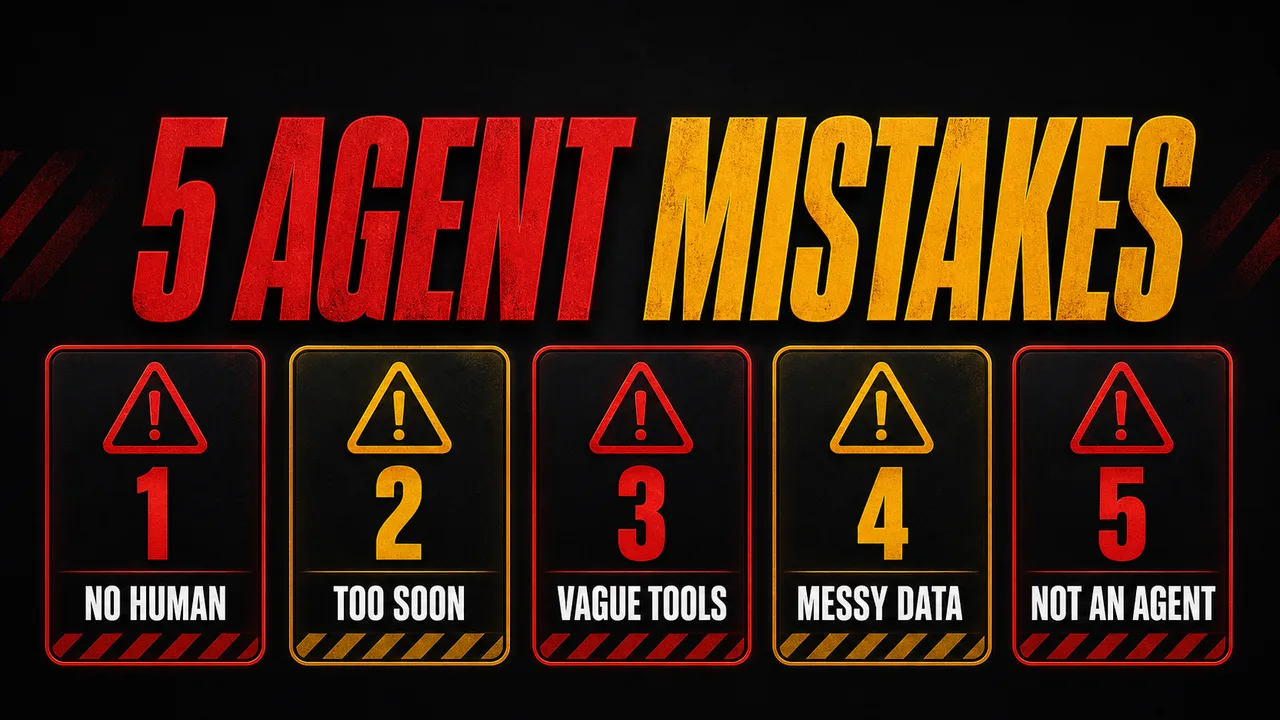
Most first AI agent projects don't fail because the model is too weak — they fail because of a small set of avoidable, well-documented mistakes. Anthropic's own engineering guidance and OpenAI's practical guide to building agents both converge on the same short list, and it's worth knowing before you build your first one, not after.
Definition: These are the five most common, avoidable mistakes that undermine first-time AI agent projects — not model limitations, but design and process choices.
Example: A team builds a "support agent" that's really a chatbot with a friendlier prompt, ships it with no review step, and is surprised when it confidently does the wrong thing.
Key takeaway: Every mistake below is a choice, not a technology limit — each one has a straightforward fix once you know to look for it.
Business impact: Avoiding these five mistakes is a bigger reliability lever than switching to a more expensive model.
Mistake 1: Confusing a chatbot for an agent
A chatbot answers questions. An AI agent takes multi-step action — reading records, calling tools, updating systems — often across several steps without a person typing each one. Forbes contributor Bernard Marr, writing about the AI agent mistakes costing businesses money, puts this first for a reason: teams that build a chatbot and expect agent-level autonomy are solving the wrong problem, then blaming the model when it doesn't deliver.
The fix is architectural, not cosmetic: decide up front whether the task genuinely needs autonomous multi-step action (an agent) or just a good conversational interface (a chatbot). If you're unsure which one you actually need, AI agents vs. RPA covers the closely related question of how much judgment versus fixed rules a given task actually requires. More on this: What Skills Do I Need to Build AI Agents?.
Mistake 2: Skipping the human checkpoint
Agents inherit the same failure mode as the language models underneath them: confidently wrong output. Marr's Forbes piece cites research that hybrid human-plus-agent teams outperform fully autonomous agents the large majority of the time — the fix isn't avoiding agents, it's not fully trusting them unsupervised from day one.
This is the same point made in how to get started with AI agents: review output before it takes a real action, especially early on, and relax that review only as the agent earns a track record on that specific task. Skipping straight to full autonomy is how a small early mistake turns into a real one.
Mistake 3: Reaching for multi-agent orchestration too soon
Anthropic's own engineering guidance is blunt about this: start with the simplest solution that works, and add complexity "only when it demonstrably improves outcomes" — for a lot of tasks, that means a single well-scoped agent, or no agent at all, not a multi-agent system. Multi-agent orchestration adds real latency, cost, and new ways to fail, and that tradeoff is only worth making once a single agent has actually proven the task out and hit a genuine ceiling.
This is a build-vs-buy-adjacent decision worth making deliberately rather than defaulting into: see the AI automation stack explained for how orchestration fits alongside the model, memory, and tools that make up a working agent system, and build vs. buy for AI agents for the broader version of this "don't over-invest before you've proven the need" pattern.
Mistake 4: Vague tools and instructions
An agent can only act as well as it understands what it's been given to work with. Anthropic's guidance treats tool design as deserving the same care as a human-facing interface — what it calls the "agent-computer interface" — recommending clear example usage, explicit edge cases, and unambiguous input formats for every tool an agent can call. Underspecified tools don't just produce unclear documentation; they produce agents that take the wrong action with full confidence, because the model genuinely can't tell where a tool's boundaries are.
In practice, this shows up most when connecting an agent to real tools like a CRM, inbox, or spreadsheets — the connection working technically is a different thing from the agent understanding when and how it should actually be used.
Mistake 5: Data that isn't agent-ready
An agent can only act on data it can actually reach and understand. Marr's Forbes piece cites Gartner's finding that a large share of enterprise AI projects get abandoned specifically because of data that isn't prepared for agent use — siloed across systems, stale, or formatted in ways a model can't parse reliably. This failure mode shows up before the agent's own logic is ever really tested, which makes it easy to misdiagnose as a model problem when it's actually a data problem.
Tasks involving unstructured or scattered documents feel this especially hard — see document processing with AI for what "agent-ready" actually looks like in that specific case.
The pattern underneath all five
None of these mistakes are about the underlying model being too weak — they're about scope, oversight, complexity, tool clarity, and data readiness, all choices a team makes before the agent ever runs. Getting these five right is a bigger reliability lever than upgrading to a more expensive model, and it's exactly the same order of operations covered in how to get started with AI agents: narrow scope first, human review before autonomy, and complexity added only once it's actually earned.
Frequently asked questions
What's the biggest mistake beginners make with AI agents?
Treating a chatbot and an agent as the same build. A chatbot answers questions; an agent takes multi-step action — reading data, calling tools, updating records — often without a human typing each step. Building on a chatbot's architecture and expecting agent-level reliability is the single most common source of early disappointment.
Is it safe to let an AI agent act without human review?
Not at first. Agents make mistakes and can produce confidently wrong output, the same failure mode as the language models underneath them. Reviewing output before it takes a real action — sending a message, updating a record — is standard early-stage practice, not overcaution, and can be relaxed as the agent earns a track record on that specific task.
Should my first AI agent project use multiple agents?
Usually not. Anthropic's own engineering guidance recommends starting with the simplest solution that works and adding complexity only when it demonstrably improves outcomes — often that means a single well-scoped agent, or no agent at all. Multi-agent orchestration adds real cost, latency, and failure surface that's only worth it once a single agent has proven the task and hit a real ceiling.
Why does tool design matter so much for AI agents?
An agent can only act as well as it understands the tools it's given. Vague tool definitions — unclear inputs, missing edge cases, ambiguous boundaries — confuse the model in the same way unclear instructions confuse a new employee, and the failures show up as wrong or unpredictable actions, not just wrong text.
What does "data isn't agent-ready" actually mean?
It means the information an agent needs to act on is siloed, stale, or hard to retrieve reliably — spread across systems that don't talk to each other, or formatted in ways a model can't parse cleanly. An agent can only act on what it can actually reach and understand, so messy underlying data undermines agent projects before the agent logic is even the problem.
Alex
Founder & Lead AI Writer
Alex is the founder of Yowox and lead AI writer since 2024, breaking down complex information into clear, actionable insights for thousands of readers every day. Alex has built AI automation systems for businesses since 2024, focusing on AI agents, workflow automation, and business process optimization.
Save hours. Save thousands.
Practical guides, real workflows, and the latest AI and automation news that matters — straight to your inbox.