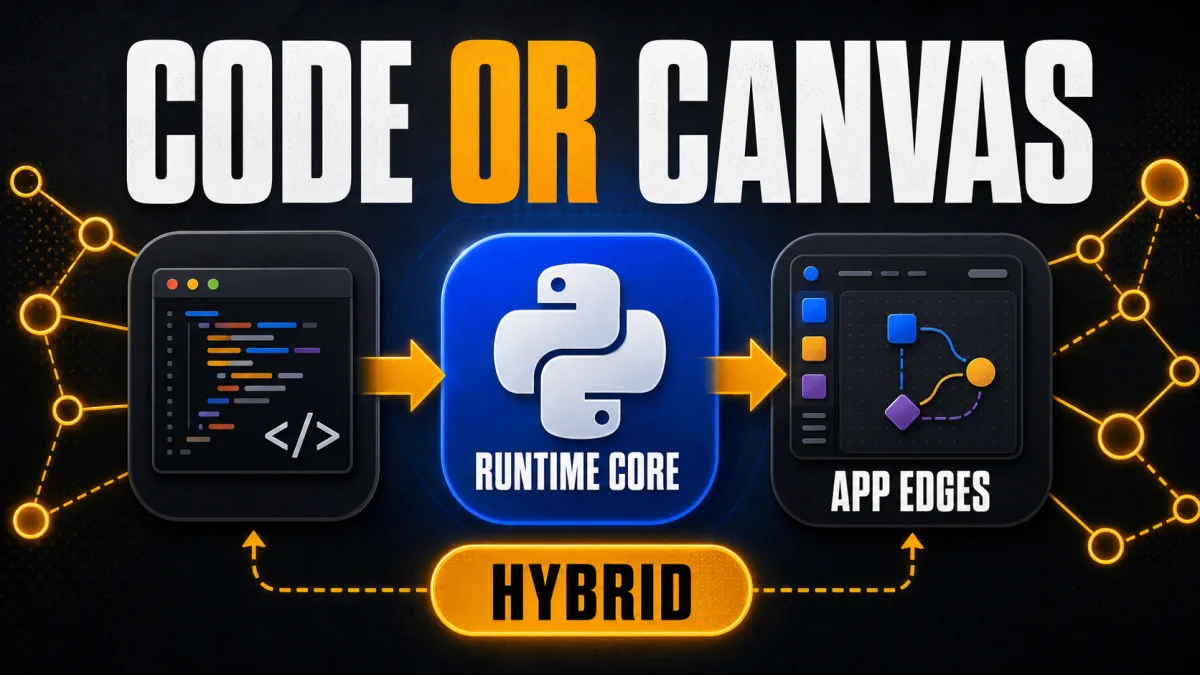
 By Alex
 AI Agents vs RPA: When to Use Which
RPA is best for stable rule-based workflows. AI agents are better for variable work with language, judgment, context and tool use.
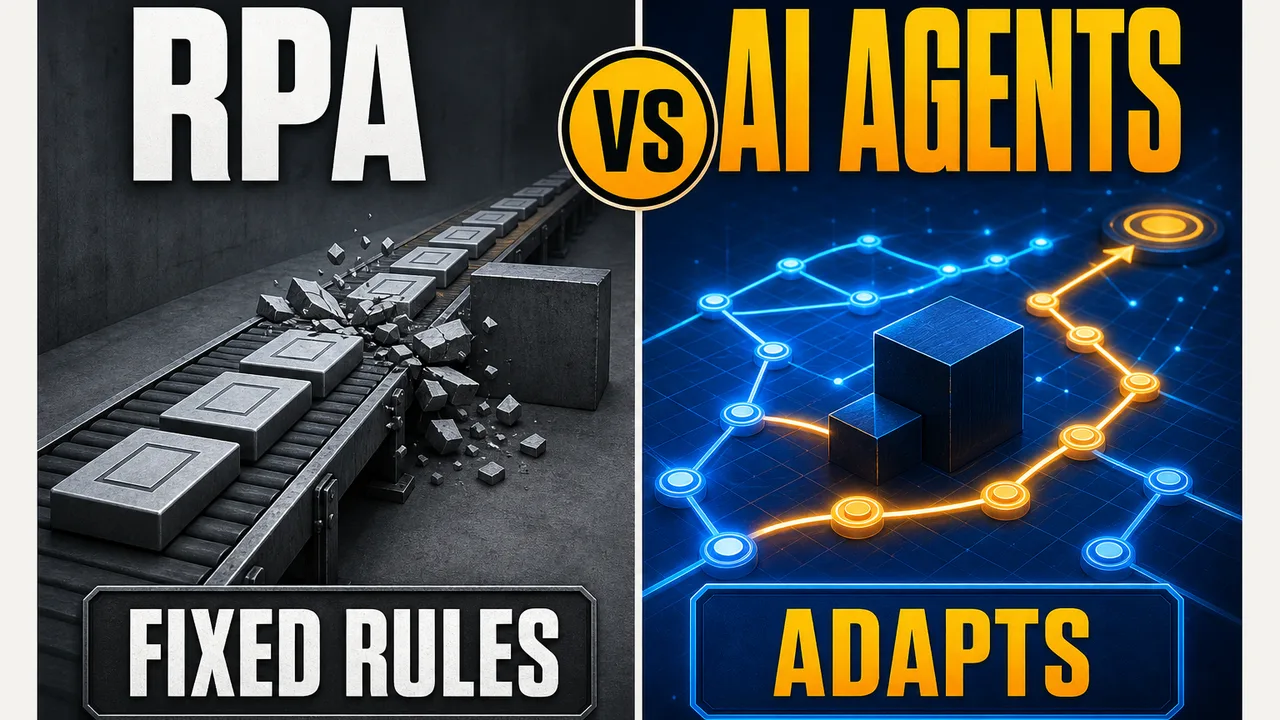
AI agents vs RPA is a workflow-fit decision, not a technology popularity contest. RPA is best when the process is stable and deterministic. AI agents are better when the work involves language, changing context, judgment, tool use or exception handling.
Definition: RPA automates fixed rules; AI agents automate goal-driven work that needs context, reasoning and controlled tool use.
Example: RPA can copy invoice data between two stable systems, while an AI agent can read an unusual vendor email, extract the issue, check records and decide whether to escalate.
Key takeaway: Use RPA for predictable steps, AI agents for variable decisions and a hybrid system when both patterns appear in the same workflow.
Business impact: Choosing the right automation type reduces brittle builds, avoids overengineering and keeps risk aligned with the workflow.
What is the practical difference between AI agents and RPA?
The practical difference is that RPA executes a predefined path, while an AI agent chooses the next step under constraints. RPA is useful when the input, system screens and rules stay consistent. An AI agent is useful when the workflow requires reading natural language, retrieving context, comparing options, drafting output or deciding which tool to call.
This distinction matters because the failure modes are different. RPA usually breaks when a screen changes or a rule no longer matches. AI agents usually fail when context is missing, instructions are vague, tools are too broad or the system lacks evaluation. The right choice depends on the shape of the work.
When should you use RPA?
Use RPA when the workflow is repetitive, stable, rules-based and easy to verify. Good RPA candidates include structured data entry, report downloads, invoice status checks, spreadsheet updates, form submissions and legacy-system tasks where APIs are unavailable. RPA is strongest when the process has few branches and a clear success condition.
RPA should not be treated as "old AI." RPA is deterministic automation. That determinism is valuable when a business needs the same action every time. A 2025 comparative study of LLM agents and RPA across enterprise workflows found traditional RPA stronger in speed and reliability for repetitive stable environments, while LLM-based agents were more flexible for dynamic interfaces.
When should you use AI agents?
Use AI agents when the workflow is variable and the input is messy. Strong AI-agent candidates include support triage, lead qualification, document exception handling, email classification, internal knowledge search and multi-system handoffs. These workflows often have a goal, but not a single fixed click path.
AI agents need more guardrails than RPA because an AI agent can reason and choose tools. The AI agent should have narrow permissions, clear escalation rules, logs, validation and evaluation data. For the underlying agent behavior, see What Is an AI Agent, and How Is It Different From a Chatbot?.
The Yowox Automation Fit Matrix
The Yowox Automation Fit Matrix compares two dimensions: process stability and input variability. Stable process plus structured input points toward RPA or simple workflow automation. Variable process plus unstructured input points toward AI agents. Mixed workflows usually need a hybrid architecture.
| Workflow shape | Better fit | Example |
|---|---|---|
| Stable process, structured input | RPA or API automation | Copy approved invoice fields |
| Stable process, unstructured input | AI extraction + RPA/API action | Read invoice PDF, post clean fields |
| Variable process, structured input | Rules engine + human review | Route edge-case account updates |
| Variable process, unstructured input | AI agent | Triage customer complaint |
Can AI agents and RPA work together?
AI agents and RPA often work best together because many workflows contain both judgment and repetition. The AI agent can read the messy input and decide the action. RPA can execute the stable downstream step. This hybrid model keeps reasoning where reasoning is useful and keeps deterministic execution where deterministic execution is safer.
For example, an AI agent can read a support message and decide that the customer needs a replacement order. RPA or an API workflow can then open the order system, fill a known form and record the action. The AI agent should not improvise the refund policy; the business rule should decide whether that action is allowed.
What does each option cost?
RPA cost is usually driven by licensing, bot maintenance, process changes and exception handling. AI agent cost is usually driven by model calls, orchestration, tool integrations, monitoring, evaluation and human review. The correct metric is cost per completed task, not monthly software price or token price alone.
A stable high-volume process may be cheaper with RPA because the bot performs the same action many times. A variable lower-volume workflow may be cheaper with an AI agent because the business avoids writing dozens of brittle rules. For estimating the business case, see How to Measure ROI of an AI Automation Project.
What should a business choose first?
A business should choose the simplest automation that can complete the workflow safely. If the process is fixed, use RPA or API automation. If the process requires language understanding or judgment, use an AI agent with human approval. If the process has both parts, split the workflow instead of forcing one technology to do everything.
The safest first project is usually a hybrid: AI for classification, extraction or drafting; deterministic automation for writes and updates; human review for risky steps. That design gives the business useful automation without pretending AI agents or RPA are universally better.
The right question is not "AI or RPA?" The right question is "which parts of this workflow are deterministic, and which parts need reasoning?"
Frequently asked questions
What is the difference between AI agents and RPA?
RPA follows predefined rules to repeat a stable process, often by moving data between screens or systems. AI agents work toward a goal by reading context, reasoning over messy inputs, choosing tools and escalating when needed. RPA is usually stronger when the workflow is predictable and deterministic. AI agents are usually stronger when the workflow involves language, judgment, changing inputs or several possible paths.
Is RPA obsolete because of AI agents?
RPA is not obsolete because many business workflows are still stable, rules-based and better served by deterministic automation. AI agents do not make every process smarter or safer. A payroll export, invoice status sync or repetitive data-entry step may need reliability more than reasoning. AI agents expand what can be automated, but RPA remains useful for predictable work and as a deterministic action layer inside a larger AI automation stack.
When should a business use an AI agent instead of RPA?
A business should use an AI agent instead of RPA when the task involves unstructured text, customer messages, documents, variable decisions, research, summarization or tool choice. AI agents fit workflows where the next step depends on context rather than a fixed rule. Examples include support triage, lead qualification, document exception handling, internal knowledge search and drafting a handoff after reading several systems.
Can AI agents and RPA work together?
AI agents and RPA can work together when the AI agent decides what should happen and RPA completes a predictable step. For example, an AI agent can classify a support ticket and decide that a refund workflow should start, while RPA or an API automation fills a fixed back-office form. This hybrid model is often safer than asking the AI agent to improvise every action.
Which is cheaper, AI agents or RPA?
Neither AI agents nor RPA is always cheaper. RPA can be cheaper for a stable high-volume process because the logic is fixed and execution is predictable. AI agents can be cheaper for variable work because they may reduce development time and manual review, but they add model, evaluation and monitoring costs. Compare cost per completed task, not tool license or model price alone.
Alex
Founder & Lead AI Writer
Alex is the founder of Yowox and lead AI writer since 2024, breaking down complex information into clear, actionable insights for thousands of readers every day. Alex has built AI automation systems for businesses since 2024, focusing on AI agents, workflow automation, and business process optimization.
Save hours. Save thousands.
Practical guides, real workflows, and the latest AI and automation news that matters — straight to your inbox.