 By Alex
 How to measure ROI of an AI automation project
A practical framework for measuring time saved, cost avoided, quality, throughput and risk before and after AI automation.
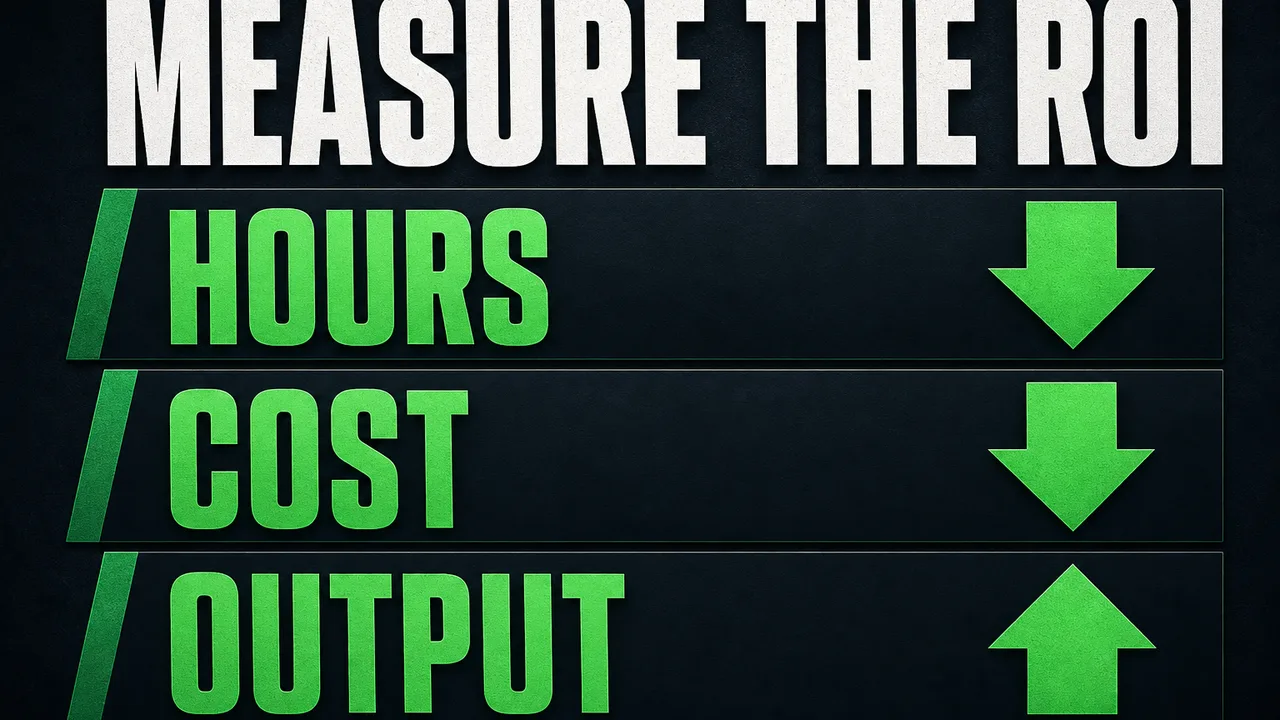
AI automation ROI is the measurable difference between the manual workflow and the automated workflow after build, run, review and maintenance costs are included. The business case should be built before the demo, because a demo can look impressive while saving little time in production. The same arithmetic is now being argued at industry scale, both as a scorecard of useful intelligence per dollar and as the enterprise AI compute gap.
Definition: AI automation ROI is the net value created when AI reduces manual work, errors, cycle time or missed opportunities in a measured workflow.
Example: If an AI agent saves six minutes on 1,000 monthly support tickets but adds one minute of review, the time-saving calculation should use five net minutes, not six gross minutes.
Key takeaway: Measure baseline, net time saved, quality, exceptions and total operating cost; do not count generated output as ROI.
Business impact: A good ROI model helps the business choose the workflow worth automating first and avoid expensive AI demos with weak economics.
What is the basic AI automation ROI formula?
The basic AI automation ROI formula is: baseline workflow cost minus automated workflow cost, divided by automation cost. In plain terms, compare what the process costs today with what the process costs after automation, including build, software, model calls, human review, monitoring and maintenance.
Use this simple monthly estimate before building:
| Metric | Formula |
|---|---|
| Manual cost | Task volume x manual minutes x loaded hourly rate |
| Review cost | Automated volume x review minutes x loaded hourly rate |
| Run cost | Model/API/software/infrastructure cost |
| Net monthly value | Manual cost avoided + measurable gains - review cost - run cost |
| Payback period | Build cost / net monthly value |
What baseline should you measure first?
Measure the current process before building the AI automation. The baseline should include task volume, average handling time, people involved, error rate, rework rate, escalation rate and cycle time. Without a baseline, every ROI number becomes a story instead of a measurement.
The baseline should be workflow-specific. A support workflow needs ticket types and response times. A document workflow needs documents per month and correction rate. A lead workflow needs research time and routing accuracy. For selecting which workflow deserves the first measurement pass, see 7 Business Workflows You Should Automate First.
How do you count time saved correctly?
Count net time saved, not gross time saved. If an AI agent drafts a reply in seconds but a human spends most of the original time checking and rewriting the answer, the actual time saved is small. The useful calculation is manual handling time minus review time minus exception handling time.
Time saved should also be tied to volume. Saving three minutes on a task that happens 30 times per month is not the same as saving three minutes on a task that happens 3,000 times per month. Volume turns small improvements into meaningful ROI.
What costs should be included?
AI automation cost should include discovery, build, integrations, model usage, software subscriptions, data cleanup, QA, human review, monitoring, maintenance and future changes. The model bill is rarely the whole cost. The expensive part is often connecting systems, defining edge cases and keeping the workflow reliable when business rules change.
Include failure costs too. If the AI automation creates wrong CRM notes, routes good leads away from sales or sends inaccurate support replies, the cost is not just rework. The cost can include lost trust, customer frustration and missed revenue. That is why quality metrics belong in the ROI model.
Which quality metrics matter?
Quality metrics matter when automation changes the consistency or outcome of a workflow. For support, track first-response time, resolution time, reopen rate and customer satisfaction. For lead qualification, track sales acceptance, false rejection and meeting conversion. For document processing, track extraction pass rate, validation failures and downstream corrections.
Quality gains can be real ROI, but they need a baseline. "Better quality" should mean fewer errors, fewer missed follow-ups, more complete records, faster cycle time or higher acceptance by the team that receives the output. If the metric cannot be checked, keep it out of the financial case.
How should exceptions be measured?
Exceptions should be measured as their own cost center. Every AI automation project has cases the system cannot complete: missing data, low confidence, policy exceptions, API errors or human approval required. A high exception rate can erase ROI even when the easy cases are automated.
Track exception volume, reason, review time and final outcome. Exceptions are also the roadmap. If the same exception repeats often and has a safe rule, automate it next. If the exception is rare or risky, keep human review and do not force autonomy where it does not pay back.
What dashboard should a pilot have?
A pilot dashboard should show baseline volume, automated volume, completion rate, review rate, exception rate, average handling time, net minutes saved, cost per completed task and quality outcome. The dashboard should be boring enough that a business owner can understand it in five minutes.
The pilot should run on real work for two to four weeks when volume allows. One demo can prove feasibility. A pilot proves economics. The business should decide the next build step from measured workflow data, not from how impressive the prototype felt in a meeting.
How do you decide whether to continue?
Continue an AI automation project when the workflow shows net time saved, acceptable quality, manageable exceptions and a clear path to expansion. Stop or redesign the project when review time is too high, data access is poor, the process is not stable or the team does not trust the output.
The best ROI decision may be "not yet." A workflow with poor documentation or messy data may need process cleanup before automation. A smaller adjacent workflow may deliver value sooner. Good ROI measurement protects the business from scaling the wrong AI system.
A good automation project has a dashboard before it has a demo.
Frequently asked questions
How do you calculate AI automation ROI?
Calculate AI automation ROI by comparing the baseline cost of the manual workflow with the total cost of the automated workflow. Start with task volume multiplied by manual minutes per task and loaded hourly cost. Then subtract build cost, model cost, software cost, human review time, maintenance and monitoring. Add measurable gains such as faster response, fewer errors or higher throughput only when the business can track them before and after launch.
What metrics should an AI automation project track?
An AI automation project should track task volume, manual time saved, review time, completion rate, error rate, exception rate, escalation rate, cost per completed task, cycle time and user acceptance. The exact metric depends on the workflow. Support automation should track first-response time and resolution quality. Lead automation should track routing accuracy and sales acceptance. Document automation should track extraction pass rate and downstream correction rate.
Why do AI automation ROI estimates become inflated?
AI automation ROI estimates become inflated when teams count gross time saved but ignore review time, exception handling, build cost, maintenance, model cost, failed runs and quality corrections. A draft that saves ten minutes but needs eight minutes of editing saves only two minutes. A tool that automates easy cases but creates manual cleanup elsewhere may not be profitable. Always measure cost per completed task, not impressive demo output.
How long should you measure an AI automation pilot?
Measure an AI automation pilot long enough to include normal variation in the workflow. For many operational workflows, two to four weeks is enough to see volume, exception patterns, review time and early quality issues. High-volume workflows may show signal faster, while low-volume workflows need more time. Do not judge ROI from one demo day. Use real work, real users and the same metrics collected before launch.
Can AI automation ROI include quality improvements?
AI automation ROI can include quality improvements when they are measured. Quality gains might include fewer missed follow-ups, fewer routing errors, more complete CRM notes, faster responses or more consistent document validation. These improvements can matter as much as labor savings, but they should not be hand-waved. Define the quality metric before launch and compare it against a baseline after the automation is running.
Alex
Founder & Lead AI Writer
Alex is the founder of Yowox and lead AI writer since 2024, breaking down complex information into clear, actionable insights for thousands of readers every day. Alex has built AI automation systems for businesses since 2024, focusing on AI agents, workflow automation, and business process optimization.
Save hours. Save thousands.
Practical guides, real workflows, and the latest AI and automation news that matters — straight to your inbox.