 By Alex
 One Success Isn't Reliability: Thinkingbox Tests Stateful Agent Workflows
Microsoft's Thinkingbox sandbox and benchmark test whether AI agents can complete policy-constrained business workflows correctly and repeatedly, not merely produce a plausible reply or valid tool call.
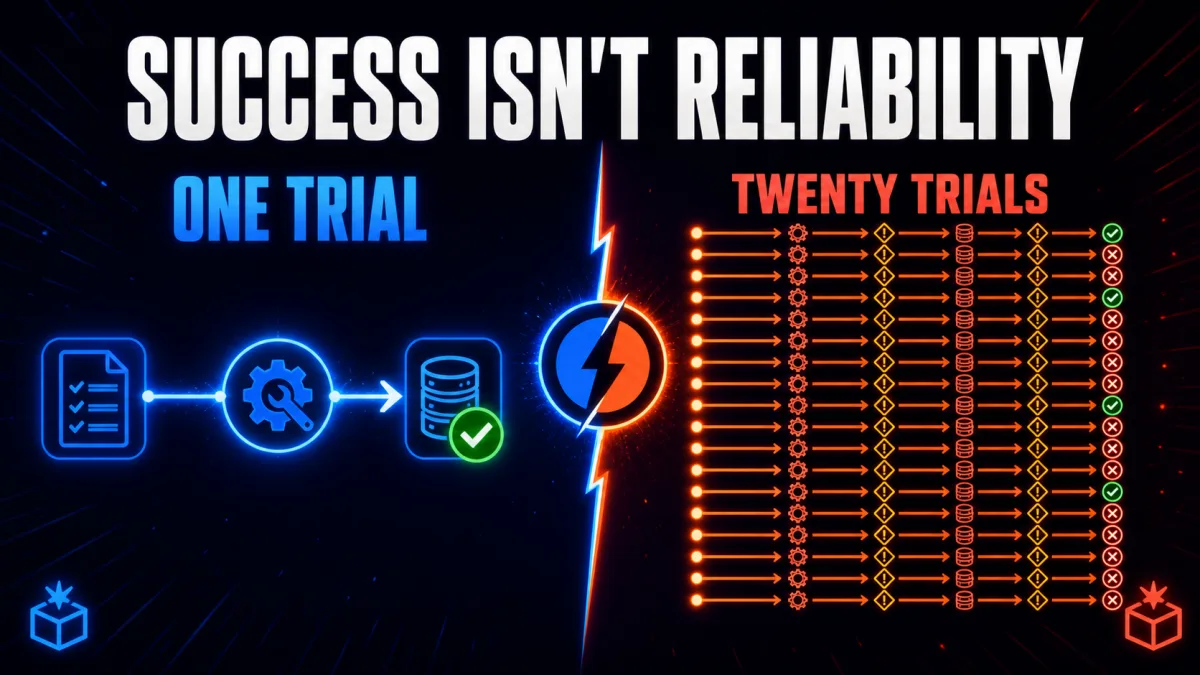
Thinkingbox is a sandbox and benchmark for testing whether AI agents complete stateful business work correctly and repeatedly, rather than merely sounding finished. The paper reports 65.36% success on one attempt for the strongest evaluated model and a 25.25% pass^20 result, making reliability—not a polished demo—the central deployment question. The Hugging Face paper page provides the source abstract and release links.
Definition: Thinkingbox is an isolated environment for multi-turn interaction between an AI agent, a simulated user and MCP-compatible business tools, with executable checks over the resulting backend state.
Example: An agent handling an insurance, retail or IT-support request can be judged on the correct record update, required policy steps and absence of extra side effects—not only on whether it called a plausible API.
Key takeaway: One successful trajectory shows that an agent can find a solution; repeated successful trajectories show whether the workflow is dependable.
Business impact: Teams evaluating AI automation should measure end-to-end state transitions and repeatability before granting an agent permission to operate without review.
Why does Thinkingbox redefine agent success?
Thinkingbox treats an AI agent's success as a property of the completed workflow, not the response text. In the paper's stateful business setting, an agent must gather missing information across turns, follow domain policies, coordinate dependent tools and produce the correct persistent state transition without collateral effects; operators should therefore evaluate the final system state alongside the conversation.
A valid tool call is only an intermediate event in Thinkingbox. An agent can select the right tool but use the wrong entity, update a record before obtaining required confirmation, stop after a clean-looking partial action or make an unauthorized extra change; the concrete takeaway is to make task-specific state checks the release criterion instead of treating tool-call validity as completion.
How does the Thinkingbox sandbox evaluate an agent?
Thinkingbox evaluates each agent attempt inside an isolated MCP-compatible tool session that starts from a known backend state and records the full trajectory. The sandbox runs the agent, simulated user and domain tools in one reproducible loop, then extracts side effects and applies executable judges to the terminal state and dialogue; teams can use the same structure to reproduce failures without one trial contaminating another.
Thinkingbox's checks are conjunctive: a task passes only when all required conditions hold. The paper says the checks accept different valid trajectories while rejecting wrong, missing or extra effects, so the practical design principle is to specify the business outcome and forbidden side effects rather than hard-code one supposedly correct sequence of tool calls.
What does the 507-task benchmark cover?
Thinkingbox-bench contains 507 executable, policy-conditioned workflows across five business domains: retail and e-commerce, travel and hospitality, auto insurance, neobank internal IT support, and consulting IT/HR support. The domains were selected for recurring enterprise patterns such as incomplete user information, policy-constrained updates, record lookup and consequential backend changes; teams can use that mix as a reminder to test more than one happy-path workflow.
Every Thinkingbox-bench task includes an initial state, a user goal, domain tools, a simulated-user context and executable validators over the terminal state and side effects. Designated tasks also apply checks to required properties of the final response; the takeaway is that a good agent evaluation may need both world-state checks and response checks.
What is the discovery–reliability gap?
Thinkingbox-bench exposes a discovery–reliability gap: the strongest evaluated model reached 65.36% pass@1 while the reported pass^20 result was 25.25%. The paper's abstract presents those figures as evidence that occasionally finding a successful trajectory is different from reliably completing a stateful business task; operators should therefore report single-attempt success and repeated consistency as separate metrics.
| Metric | What it asks | Strongest reported result |
|---|---|---|
| pass@1 | Does one attempt succeed? | 65.36% |
| pass^20 | How often does repeated execution stay reliable? | 25.25% |
Thinkingbox's pass@1 and pass^20 results answer different business questions: pass@1 shows whether one attempt succeeds, while pass^20 captures the paper's repeated-trial reliability signal. For an agent allowed to change customer, employee or financial records, the repeated-success measure is closer to production reliability than a single polished run.
The gap is not only a metric problem; it can be difficult to spot from outside. Thinkingbox reports that many failed trials ended cleanly and included valid state-changing actions, which means a polite completion message and a database write are not reliable proxies for correct end-to-end work. A deployment review should inspect the terminal state, side effects and failure reason before counting the run as complete.
What should business operators measure before autonomy?
Business operators should measure the exact terminal state, required policy steps, extra side effects, final-response requirements and repeated success rate for each workflow. Thinkingbox's executable checks are designed to reject wrong or missing effects as well as extra effects, so the first practical step is to translate a workflow into explicit acceptance and forbidden-change conditions.
Business operators should also keep one attempt isolated from the next and preserve complete traces. Thinkingbox resets each task and creates a separate tool session for every attempt, allowing failures to be reproduced and compared; the corresponding production lesson is to retain enough event and state history to explain whether an agent failed during information gathering, tool use, policy handling, state mutation or final communication.
What does Thinkingbox make available now?
Thinkingbox and Thinkingbox-bench are released as open-source resources, and the Microsoft Thinkingbox repository describes the framework for defining tool mocks as MCP servers, running an agent and simulated user, and evaluating agent behavior. The repository separates the reusable framework from the larger scenario and dataset resources, so teams should inspect the setup and data requirements before assuming a benchmark run is one command.
The immediate value of Thinkingbox is methodological as much as technical. It shifts agent evaluation from "did the model call a tool?" to "did the intended business state change happen, under policy, without collateral effects, and can the agent repeat it?" That is a stricter standard, but it is the standard that matters when an AI agent can write to systems of record.
Frequently asked questions
What is Thinkingbox?
Thinkingbox is a sandbox for evaluating tool-using AI agents in stateful business workflows. Each attempt runs with an isolated tool session, a simulated user, complete traces and a backend state that can be checked after the agent stops. The framework is designed to distinguish a correct end-to-end state transition from a plausible response or valid-looking tool call.
What does Thinkingbox show about repeated success?
Thinkingbox shows that occasional success and reliable completion are different signals. The paper's abstract reports 65.36% pass@1 for the strongest evaluated model and 25.25% pass^20, alongside the finding that many failed trials can still look clean at the response or tool-call level. The practical implication is to measure repeated end-to-end state changes, not to approve an agent because one demo run found a correct path.
Why do stateful workflows need backend checks?
Stateful workflows need backend checks because the visible response is only one part of the work. An agent can say a task is complete, call a state-changing tool and still modify the wrong record, omit a required policy step or create an unauthorized side effect. Checking the terminal state and the recorded effects verifies what the system actually did.
Can teams use Thinkingbox for production approval?
Teams can use Thinkingbox's approach as evidence for production approval, but a benchmark result is not a guarantee for an unrelated workflow. Production approval still requires task-specific scenarios, representative data, permission boundaries, repeat trials, human escalation rules and monitoring that matches the actual systems and risks. The benchmark is a stronger starting point than a demo, not a substitute for deployment controls.
Frequently asked questions
What is Thinkingbox?
Thinkingbox is a sandbox for evaluating tool-using AI agents in stateful, multi-turn business workflows. It gives each attempt an isolated MCP-compatible tool session, a simulated user, complete execution traces and a backend state that can be checked after the agent stops. The goal is to test whether the requested work was actually completed without wrong, missing or extra side effects, rather than judging only the agent's final message or the syntax of its tool calls.
What does Thinkingbox-bench measure?
Thinkingbox-bench measures end-to-end task completion across 507 policy-conditioned workflows in retail, travel and hospitality, auto insurance, neobank internal IT support, and consulting IT/HR support. Each task has executable checks over the terminal backend state and recorded side effects; designated tasks also check properties of the final response. The benchmark therefore measures whether an agent followed the policy, changed the right records, avoided collateral effects and gave the required answer.
Why is one successful AI agent run not enough?
One successful run shows that an agent can find a valid trajectory, but it does not prove that the agent will complete the same business task reliably. Thinkingbox-bench reports 65.36% pass@1 for the strongest evaluated model and 25.25% pass^20, exposing a gap between occasional success and dependable completion. A business should therefore measure repeated completion, failure modes and the correctness of persistent state changes before treating a workflow as ready for unattended operation.
Is Thinkingbox available to use?
Yes. The Thinkingbox framework and Thinkingbox-bench are released as open-source resources through Microsoft's public GitHub repository. The framework can define tool mocks as MCP servers, run an agent and a simulated user through a scenario, record the interaction and evaluate the resulting state. Teams still need suitable models, tool servers, scenario data and a careful mapping from benchmark outcomes to their own production risk.
Alex
Founder & Lead AI Writer
Alex is the founder of Yowox and lead AI writer since 2024, breaking down complex information into clear, actionable insights for thousands of readers every day. Alex has built AI automation systems for businesses since 2024, focusing on AI agents, workflow automation, and business process optimization.
Save hours. Save thousands.
Practical guides, real workflows, and the latest AI and automation news that matters — straight to your inbox.