 By Alex
 Gradio AI Workflows: From Visual Graph to Deployable App
Hugging Face shows how gr.Workflow turns AI pipelines into visual, inspectable apps with REST endpoints and one-command deployment to Spaces.
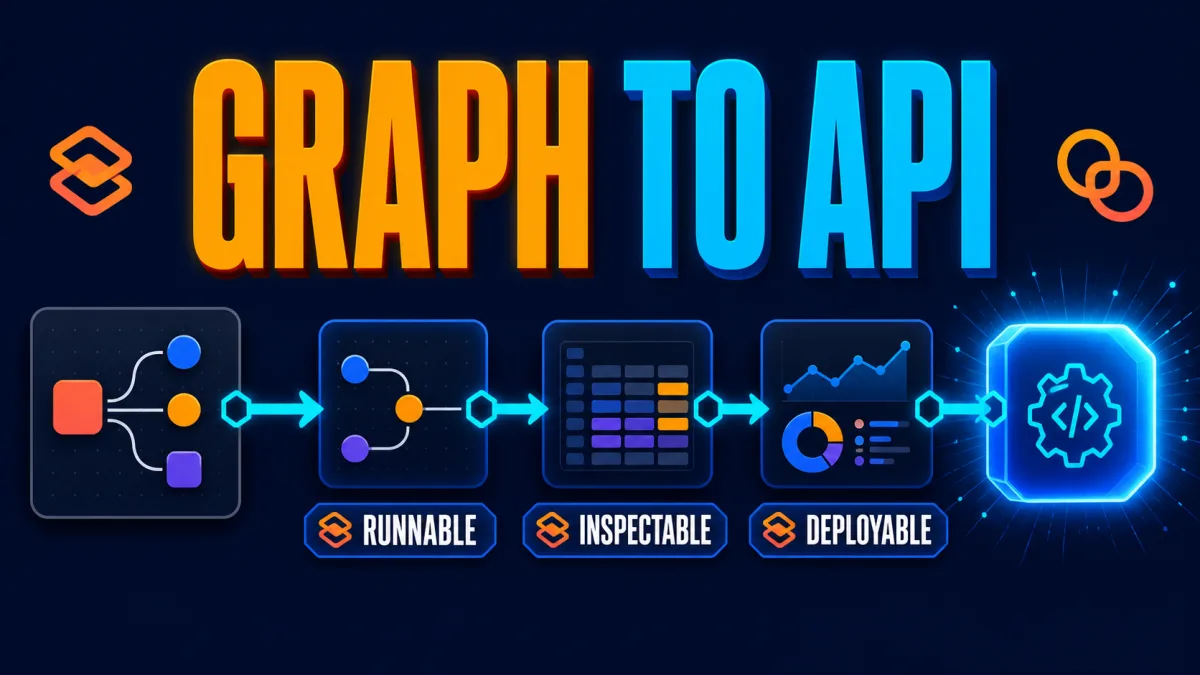
An AI pipeline becomes easier to operate when the steps are visible, runnable, and reusable. Hugging Face's new gr.Workflow announcement shows Gradio moving that idea into the interface itself: a typed graph of inputs, operators, and outputs that people can run on a canvas, inspect between steps, call through REST, and deploy to Spaces.
Definition:
gr.Workflowis a Gradio-native, node-based builder for connecting Python functions, models, Gradio Spaces, and datasets into an executable AI pipeline.Example: One workflow can generate an image with FLUX, send it to a background-removal Space, and expose the resulting sticker pipeline as an API endpoint.
Key takeaway: The graph is not only a diagram; every connected node can run and expose its intermediate result.
Business impact: Operators can prototype and debug a multi-step AI process in the same surface that users and applications later call.
What changed in Gradio workflows?
gr.Workflow turns an AI pipeline into a visual application rather than leaving the pipeline as a chain of hidden Python calls. The announcement's examples describe a drag-and-drop canvas where each node is runnable and every intermediate result is visible, while the same graph can serve as a REST API and deploy to Spaces. For an operator, the practical move is to use the canvas to inspect the handoffs before treating the pipeline as a dependable business process.
gr.Workflow matters because a multi-step AI workflow has more than one place to fail: a model can return an unexpected value, a downstream Space can reject an input, or a later transformation can hide the original problem. The Hugging Face announcement makes intermediate values part of the interface, so a team can trace the stage that needs attention instead of debugging only the final output. This is a more inspectable version of the multi-step systems described in what an AI agent does, even though a workflow graph and an autonomous agent are not the same thing. The practical takeaway is to inspect each handoff before treating the graph as a dependable business process.
Which AI workflow patterns does Gradio demonstrate?
The announcement uses several concrete patterns to show where gr.Workflow fits. An image editor puts a user image and an edit instruction through a single Qwen-Image-Edit node; an AI media studio chains FLUX, a background-removal Gradio Space, MeloTTS, and an LLM into multiple outputs; and a generative art lab fans one idea out into several image variations plus an LLM-written gallery title. These examples give operators a useful test: start with a pipeline whose inputs and outputs can be named clearly, then decide whether the graph's visibility improves iteration.
gr.Workflow also supports parallel analysis when one input should produce several independent results. The Data Detective example fans out a dataset ID to an overview card, row preview, per-column statistics, and a distribution chart through the Datasets Server API. The generative-art example uses the same fan-out idea for images. In practice, parallel branches are most useful when each output answers a separate question and can be checked independently; otherwise, the graph can become visual complexity without adding operational clarity.
A third pattern keeps the model close to the application instead of calling an external provider. The announcement shows an fn node decorated with @spaces.GPU to run a Lightricks LTX-Video model inside a hosted Space through ZeroGPU. The gr.Workflow graph does not need to understand the Space's GPU setup; it invokes the bound function. That gives an operator a clear boundary to test: compare a provider-backed node, a Space-backed node, and an in-Space GPU function before choosing where each stage should execute.
How does the workflow graph work?
A gr.Workflow graph has three node roles: references are inputs, operators do the work, and subjects are outputs. The guide says operators can be a custom Python function, a model on Inference Providers, another Gradio Space, or a row from a Hub dataset. The immediate implementation task is to connect compatible typed ports, run the graph, and inspect each result in place rather than treating the pipeline as an opaque function.
The graph can also be created directly from Python, which keeps the workflow versionable. The source's minimal example binds a function to a workflow and launches it:
import gradio as gr

def your_function(text: str) -> str:
    return text.strip()

gr.Workflow(bind=[your_function]).launch()
The official Gradio workflow guide adds the other side of the model: a workflow can be edited on the canvas, saved as workflow.json, loaded from that JSON file, and extended with edges and typed ports in code. For a team, that creates a useful division of labor: a developer can review the graph as code, while an operator can reason about the same graph visually.
Can one Gradio workflow expose multiple APIs?
A Gradio workflow can expose connected pipelines through standard Gradio API access, with endpoint names derived from output labels. The announcement demonstrates separate endpoints such as /sticker, /voiceover, and /episode_title for different outputs of one media workflow, while the Gradio guide explains how to inspect the exact API with client.view_api(). The operational takeaway is to name output subjects for the action an application needs, because the labels influence how downstream callers discover the interface.
The Python client can then call a workflow without opening its canvas. The source shows a no-token example using Client.predict() and a token-bearing example for a model or Space that requires provider authentication:
from gradio_client import Client

client = Client("ysharma/gr-workflow-multi-endpoint-API")
result = client.predict("hello there friend", api_name="/word_count")
print(result)
A plain HTTP client is also possible: the announcement shows a curl request to a /gradio_api/call/<endpoint> route with JSON input. That means a workflow can start as a human-inspected canvas and later become a callable service, but the owner still needs to verify tokens, endpoint inputs, and error behavior before wiring it into a critical process.
What does deployment to Spaces involve?
A gr.Workflow app is a standard Gradio app, so the workflow can be deployed to Spaces like other Gradio applications. The Gradio guide documents the gradio deploy command and explains that Spaces OAuth determines who can authenticate to edit and save a deployed workflow; other visitors receive a read-only canvas and can run the pipeline with the permitted identity or token. The deployment checklist is therefore simple but concrete: confirm the Space SDK, confirm authentication, and test both edit and run permissions before sharing the URL.
For business operators, gr.Workflow deployment is more important than the novelty of the canvas. A workflow that can be launched in Spaces still needs a narrow purpose, a known owner, a credential policy, and a fallback for unavailable nodes. The same discipline used when choosing business workflows to automate first applies here: start with a repeatable process, make its baseline measurable, and keep high-cost or high-risk actions behind review until the graph has earned trust.
Why does this matter for AI automation teams?
gr.Workflow lowers the distance between a prototype and an inspectable service. The source's examples combine hosted models, Inference Providers, other Spaces, dataset APIs, and Python functions in one graph, while the API and deployment paths reuse the same workflow. That combination makes Gradio relevant to teams designing an AI automation stack, especially when the team needs to see where a result came from before it decides which steps deserve stronger monitoring or production infrastructure.
The important caveat is that visibility is not the same as reliability. A canvas can show an intermediate result, but it cannot by itself validate a model's output, guarantee a provider's uptime, or decide whether a business action is safe. The sensible next step is to build one small graph, name every output, test representative failures, and measure whether the visible workflow actually shortens debugging and review. That is the durable value in this announcement: not a promise that every AI pipeline is production-ready, but a clearer way to wire, run, inspect, and deploy one.
Frequently asked questions
What is gr.Workflow in Gradio?
gr.Workflow is a visual, node-based pipeline builder built into Gradio. It lets a developer connect inputs, operators, and outputs on a drag-and-drop canvas, then run each node while viewing intermediate results. The operators can be custom functions, models called through Inference Providers, other Gradio Spaces, or rows from a Hub dataset. The practical value is that the same graph is both an interface for people and an API for code, so a team can inspect a workflow before deciding how to productionize it.
Can a Gradio workflow be used as an API?
Yes. Gradio's workflow guide says that each connected pipeline with output nodes becomes available through the standard Gradio REST API. Endpoint names are derived from output labels, and the Gradio client can call them with client.predict(). A workflow with a model or Space dependency may also need a provider token. This lets an operator test a workflow visually, then call the same outputs from an application or another workflow without building a separate API layer first.
How does gr.Workflow reach production?
A Workflow app is a standard Gradio app and can be deployed to Spaces with the normal Space workflow. The official guide also documents a gradio deploy command and explains that Spaces OAuth controls who can edit and save a deployed workflow. Visitors can still run a read-only canvas, while write access remains tied to the owner or an organization member with the required permissions. Teams should therefore test credentials and editing permissions as part of deployment, not after launch.
What should a business test before adopting a Gradio workflow?
Test the workflow's inputs, intermediate outputs, endpoint behavior, authentication, and failure handling on representative cases before making it a business dependency. The announcement's examples show that one graph can combine model calls, Gradio Spaces, datasets, and Python functions, which is useful but also creates several points to monitor. Start with one narrow process, keep the stages visible, and define what happens when a model, Space, token, or downstream API is unavailable. The visual canvas makes those checks easier; it does not replace them.
Alex
Founder & Lead AI Writer
Alex is the founder of Yowox and lead AI writer since 2024, breaking down complex information into clear, actionable insights for thousands of readers every day. Alex has built AI automation systems for businesses since 2024, focusing on AI agents, workflow automation, and business process optimization.
Save hours. Save thousands.
Practical guides, real workflows, and the latest AI and automation news that matters — straight to your inbox.