 By Alex
 Meta’s Hatch Signals a New Consumer AI Push
Meta is reportedly preparing Hatch, a consumer AI agent platform inspired by OpenClaw, while targeting October for its next model, Watermelon.
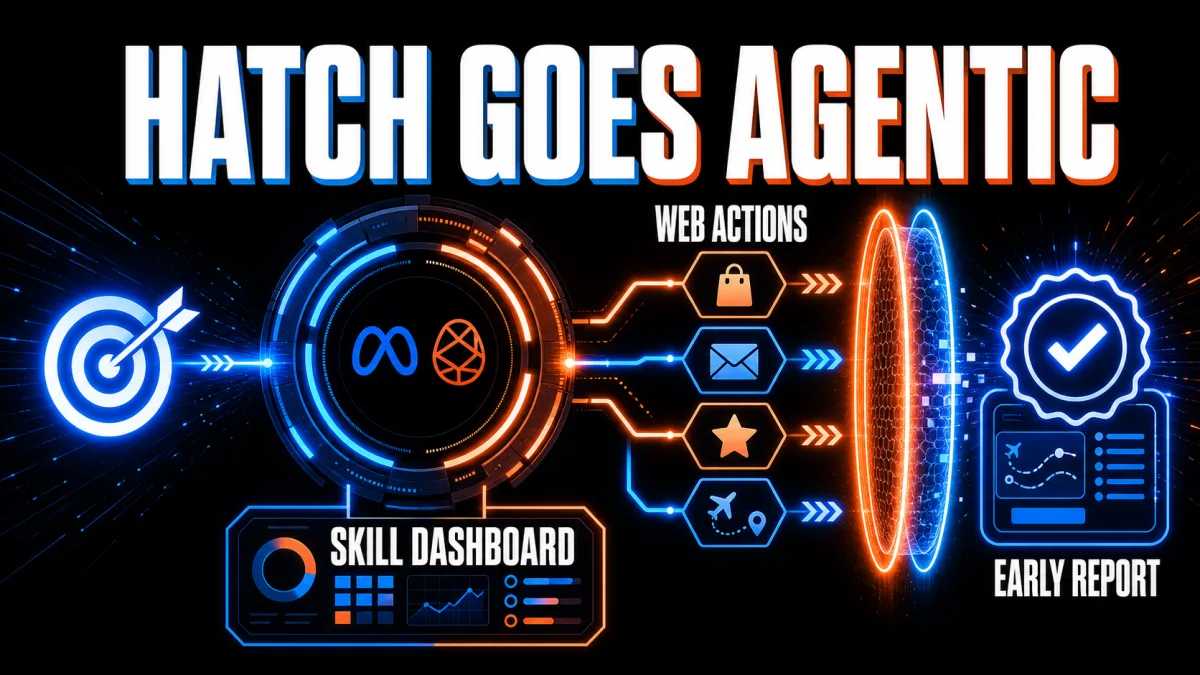
Meta is reportedly preparing Hatch, a consumer AI agent platform, for release in the coming weeks. The Information reports that the platform is inspired by OpenClaw, while Meta is also targeting October for a new model codenamed Watermelon. The timing matters for operators tracking the shift from chat assistants to software that can act across services, but the report is based on internal documents rather than a public launch announcement.
Definition: Meta Hatch is a reported consumer AI agent platform designed to move Meta’s AI products toward multi-step work across external services.
Example: Secondary reporting describes Hatch as an OpenClaw-inspired system that could interact with services such as DoorDash, Etsy, Reddit, Yelp, and Microsoft Outlook.
Key takeaway: Hatch appears close to an initial release, but its final access, capabilities, and pricing are still unconfirmed.
Business impact: Teams should watch for real documentation and testable access before treating Hatch as a dependable automation platform.
What is Meta’s Hatch platform?
Meta Hatch is described as a consumer-facing AI agent platform rather than another text-only assistant. Investing.com’s report says Meta plans to release Hatch within several weeks and characterizes it as the consumer version of Meta’s OpenClaw AI agent. For a business operator, the useful distinction is the intended unit of value: an agent should complete a task across connected systems, while a chatbot mainly returns an answer. That is the same practical difference explained in our AI agent guide.
The reported platform is therefore important even before its feature list is final. If Hatch can reliably interpret a goal, use approved services, and return a completed result, it would put Meta closer to the agent products now competing for consumer workflows. If it only coordinates narrow actions or requires heavy supervision, its value will be closer to an assistant with integrations. The first public product limits will decide which description is accurate.
Why does OpenClaw matter for Hatch?
OpenClaw is the comparison that gives the Hatch report its clearest product signal: Meta is reportedly adapting an agent pattern built around action, not just conversation. The available coverage calls Hatch OpenClaw-inspired or a consumer version of OpenClaw, but it does not establish that Meta copied OpenClaw’s implementation or will expose the same permissions. Operators should use the comparison to form a test plan, not to assume feature parity.
A useful test plan would ask whether Hatch can complete one narrow workflow end to end, what approvals it requests, how it handles a failed external action, and what audit trail it leaves. Those questions matter because an AI agent’s practical difference from a chatbot is the ability to use tools and verify work, not the label attached to the interface.
Which services could Meta Hatch use?
Meta Hatch is reported to be designed to interact with external web services, with coverage naming DoorDash, Etsy, Reddit, Yelp, and Microsoft Outlook. TradingView’s summary also describes prototype ideas such as a customizable dashboard for skills including fitness tracking and travel planning. These details come from internal documents, so they should be read as reported plans rather than a committed public feature list.
For operators, the important question is not how many integrations appear in a launch story; it is whether the agent can act safely inside each one. A useful evaluation should measure successful task completion, permission boundaries, recovery from errors, and the amount of human review required. Hatch would be materially different from a general chat feature only if those controls work consistently on real tasks.
How could Hatch change Meta’s AI business?
Meta Hatch would give Meta a direct consumer AI product to monetize alongside its advertising business, according to the reporting. The reported pricing discussion includes a tiered structure and a premium option as high as $199.99 per month for higher usage limits. That figure is not a confirmed price, but it shows the scale of the subscription model Meta has reportedly considered.
The commercial test is straightforward: a paid agent must complete enough valuable work to justify its subscription and the risk of supervising it. Businesses evaluating Hatch should compare the final plan against the number of reliable task completions, connected services, usage caps, data controls, and review time. Meta’s earlier reporting about slower-than-expected agent progress is a useful reminder to judge actual agent releases rather than internal momentum.
What does Watermelon add to the story?
Meta is also targeting October for Watermelon, a new AI model named in the same reporting. Investing.com and TradingView both describe Watermelon as a separate upcoming model target, but the available reports do not confirm whether it will power Hatch or arrive as a standalone system. That distinction matters because an agent platform and a frontier model solve different product problems: one packages actions and permissions for users, while the other supplies the underlying reasoning capability.
Teams should wait for a public release, model documentation, and reproducible evaluations before treating Watermelon as production-ready. Meta’s model roadmap may affect Hatch’s quality, but a stronger model alone does not guarantee reliable web actions, safe permissions, or useful workflow economics.
What remains unconfirmed about Meta Hatch?
The core news is a reported launch plan, not a completed release. The available reporting does not settle Hatch’s exact launch date, supported regions, final integrations, pricing, model choice, or safety controls. Meta also has not publicly validated the internal documents described by the reports. The next meaningful evidence will be a product announcement, a limited trial that outside users can inspect, or documentation showing what Hatch can actually do.
Until that evidence arrives, businesses should keep Hatch on a watchlist and continue evaluating agents against narrow, measurable workflows. A platform earns a place in production through dependable tool use, clear permissions, recoverable errors, and acceptable cost—not through a promising codename or a reported launch window.
Frequently asked questions
What is Meta’s Hatch platform?
Hatch is Meta’s reported consumer AI agent platform. The Information says Meta aims to release it within weeks, and follow-up reporting describes it as an OpenClaw-inspired system intended to work across external services. The reporting is based on internal documents rather than a public product announcement, so the final feature set, availability, and launch date are not confirmed. Readers should treat Hatch as a planned platform until Meta publishes product details or opens access.
When could Meta Hatch launch?
The Information reports that Meta is targeting a launch in the coming weeks. Secondary coverage narrows that window to late August or early September 2026, but neither date is confirmed by Meta. The practical answer is that Hatch appears to be near a limited or initial release, not necessarily a broad global rollout. Businesses watching the platform should wait for an official announcement, access terms, and documentation before planning around a specific date.
Is Meta Hatch based on OpenClaw?
Yes, available reporting describes Hatch as Meta’s consumer version of, or an OpenClaw-inspired platform. That comparison points to an AI agent that can move beyond chat and interact with external services. It does not prove that Hatch will share OpenClaw’s exact architecture, permissions, or user experience. Those implementation details remain unconfirmed until Meta releases technical information or lets outside users test the product.
Will Meta Hatch cost $199.99 per month?
Not necessarily. Reporting says Meta has considered a tiered subscription structure with a premium tier priced as high as $199.99 per month for higher usage limits. That is a reported pricing option, not a final price list. Businesses should compare the eventual cost with the number of tasks Hatch can complete reliably, the services it can access, its usage limits, and the human review it still requires. A high subscription price would only make sense if the delivered work replaces enough manual effort.
What is Meta’s Watermelon model?
Watermelon is the reported codename for Meta’s next AI model, which the company is targeting for an October release. The available reporting does not establish whether Watermelon will power Hatch, replace an existing model, or ship as a separate product. It also does not provide public benchmark methodology or an API. Teams should therefore treat Watermelon as a future signal about Meta’s model roadmap, not as a model they can evaluate in production today.
Alex
Founder & Lead AI Writer
Alex is the founder of Yowox and lead AI writer since 2024, breaking down complex information into clear, actionable insights for thousands of readers every day. Alex has built AI automation systems for businesses since 2024, focusing on AI agents, workflow automation, and business process optimization.
Save hours. Save thousands.
Practical guides, real workflows, and the latest AI and automation news that matters — straight to your inbox.