 By Alex
 AI agent reliability shifts from prompts to schemas
A new Towards AI article argues that reliable AI agents need typed tool calls, structured outputs and explicit error handling rather than prompt-only control.
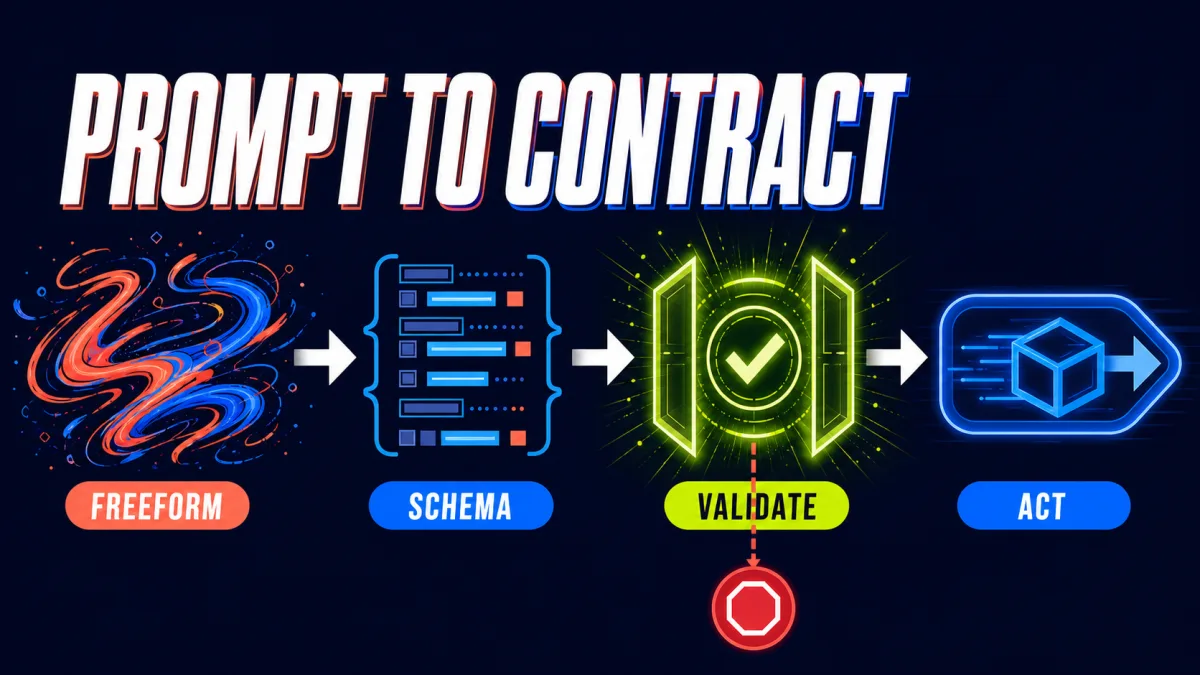
AI agent reliability is moving from prompt craftsmanship toward explicit software contracts. A new Towards AI article on tool calling and structured output argues that production AI agents need predefined tools, validated outputs and deliberate error handling instead of relying on free-form reasoning alone. The practical takeaway is to make the model's boundary with business software typed, testable and observable before expanding autonomy; that boundary is one layer in the broader AI automation stack.
Definition: Tool calling lets an AI agent select a predefined function and provide arguments for it instead of describing an action in plain text.
Example: A support agent can return a validated
lookup_ordercall with an order ID and a bounded action, rather than inventing an API request in prose.Key takeaway: Schemas reduce ambiguity at the model-to-software boundary, but they do not replace authorization, testing or human escalation.
Business impact: Fewer malformed calls mean fewer avoidable retries and a clearer path to measuring whether an AI agent actually completes work.
Prompt-only AI agents: why they fail in production
Prompt-only AI agents are fragile when a task requires repeated tool use, multi-step state or a consistent output shape. The Towards AI article identifies four recurring failure modes: hallucinated function parameters, difficulty with complex multi-step tasks, inconsistent formatting and unreliable interaction with external APIs. The business implication is direct: if the agent's output feeds a CRM, database or customer workflow, a plausible paragraph is not a reliable interface.
Tool calling narrows an AI agent's action space by exposing predefined functions with strict schemas. In the source article's framing, the model still decides which action is relevant, but the surrounding application defines the available function and the shape of its arguments. That separation gives engineering teams a concrete boundary to validate, log and reject, so a prototype can move toward a controlled workflow instead of becoming a larger prompt.
Pydantic models: typed tool schemas
Pydantic turns a Python model into a validation and serialization contract for untrusted input. The Pydantic model documentation explains that models inherit from BaseModel, define typed fields and validate data during initialization; a successful model instance conforms to those declared field types. For an AI agent, that makes the tool definition inspectable by code and easier to reject before an external side effect occurs.
A small tool boundary might look like this:
from typing import Literal
from pydantic import BaseModel, Field

class OrderLookup(BaseModel):
    order_id: str = Field(min_length=1)
    channel: Literal["store", "web"] = "web"

class AgentDecision(BaseModel):
    action: Literal["lookup", "escalate", "stop"]
    reason: str
The value of an AI agent schema is not that it makes the model correct; it makes incorrect shapes visible before they travel downstream. OrderLookup can reject an empty identifier, while AgentDecision can prevent an unrecognized action from being treated as a valid next step. The takeaway for operators is to validate both tool arguments and the agent's result, then record the validation outcome as part of the run.
Structured output: predictable handoffs between agent steps
Structured output gives each AI agent step a predictable handoff to the next step. A free-form response can mix explanation, instructions and data in one string; a structured result can separate the requested action, required fields and escalation reason. In a multi-step workflow, that distinction lets application code route the result without guessing where the data ends or whether a sentence is an instruction.
Structured output is most useful when the AI agent's schema represents a real business decision rather than a decorative JSON wrapper. A result schema should name the allowed actions, required identifiers and conditions for escalation, while the application should reject missing or contradictory fields. The concrete takeaway is to design schemas from the permissions and state transitions of the workflow, not from whatever shape a model happens to produce in a demo.
AI agent orchestration: where error handling enters
An AI agent needs orchestration when one tool call is no longer the whole task. The Towards AI article's implementation path extends from Pydantic tool definitions to structured output, framework-based tool integration, multi-step orchestration and error handling. That progression matters because a failed lookup, timeout or invalid result must become an explicit branch rather than an exception that disappears inside a long prompt.
Error handling should preserve the AI agent's state and make the next action explicit. A production workflow can retry a transient tool failure, ask for missing information, fall back to a safe read-only action or escalate to a human; it should not silently turn an error into a confident final answer. The operator's job is to define which failures are recoverable, which actions are idempotent and which steps require approval before the agent can continue.
Schemas: what validation cannot guarantee
A valid schema does not prove that an AI agent selected the right tool or had permission to use it. Pydantic can establish that a field is a string, an integer or one of a fixed set of values, but it cannot decide whether a customer may view an order or whether a refund is justified. The practical consequence is that schema validation must sit beside authorization, tenant checks, timeouts and audit logs rather than replace them.
Structured output also does not prove that the information behind a tool result is current or truthful. An AI agent can produce a perfectly valid AgentDecision from stale context or an incomplete API response. Teams should therefore test the full workflow: tool selection, argument validity, permission checks, tool-result handling, retry behavior, escalation and final task completion. This is more informative than counting only successful JSON parses.
Business AI agents: what operators should test
Businesses evaluating AI agents should start with one narrow workflow and measure the failure boundary before adding autonomy. The source story is useful because it names concrete engineering patterns—tool schemas, structured output and error handling—rather than presenting reliability as a prompting trick. A support triage or order-status process can expose malformed arguments, missing data and unsafe actions quickly, so the team can fix the contract before connecting more systems; a practical AI-agent learning roadmap puts tool use before more advanced orchestration for the same reason.
Framework choice should follow workflow shape, not the popularity of a tool-calling library. A short, mostly linear agent may need a model client, typed functions and validation; a long-running workflow with branching, retries, persistence or approvals may justify a larger orchestration runtime. Teams should compare options on the same cases and track accepted outputs, tool-call success, validation failures, latency, cost and human escalations before changing production routing.
Reliable AI agents: systems, not prompts
The strongest lesson from the Towards AI story is that reliable AI agents are systems, not prompts. Tool calling constrains what a model can ask software to do, structured output makes handoffs machine-readable, and error handling defines what happens when reality does not match the happy path. Together, those layers create a workflow that can be tested and improved.
Businesses should treat schemas as the beginning of an AI agent reliability program, not the finish line. A validated call can still be unauthorized, stale or strategically wrong, so production readiness requires permissions, observability, evaluation and escalation around the model. That is the practical bridge from an impressive demo to an AI agent that can be trusted with a real business process.
Frequently asked questions
What is the main idea behind reliable AI agents in 2026?
The main idea is that an AI agent should not be controlled by prose prompts alone. An AI agent becomes more dependable when its tools have explicit input schemas, its outputs are validated against a known structure, and failures are handled as part of the workflow. The Towards AI article argues that this combination is more suitable for production than asking a model to describe every action in free-form text. The practical takeaway is to design the contract between the model and the surrounding software before adding more autonomy or more tools.
Why are schemas useful for AI agent tool calls?
Schemas tell an AI agent which fields a tool accepts, what types those fields use and which values are allowed. Pydantic models are one way to define that contract in Python: Pydantic validates incoming data and produces a model whose fields conform to the declared types. That check can stop malformed arguments before they reach an API or database. Schemas do not prove that a request is authorized or that the underlying data is correct, so production systems still need permissions, timeouts, logging and human review for high-risk actions.
Does structured output make an AI agent reliable by itself?
No. Structured output improves the shape and predictability of an AI agent's response, but it does not guarantee a correct decision. A response can match a valid schema while selecting the wrong tool, using stale context or requesting an action the user is not allowed to perform. Reliability comes from the full loop: constrained tool inputs, validated outputs, explicit failure handling, safe permissions and evaluation on realistic tasks. Teams should measure tool selection, argument validity, retries, escalation and final task completion, not only whether the JSON parses.
Should a business adopt a new AI agent framework because of this story?
A business should not choose a framework from a headline alone. The story is useful because it identifies engineering patterns to test: typed tools, structured results and error handling. The right framework still depends on the workflow. A small linear agent may need only a model client, validation library and a few guarded functions; a long-running process with branching, retries or approvals may need a dedicated orchestration layer. Compare candidates on the same business test set and keep the framework that makes failures visible and recoverable.
Alex
Founder & Lead AI Writer
Alex is the founder of Yowox and lead AI writer since 2024, breaking down complex information into clear, actionable insights for thousands of readers every day. Alex has built AI automation systems for businesses since 2024, focusing on AI agents, workflow automation, and business process optimization.
Save hours. Save thousands.
Practical guides, real workflows, and the latest AI and automation news that matters — straight to your inbox.