 By Alex
 GPT-5.6 for builders: lower-cost agent architecture
OpenAI's GPT-5.6 builder guide shifts the optimization problem from choosing one flagship model to combining model tiers, retained reasoning, programmatic tools and multi-agent execution.
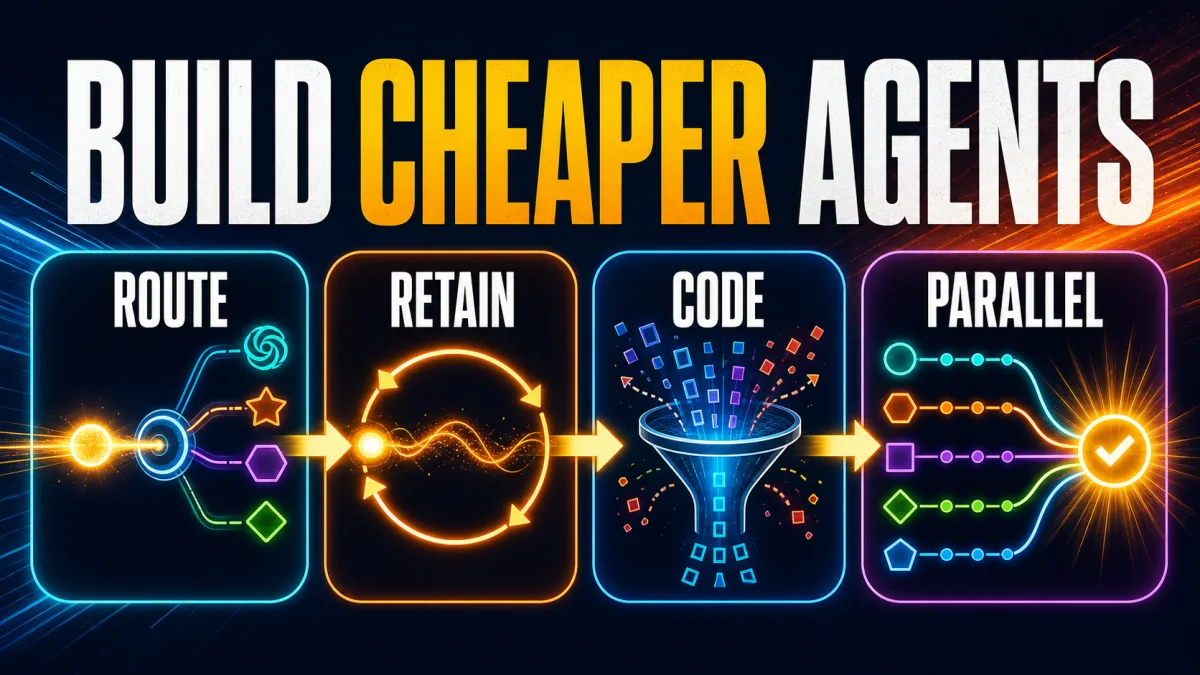
GPT-5.6 changes agent building from a “pick the strongest model” decision into a systems-design problem. OpenAI’s builder guide to GPT-5.6 argues that lower-cost model selection, retained reasoning, native compaction, programmatic tool calling and multi-agent orchestration can improve both economics and capability. The practical takeaway is to benchmark a complete workflow—including tool calls and retries—rather than compare model names in isolation.
Definition: GPT-5.6 is presented as a model family and API architecture for longer-horizon agents, not only as a higher-scoring model.
Example: A research agent can use a smaller model for extraction, process records in code, preserve reasoning across turns and reserve a stronger model for final judgment.
Key takeaway: The cheapest reliable agent is the one with the right model and the right surrounding control flow.
Business impact: Better routing and context management can reduce token spend without forcing teams to accept weaker results on the parts of a workflow that require judgment.
Why model choice is becoming a workflow decision
GPT-5.6 makes smaller model tiers more relevant for high-volume and repeated agent steps. OpenAI says Luna and Terra can often approach the performance of earlier flagship models when given more test-time compute, while costing less; the fit is strongest for latency-sensitive work, extraction and repeated tool-driven actions. For a business, the next step is to classify workflow stages by required judgment, volume and error cost instead of sending every stage to the top tier.
OpenAI’s BrowseComp example makes that trade-off concrete: GPT-5.5 at Extra High scored 84.36% at a reported total cost of $33.27, while GPT-5.6 Luna at Extra High scored 84.04% at $1.33 in the comparison. The figures come from OpenAI’s own guide and should be treated as a test hypothesis, not a universal price-performance guarantee. Teams can use the same structure—fixed task set, fixed harness, accepted-output rate and full cost—to decide whether a cheaper tier is good enough. See also GPT-5.6 price cuts: Luna down 80%, Terra down 20%.
Model routing should follow the acceptance bar for each step, not the prestige of the model name. A document workflow may use Terra or Luna to extract fields before a stronger model checks exceptions; a coding agent may reserve Sol for changes that need deeper reasoning. The business action is to write a routing policy with measurable thresholds, then monitor when the cheaper path escalates.
What retained reasoning and compaction change
Retained reasoning and native compaction let GPT-5.6 agents continue long tasks without reconstructing all prior work. OpenAI describes reasoning persistence across model turns and compaction for compressing long-running conversations as complementary controls for maintaining coherence. Builders should apply them to workflows that revisit evidence or tools over many turns, then measure whether the smaller context and fewer repeated steps preserve accepted outcomes.
The GPT-5.6 architecture example shows that harness settings can change results without changing model weights. OpenAI reports GPT-5.6 Sol scoring 13.3% on ARC-AGI-3 with a standard harness and 38.3% after retained reasoning and compaction, while using roughly six times fewer output tokens. Because this is a vendor-reported investigation, the useful operational lesson is to test harness settings alongside model variants; a model comparison that holds the harness constant may miss a large part of the system-level result.
This is also why an AI automation stack needs explicit context, orchestration and monitoring layers around its model. The model can be capable while the workflow still loses context, repeats tool work or spends tokens moving data that code could process more cheaply. Background: Writer targets 50% lower AI costs with Palmyra X6.
When programmatic tool calling is the right move
Programmatic tool calling is useful when an agent must move and filter data before it needs to reason about the result. OpenAI’s example is an agent retrieving 100 filings, filtering them by date and identifying relevant transactions; JavaScript can coordinate the calls and process intermediate outputs outside the context window. Builders should look for deterministic loops, aggregation and filtering in their own workflows, then move only those operations into code while leaving ambiguous decisions to the model.
The design boundary is straightforward: code handles predictable transformation, while GPT-5.6 handles judgment. A team should log the tool inputs, generated program, intermediate failures and final decision because a shorter context is valuable only if the resulting action remains explainable and recoverable.
Programmatic tool calling does not remove the need for guardrails around agent actions. A program that can call tools still needs scoped credentials, rate limits, validation and an approval path for changes to real systems. Builders can begin with read-only retrieval and a fixed test set, compare the programmatic path with the existing workflow, and expand permissions only after the error and retry behavior is understood.
How multi-agent orchestration fits
Multi-agent execution helps when a complex task contains independent workstreams that can run in parallel. OpenAI describes a primary agent delegating objectives to subagents, receiving their results and synthesizing a final response; the approach can improve completion time and intelligence on parallelizable work. The practical test is not whether more agents sound advanced, but whether the task can be divided cleanly enough that the quality gain exceeds the additional token and coordination cost.
Multi-agent orchestration should be an explicit policy, not an automatic default for every request. OpenAI notes that GPT-5.6 can judge when to spawn subagents, while builders can steer that behavior with instructions. Teams should define the conditions for delegation, cap concurrency, preserve the primary agent’s synthesis role and record the cost of every branch. For a first experiment, compare one-agent and multi-agent runs on the same tasks and acceptance criteria.
The broader AI agent distinction matters here: an agent is only one behavior inside a production workflow. The surrounding system still needs data access, tool permissions, human escalation and an audit trail. See also Second Thought cuts agent decoding by up to 43%. Background: AI agent reliability shifts from prompts to schemas.
What prompt caching adds to the economics
GPT-5.6 prompt caching can make repeated long prefixes cheaper and faster when requests are routed consistently. OpenAI says the family now has a minimum 30-minute prompt-cache lifetime and deterministic cache breakpoints, while a suitable cache key can increase the chance of landing on the same inference engine. Builders with repeated system instructions, schemas or reference material should measure cache-hit rate and latency before redesigning prompts around the feature.
Prompt caching is an optimization, not a substitute for workflow measurement. The cost ledger should separate uncached input, cached input, output, reasoning, tool calls and retries; otherwise a high cache-hit rate can look successful while the workflow remains expensive because of repeated model-generated actions. Related reading: GenRouter cuts agentic image costs by over 95%.
What builders should test first
A sensible GPT-5.6 rollout starts with one narrow, tool-connected workflow and a fixed baseline. Use the same prompts, files, tools, reviewers, acceptance rules and safety checks for the current system and each GPT-5.6 configuration. Record accepted-output rate, latency, retries, token cost and escalation frequency so the comparison reflects the completed job rather than a single model response.
A practical sequence is:
- Route deterministic extraction or classification to the least expensive tier that clears the acceptance bar.
- Enable retained reasoning and compaction for a long-horizon workflow that currently repeats context.
- Move filtering, aggregation and predictable tool coordination into code.
- Test multi-agent execution only on work that has independent branches.
- Compare the total cost and accepted outcome against the existing baseline before widening access.
The existing GPT-5.6 launch overview covers the family’s product tiers and access context. This builder-focused story adds a different question: how the model, harness and tool architecture should work together once a team starts building against it. Related reading: How GPT-5.6 fuses frontier intelligence with frontier efficiency. Related reading: OpenAI’s new flagship model deletes files on its own, people keep warning. See also Model ML turns GPT-5.6 Sol into finance-ready files.
What the builder guide changes
The builder guide’s central claim is that agent economics are now shaped by architecture as much as by model selection. OpenAI’s examples connect cheaper tiers with preserved reasoning, compaction, code-driven tool processing, parallel agents and longer prompt-cache lifetimes. Teams should treat those examples as testable design patterns, not promises that every workflow will improve automatically.
The next useful decision is therefore not “Should we use GPT-5.6?” It is “Which workflow steps need judgment, which steps can be handled by code, and which GPT-5.6 configuration clears our acceptance bar at an acceptable total cost?” That question produces a migration plan a benchmark headline cannot.
Frequently asked questions
What is the main idea in OpenAI's GPT-5.6 builder guide?
The main idea is that agent cost and capability now depend on architecture as much as on the model itself. OpenAI recommends choosing among GPT-5.6 model tiers, preserving reasoning across turns, compacting long contexts, running parallel subagents where useful, and moving deterministic data processing into code. Builders should test the whole workflow rather than defaulting every step to the most expensive model or the highest reasoning setting.
How much cheaper is the GPT-5.6 Luna example in BrowseComp?
OpenAI's guide compares GPT-5.5 at Extra High reasoning with GPT-5.6 Luna at Extra High on BrowseComp. The guide reports 84.36% for GPT-5.5 at a total cost of $33.27 and 84.04% for GPT-5.6 Luna at $1.33 in the cited comparison. The figures are OpenAI's own benchmark example, not a guarantee for another workload, so teams should reproduce the comparison with their own prompts, tools, acceptance criteria and cost accounting.
What does programmatic tool calling change?
Programmatic tool calling lets GPT-5.6 write JavaScript that orchestrates tool calls and processes intermediate results outside the model's context window. That is useful when an agent must retrieve, filter, aggregate or combine many records before applying judgment. The model sees less mechanical intermediate data, which can reduce context use and latency. Builders still need to test failure handling, permissions and output correctness before allowing the code to affect production systems.
When should a team use multiple GPT-5.6 agents?
A team should use multiple GPT-5.6 agents when a task can be split into genuinely parallel workstreams and the extra token cost is justified by better results or faster completion. OpenAI describes a primary agent that delegates to subagents and synthesizes their outputs. Teams should specify when spawning is worthwhile, cap the number of subagents, log every branch, and compare the multi-agent version with a single-agent baseline before making it the default.
Alex
Founder & Lead AI Writer
Alex is the founder of Yowox and lead AI writer since 2024, breaking down complex information into clear, actionable insights for thousands of readers every day. Alex has built AI automation systems for businesses since 2024, focusing on AI agents, workflow automation, and business process optimization.
Save hours. Save thousands.
Practical guides, real workflows, and the latest AI and automation news that matters — straight to your inbox.