 By Alex
 Writer targets 50% lower AI costs with Palmyra X6
Writer launched Palmyra X6 and a rebuilt agent harness, arguing that model choice and orchestration together can make enterprise AI cheaper to run.
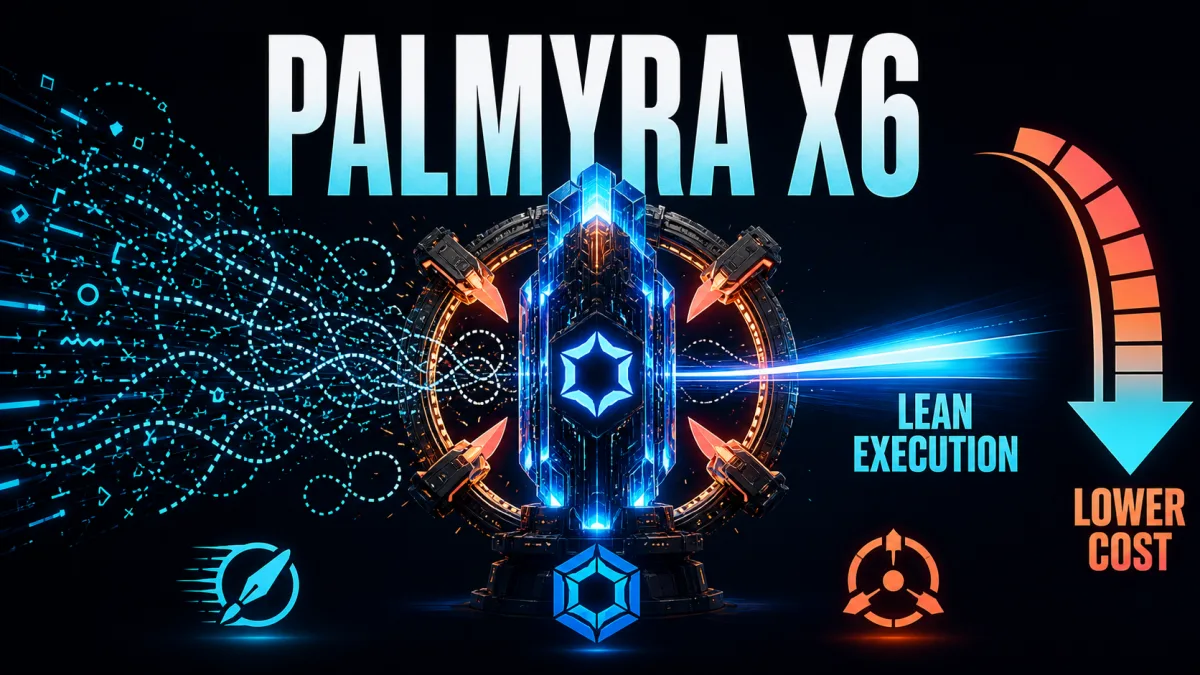
Writer has launched Palmyra X6 and a rebuilt agent harness to make enterprise AI cheaper to operate, not merely cheaper per token. In TechCrunch's report, Writer says the new model and infrastructure changes could cut costs by as much as 50% for basic tasks. The practical question for an operator is whether the combined system lowers cost per completed workflow while preserving quality, reliability and control.
Definition: Palmyra X6 is Writer's new flagship model, while the Writer Agent harness is the orchestration layer that manages multi-step agent work around a model.
Example: Writer says the harness can answer simple requests directly, plan more complex work, run tasks in batches and delegate work to sub-agents.
Key takeaway: Token economics depend on the model and on how the surrounding agent system uses that model.
Business impact: A lower cost per completed task can make high-volume or longer-running automation viable where a raw token-price comparison would not.
What did Writer launch with Palmyra X6?
Writer launched Palmyra X6 as a flagship model for enterprise marketing and revenue workflows, and Writer released substantial upgrades to Writer Agent at the same time. The company's launch announcement describes the release as three connected pieces: a cost-focused model, a faster agent execution layer and new governance and reporting controls. For a business evaluating the release, the useful unit of comparison is the complete workflow rather than Palmyra X6 in isolation.
Palmyra X6 is a post-training variation on Z.ai's open-source GLM-5.2 model, according to TechCrunch's reporting, and Writer says Palmyra X6 was built for work such as high-volume personalization, research and content operations. Writer positions Palmyra X6 as a model for long-running agent work, while the Writer Agent harness supplies the planning, tool-use and execution behavior around it. Businesses should therefore test both model output and end-to-end task completion before treating the launch as a general-purpose model replacement.
Why is the Writer Agent harness part of Palmyra X6's cost story?
The Writer Agent harness matters because an agent can spend tokens on planning, repeated context, tool calls and recovery steps before producing a useful result. Writer's research describes the harness as the scaffolding of tools and instructions around a model and reports that a token-efficient design reduced cost and duration by more than 40% while retaining quality parity in its tests. The takeaway for operators is to measure orchestration overhead, not just the advertised input and output price.
Writer's research also says the efficiency gains were model-invariant across the models tested, including Claude Sonnet 4.6, Gemini 3.1, Gemini Flash 3.5, Qwen 3.6, GLM 5.1 and Palmyra X6. Writer reports that quality per dollar rose 82% in that study, but the research also notes that its sample of 22 prompts is not enough to establish broad quality conclusions. Teams should use the finding as a reason to inspect their harness design, not as a guarantee that every workflow will produce the same savings.
The upgraded Writer Agent now adapts its reasoning to task complexity, according to the launch materials: direct answers for simpler work, structured plans for complex work, and batch or sub-agent execution for higher-volume jobs. Writer says these changes reduce unnecessary steps and repeated context. The operational implication is concrete: an enterprise should compare token use, latency, retries and accepted outputs per finished task before and after the harness change.
What do Writer's numbers show?
Writer says Writer Agent completed tasks 44% faster and at a 41% lower cost per task on average across Writer and third-party models while maintaining quality. Writer also reports that Writer Agent paired with Palmyra X6 delivered a 52% lower cost, 48% higher speed and 10% higher quality in its internal evaluation. These figures come from Writer's own testing, so a buyer should treat them as launch claims to validate against production-like cases rather than universal benchmarks.
Writer lists Palmyra X6 at $2 per million input tokens and $8 per million output tokens in its launch materials. A token price alone does not determine workflow economics: a model that uses fewer steps, shorter context and fewer retries can be cheaper per finished task even when its list price is not the lowest. Businesses comparing Palmyra X6 with another model should record total tokens, tool-call failures, latency, review time and task success on the same test set.
How does Writer keep the platform model-agnostic?
Writer says Palmyra X6 will sit alongside other Writer models and outside models imported through Azure or Amazon Bedrock. That model-agnostic position makes the harness the more durable part of the release: an enterprise can change the model used for a task without necessarily rebuilding every workflow around it. The AI automation stack explains why orchestration, tools, guardrails and monitoring remain important even when the model changes.
Palmyra X6 still needs to clear the quality, latency, tool-use and safety bar for a specific workflow; Writer's own nine-capability evaluation includes grounding and retrieval, tool use, sub-agent delegation and brand voice. A business that already uses AI agents for multi-step work should evaluate Palmyra X6 against those requirements rather than assume a lower cost guarantees a fit. The sensible migration path is a controlled comparison on one workflow, with the current model retained as a fallback until the new route proves reliable.
What governance did Writer add?
Writer added centralized reporting, analytics for Playbooks and Skills, and consumption controls with alerts and limits, according to the launch announcement. Writer says administrators can compare adoption, performance and spend over time and inspect individual repeatable workflows. For an enterprise, the immediate use is visibility: identify which agent tasks consume the most tokens, which workflows are actually adopted and where limits or human review are needed.
Writer's governance controls cannot lower a weak workflow's intrinsic cost, but Writer says the controls expose adoption, performance and spend while adding alerts and limits. Writer's reporting and Playbooks and Skills analytics therefore give administrators a way to connect usage with ownership, performance and spending. Teams should pair those controls with a workflow-level evaluation set and an escalation policy so a lower invoice does not become the only success metric.
What should operators watch next for Writer's AI cost strategy?
Writer's launch points to a broader shift from model selection to agent-system economics. The company is arguing that enterprises can flatten costs through three levers at once: a model specialized for the work, a harness that avoids unnecessary computation and controls that keep adoption visible. The claim is plausible as an operating hypothesis, but the published evidence remains vendor-led and workload-dependent.
The next useful step for a business is small and measurable: choose one repetitive agent workflow, record cost per completed task, latency, retries, quality and human review effort, then compare the current stack with Palmyra X6 and the upgraded harness. If the new route improves the complete workflow rather than only the benchmark or token price, it may justify broader adoption. If it does not, the business has still learned which part of the stack is driving its cost.
Frequently asked questions
What did Writer launch with Palmyra X6?
Writer launched Palmyra X6, a new flagship model for marketing and revenue workflows, alongside major upgrades to the Writer Agent harness. Writer says the combined release is designed to reduce cost and latency for enterprise agent tasks while keeping quality competitive. The harness changes include task-adaptive reasoning, batch execution and sub-agent delegation. Writer also added reporting, workflow analytics, alerts and spending limits so administrators can see how agents are being used and control token spend.
How much cheaper does Writer say Palmyra X6 can be?
Writer says Palmyra X6 combined with the upgraded Writer Agent can reduce costs by as much as 50% for basic tasks. In Writer's broader internal testing, the upgraded harness completed tasks 44% faster and at a 41% lower cost per task on average across Writer and third-party models, while maintaining quality. These are vendor-reported results, so a business should reproduce the comparison on its own workloads before changing production routing.
What is an AI agent harness?
An AI agent harness is the orchestration layer around a model: it supplies instructions and context, decides how work is broken into steps, calls tools, manages retries and coordinates sub-agents. Writer's release emphasizes that this layer can affect token economics independently of the underlying model. For a business, the practical test is cost per completed task, not the model's token price alone. A harness that avoids redundant steps or repeated context can lower the amount of work required for the same outcome.
Is Palmyra X6 only available with Writer Agent?
Writer designed Palmyra X6 to run inside Writer Agent, but Writer also says the platform remains model-agnostic. Writer clients can use other Writer models or bring in outside models through cloud services such as Azure and Amazon Bedrock. The practical implication is that enterprises can evaluate the harness as an orchestration layer rather than treating the launch as a mandatory switch to one model. Teams should still verify availability, pricing and performance for their own account and deployment path.
Alex
Founder & Lead AI Writer
Alex is the founder of Yowox and lead AI writer since 2024, breaking down complex information into clear, actionable insights for thousands of readers every day. Alex has built AI automation systems for businesses since 2024, focusing on AI agents, workflow automation, and business process optimization.
Save hours. Save thousands.
Practical guides, real workflows, and the latest AI and automation news that matters — straight to your inbox.