 By Alex
 GenRouter cuts agentic image costs by over 95%
GenRouter routes image-generation prompts to different agentic workflows, with the paper reporting lower cost and latency than heavyweight static pipelines.
GenRouter is a research framework that sends each image-generation prompt to a more suitable agentic workflow instead of forcing every request through one heavyweight pipeline. In the paper's reported experiments, GenRouter improved visual alignment while cutting execution cost by over 95% and latency by 65% against static pipelines, according to the Hugging Face paper page.
Definition: GenRouter is a router for agentic image-generation workflows, not a single image model.
Example: A simple prompt can use a lighter workflow while a request needing search, reasoning, verification, or precise composition can be sent through a richer plan.
Key takeaway: The paper treats workflow selection as part of image generation itself.
Business impact: If the reported trade-offs generalize, image-generation systems could spend heavy compute only when a prompt's demands justify it.
Why does agentic image generation need routing?
GenRouter targets a compute-mismatch problem in agentic image generation: existing systems often package retrieval, iterative reasoning, editing, or verification into separate fixed pipelines, so prompts with very different requirements receive similar treatment. The arXiv paper describes this as a one-size-fits-all limitation and positions GenRouter as a way to choose an execution plan based on the prompt. For operators, the practical question is not only which image model to call, but how much workflow a request actually needs.
This matters because an agentic image-generation run can do more than turn text into pixels. It may retrieve information, reason over constraints, sketch an intermediate result, verify an output, or iterate on an edit. An AI agent is defined by that ability to plan and use tools, but every extra step also adds computation and time. GenRouter's proposition is to preserve those capabilities without applying the full stack to every request.
How does GenCanvas standardize the workflow space?
GenCanvas is the paper's foundation for comparing different agentic image-generation pipelines: it decomposes the generation process into reusable primitives such as search, reason, verify, and sketch, then organizes them into executable workflow templates. The authors' GenRouter repository describes GenCanvas as a unified space for standardizing the execution paradigm and maintaining a scalable template library. The takeaway is architectural: routing becomes possible only after otherwise different pipelines share a vocabulary and an execution format.
GenCanvas does not mean that every prompt follows the same sequence. A template can expose different combinations of primitives, allowing a workflow to be lighter for a straightforward request and more involved when the prompt requires multi-step spatial reasoning or precise text rendering. That is the difference between a library of possible routes and a single universal chain: the system can compare plans before it commits compute.
How does GenRouter choose a plan?
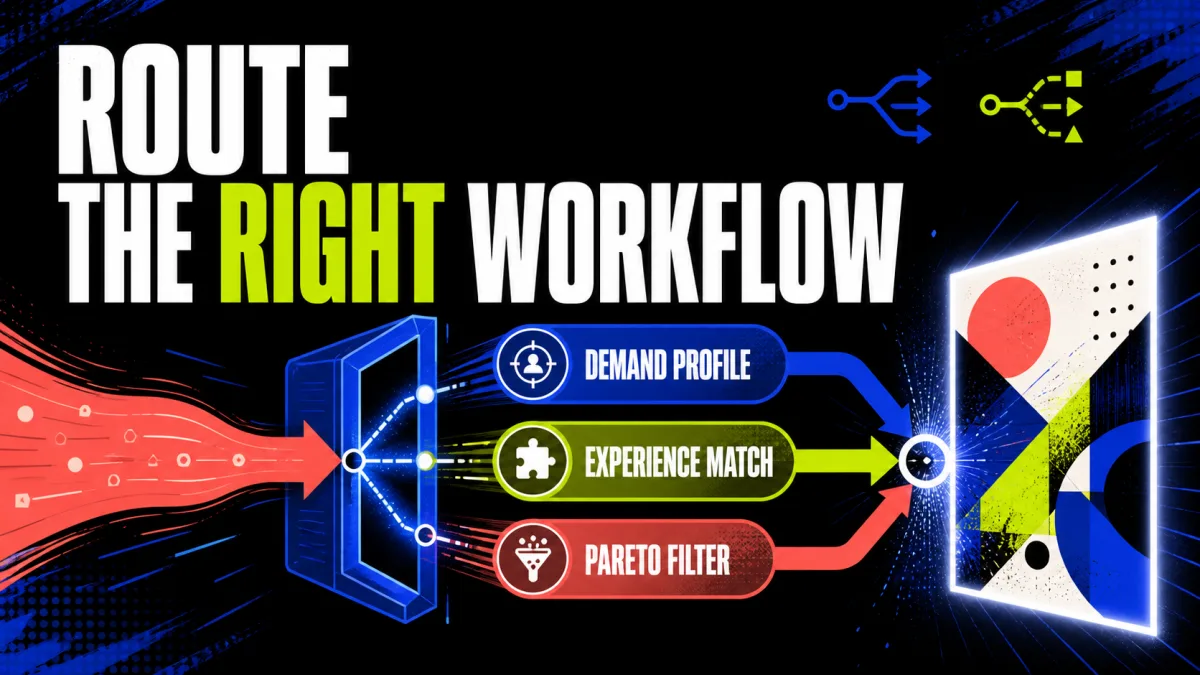
GenRouter routes a prompt through three reported mechanisms: demand profiling, experience matching, and Pareto filtering. Demand profiling estimates what the request requires; experience matching uses accumulated experience to connect that demand with useful workflow behavior; and Pareto filtering keeps candidate plans that offer different quality-cost trade-offs rather than collapsing the decision to one score. Together, these mechanisms make GenRouter a workflow optimizer, while production model-routing research shows why cost, quality, latency, and execution context are difficult to optimize in isolation.
The important point is that GenRouter is not presented as a simple “easy prompt versus hard prompt” classifier. A prompt can be visually simple but still need verification or external knowledge, while a complex-looking request may be handled by a more efficient route already represented in the system's experience. The routing decision is therefore tied to the workflow that can complete the request, not only to the words in the prompt.
What did the GenRouter experiments report?
Across diverse benchmarks, the paper reports that GenRouter achieved superior visual alignment while reducing execution cost by over 95% and latency by 65% relative to heavyweight static pipelines. The same source also reports that accumulated experience enabled zero-shot generalization, improved performance, and halved computational overhead. These are experimental results from the authors' evaluation, so teams should treat them as evidence for the routing approach rather than as a guaranteed production multiplier.
The comparison is meaningful because it evaluates a routing framework against static pipelines that keep a heavyweight workflow in place. It does not establish that every deployment will achieve the same savings: the result depends on the available workflows, generators, benchmarks, prompt mix, and definition of visual alignment. The concrete next step for an operator is to measure complete task cost and end-to-end latency on representative prompts, then compare fixed and routed plans under the same quality checks.
Why does self-evolution matter?
GenRouter is designed to accumulate experience as it operates, so future decisions can use more than a fixed hand-written routing rule. The paper connects that memory-guided behavior to zero-shot generalization and reports that it can boost performance while halving computational overhead. In practical terms, the research direction is a feedback loop: execution outcomes become evidence for later workflow selection instead of disappearing after one image is generated.
That feedback loop also creates an evaluation obligation. A router can appear efficient while quietly sending difficult prompts through a route that produces weak alignment, or appear accurate while spending too much on easy prompts. GenRouter's reported Pareto filtering points toward a better operating view: preserve several quality-cost options, observe the completed result, and update the route policy against measured outcomes rather than optimizing a proxy alone.
What should image-generation operators watch next?
GenRouter shifts the image-generation question from “which model should handle this prompt?” to “which workflow should handle this request, and what is the cheapest route that preserves the required result?” The paper provides a concrete framework for that shift—GenCanvas for a shared workflow space, demand profiling, experience matching, and Pareto filtering—but it does not remove the need for deployment-specific measurement. Teams evaluating the approach should reproduce the quality, cost, latency, and generalization checks on their own prompt distribution before treating the reported savings as a planning assumption.
The broader news is the move toward routing at the workflow level. As agentic image systems gain more tools and iterative stages, a fixed pipeline becomes an expensive default. GenRouter's reported results suggest that adaptive workflow selection may be as important to practical image generation as the underlying pixel-generation model.
Frequently asked questions
What is GenRouter?
GenRouter is a research framework for selecting an agentic image-generation workflow for each prompt instead of sending every request through one fixed pipeline. The paper describes three routing signals: demand profiling, experience matching, and Pareto filtering. Its goal is to balance visual alignment with execution cost and latency, so a simple request does not pay for the same heavy process as a complex request.
What is GenCanvas in the GenRouter paper?
GenCanvas is the paper's unified workflow space for agentic image generation. It breaks diverse pipelines into reusable primitives such as search, reasoning, verification, and sketching, then organizes those primitives into executable workflow templates. GenCanvas gives GenRouter a common space in which to compare and select workflows rather than treating each image-generation system as an isolated, incompatible stack.
How much does GenRouter reduce image-generation cost and latency?
The paper reports that GenRouter reduced execution cost by over 95% and latency by 65% compared with heavyweight static pipelines, while achieving superior visual alignment across diverse benchmarks. Those figures are the authors' reported experimental results, not a universal guarantee for every image model, prompt distribution, or production deployment. Teams would need to reproduce the evaluation on their own workloads before using the numbers for budgeting.
Does GenRouter use one image-generation workflow for every prompt?
No. GenRouter is designed to route heterogeneous prompts to different execution plans. The framework profiles what a prompt demands, matches it against accumulated experience, and filters candidate workflows along a quality-cost trade-off. That design specifically addresses the paper's criticism of one-size-fits-all agentic image-generation pipelines, where simple prompts can be forced through unnecessarily expensive computation.
Alex
Founder & Lead AI Writer
Alex is the founder of Yowox and lead AI writer since 2024, breaking down complex information into clear, actionable insights for thousands of readers every day. Alex has built AI automation systems for businesses since 2024, focusing on AI agents, workflow automation, and business process optimization.
Save hours. Save thousands.
Practical guides, real workflows, and the latest AI and automation news that matters — straight to your inbox.