 By Alex
 OpenAI GPT-5.6 price cuts reshape model economics
OpenAI says its GPT-5.6 family is cheaper after Sol helped rewrite GPU code, cutting model efficiency costs and lowering Luna to $0.20 input and $1.20 output per million tokens.
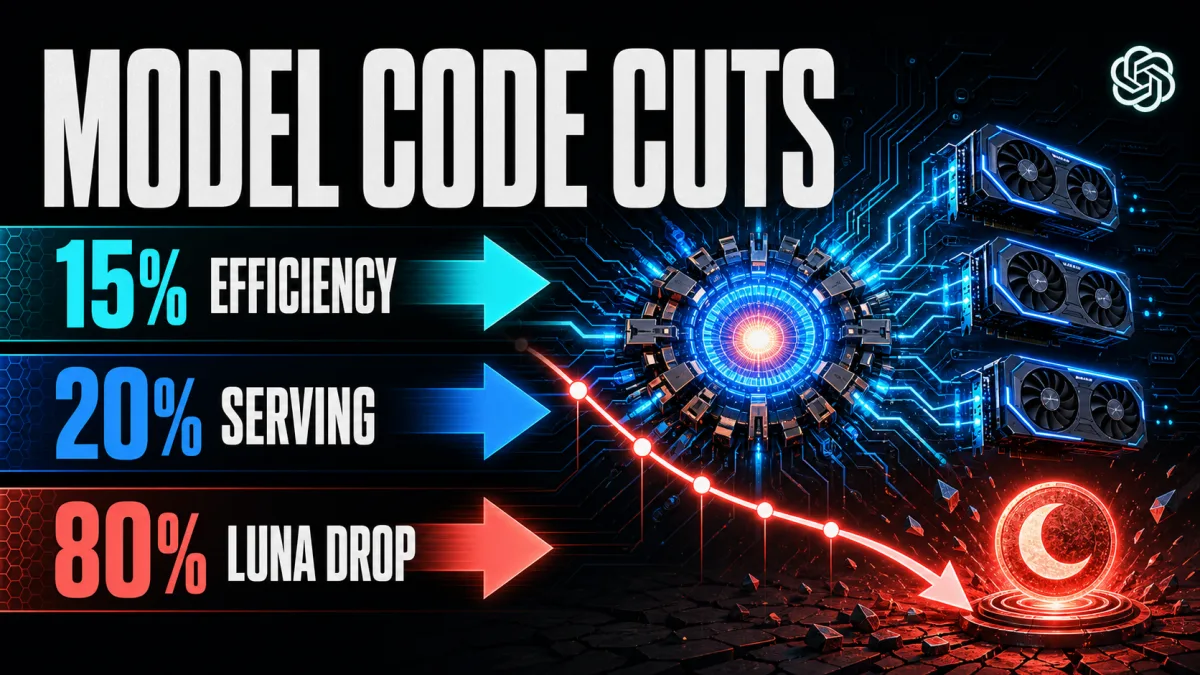
OpenAI is cutting GPT-5.6 prices after using its own Sol model to improve GPU code and serving efficiency. The source report from The Rundown says OpenAI reported 15% better model efficiency and a 20% reduction in serving costs, with an 80% price reduction for GPT-5.6 Luna; the business implication is that model selection is becoming an infrastructure and routing decision, not only a benchmark decision.
Definition: OpenAI's GPT-5.6 cost change combines reported model-efficiency work with lower prices for the Luna and Terra tiers.
Example: A high-volume classification workflow could test Luna first, while a more demanding agent keeps a stronger tier until cheaper inference meets the same acceptance bar.
Key takeaway: Lower token prices matter only when a model still completes the workflow with acceptable quality and reliability.
Business impact: Teams can revisit the cost of AI automation, but they should measure total task cost rather than multiply a published token rate by a single prompt.
What did OpenAI change in GPT-5.6 pricing?
OpenAI lowered the reported GPT-5.6 prices for Luna and Terra while keeping Sol's standard rates unchanged. The change applies to the model family described in The Rundown's July 31, 2026 report: Luna moved to $0.20 per million input tokens and $1.20 per million output tokens, while Terra moved to $2 per million input tokens and $12 per million output tokens. Teams evaluating a route should update their price assumptions, then test the complete workflow rather than treating the token table as the final business case.
| GPT-5.6 tier | Reported input price | Reported output price | Practical evaluation question |
|---|---|---|---|
| Luna | $0.20 / 1M tokens | $1.20 / 1M tokens | Can it handle high-volume routine work without extra retries? |
| Terra | $2 / 1M tokens | $12 / 1M tokens | Does the balanced tier reduce review and correction work? |
| Sol | Unchanged in the report | Unchanged in the report | Is the stronger tier worth its existing cost for difficult tasks? |
The reported Luna reduction changes the economics most visibly for high-volume workloads. The Rundown describes the move as an 80% cost reduction for the already cost-effective variant, so a workflow that sends many small requests has a reason to revisit its model route. The practical limit is that lower inference cost does not automatically lower completed-task cost when a cheaper model causes more retries, escalations or human review.
How did OpenAI say its models became cheaper?
OpenAI said its Sol model rewrote GPU code that improved GPT-5.6 efficiency by 15%, while serving costs fell 20%. The report presents this as a link between model-generated engineering work and the cost of running the model at scale; the claim is OpenAI's own research as summarized by The Rundown, not an independent benchmark. Operators should treat the result as a testable signal: measure their own task success, latency and retries before assuming the same efficiency applies to a different workload.
The reported mechanism matters because inference economics are part of the product now. A model provider can lower a customer's bill through price changes, through more efficient serving, or through both at once; OpenAI's announcement combines the two. For a team already using AI agents in tool-connected workflows, the relevant follow-up is a route-level audit showing which tasks consume the most tokens and which tasks consume the most human correction time.
What does Sol Fast mode add?
OpenAI kept Sol's rates unchanged and introduced a Fast mode that runs 2.5 times faster for twice the price. The trade-off gives teams a latency option rather than a universal discount: a workflow that is blocked on response time may value the faster mode, while a batch job may prefer the standard rate. Measure elapsed time to an accepted result, not only model response speed, because downstream tools and review steps can dominate the total.
Sol Fast mode is most useful when faster completion has a measurable operational value. A business should compare standard Sol and Fast mode on the same requests, tool calls and acceptance checks, then include the doubled model price in the comparison. If the faster response does not reduce queue time, abandonment or paid idle capacity, the additional price may not improve the workflow's economics.
What should operators do with the new prices?
Teams should rerun model-routing tests with GPT-5.6 Luna, Terra and Sol against the same fixed task set. The test should preserve prompts, input files, tool permissions, acceptance criteria and reviewers while recording accepted output rate, latency, retries, escalation rate and total token spend. This turns OpenAI's reported price change into evidence for a specific workflow instead of a blanket migration decision.
A useful routing policy assigns the cheapest tier that consistently clears the workflow's acceptance bar. Luna is the natural first candidate for high-volume routine work because the reported rates are lowest; Terra is a middle option; Sol remains the comparison point for harder tasks. This approach follows the same principle as measuring model value by useful intelligence per dollar: a cheaper model wins only when its completed output is good enough for the job.
The reported GPT-5.6 cuts make AI automation easier to revisit, but they do not remove the need for operational measurement. OpenAI's numbers describe a meaningful change in price and efficiency, while the cost of a real task also includes retries, tool calls, review and failures. The next decision for a business is therefore concrete: build a small evaluation set, test the three tiers, and route work according to measured completed-task cost.
Frequently asked questions
What changed in OpenAI's GPT-5.6 pricing?
OpenAI announced lower prices for GPT-5.6 Luna and Terra after reporting efficiency gains in the model family. The Rundown says Luna's cost fell 80% to $0.20 per million input tokens and $1.20 per million output tokens, while Terra is priced at $2 per million input tokens and $12 per million output tokens. Teams should compare those rates with their real token mix, retries and quality requirements before changing a production route.
How did OpenAI say GPT-5.6 became more efficient?
OpenAI published research saying its Sol model rewrote GPU code and made the GPT-5.6 models 15% more efficient, while serving costs fell 20%. The reported mechanism matters because it connects model capability to the infrastructure that runs it, but the figures are still OpenAI's own report as summarized by The Rundown. Operators should validate the effect on their own workloads rather than assume every task receives the same savings.
What are the new GPT-5.6 Luna and Terra rates?
The rates reported by The Rundown are $0.20 per million input tokens and $1.20 per million output tokens for Luna, and $2 per million input tokens and $12 per million output tokens for Terra. Sol's rates stayed the same, while OpenAI added a Fast mode for Sol that runs at 2.5 times the speed for twice the price. Actual workflow cost depends on prompt size, output size, retries, caching and the number of model calls per completed task.
Should a business switch its AI workflows to GPT-5.6 Luna?
Not automatically. GPT-5.6 Luna is a stronger candidate for high-volume, cost-sensitive work because its reported rates are much lower, but a business still needs to test accepted quality, latency, failure rate and total cost on a fixed task set. Route routine work to Luna only when it meets the workflow's acceptance bar; reserve a more capable or faster tier when cheaper inference creates expensive retries or review work.
Alex
Founder & Lead AI Writer
Alex is the founder of Yowox and lead AI writer since 2024, breaking down complex information into clear, actionable insights for thousands of readers every day. Alex has built AI automation systems for businesses since 2024, focusing on AI agents, workflow automation, and business process optimization.
Save hours. Save thousands.
Practical guides, real workflows, and the latest AI and automation news that matters — straight to your inbox.