 By Alex
 Model ML turns GPT-5.6 Sol into finance-ready files
Model ML says GPT-5.6 Sol helps its finance agents turn research into editable PowerPoint decks and Excel workbooks, with stronger review readiness and fewer tokens in selected workflows.
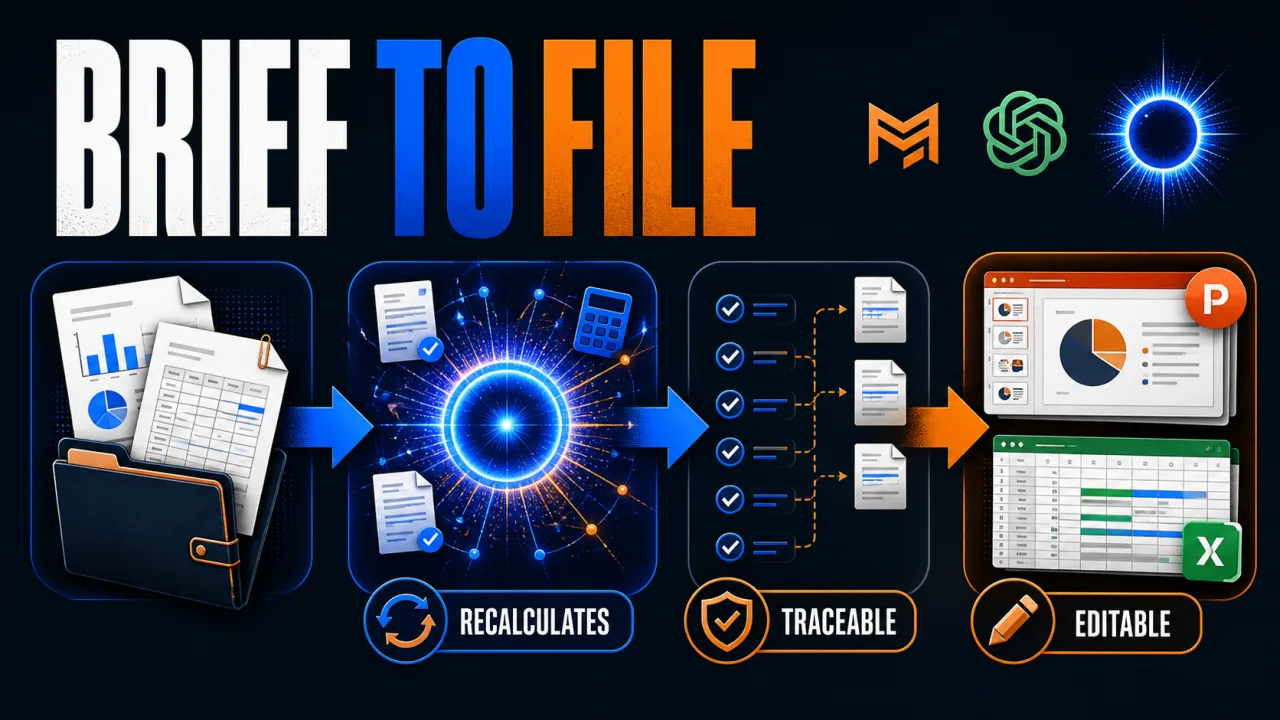
Model ML says GPT-5.6 Sol helps its finance agents carry work from research to editable PowerPoint and Excel files, rather than stopping at a text answer. In OpenAI's August 10 customer story, the company reports fewer tokens in selected document workflows and a higher rate of decks that were ready for substantive review. The business takeaway is narrower than “AI replaces finance analysts”: the value is in completing the last mile of a deliverable while keeping a professional responsible for the assumptions and evidence.
Definition: Model ML is a finance workflow platform whose agents coordinate research, analysis, calculations and document creation.
Example: Its system can take a brief and source material and return an editable PowerPoint deck or Excel workbook with traceable sources.
Key takeaway: The measured advantage is workflow completion, not a claim that GPT-5.6 Sol wins every isolated model test.
Business impact: Finance teams can evaluate AI against accepted files, review time and traceability instead of judging a chatbot response alone.
What problem does Model ML target?
Model ML targets the last mile between financial analysis and a file a client or decision-maker can actually review. In the company's description, that last mile includes reconciling evidence, checking numbers, formatting a deck or workbook, and linking claims to their sources. The practical implication for a finance team is to test the complete handoff—editable artifact, formulas, citations and human review—not only the quality of an intermediate answer.
Model ML's product is built around native office deliverables rather than a chat transcript. For an investment committee deck, the agent can turn a brief and source material into an editable PowerPoint; for an Excel task, it can work from a client template or blank workbook, build formulas across multiple tabs and apply finance-specific formatting. Teams comparing an AI agent with a basic chatbot should use this distinction as the test: does the system take controlled actions toward a defined output, or only describe what a person should do next?
How does GPT-5.6 Sol fit into the workflow?
GPT-5.6 Sol is one model inside Model ML's broader agent harness, not the entire finance product. Model ML says a core agent plans the work, chooses tools, reconciles evidence and runs calculations, routing each step to the model suited to it; GPT-5.6 Sol is often selected for those tasks. The takeaway is that the reported result belongs to a combined system of model, tools, document generation and evaluation, so a direct API test should not be presented as a reproduction of Model ML's benchmark.
Model ML's document tooling keeps the generated PowerPoint and Excel outputs editable and source-traceable. That matters in finance because a polished slide can still fail review if its chart is flattened, its numbers cannot be traced or its workbook does not recalculate. A team evaluating AI document processing should therefore score file structure and provenance alongside answer accuracy, instead of accepting a summary as the finished product.
What did Model ML's Composite evaluation measure?
Model ML's Composite evaluation follows a finance assignment from the initial brief through research, calculations and an editable deck or spreadsheet. The PowerPoint slice checks whether a deck is produced, whether it is professionally ready for substantive review, and how well it follows the brief, visual hierarchy and consistency requirements. The Excel slice checks headline accuracy, fully correct models, output location, workbook structure and efficiency. That end-to-end design makes the benchmark more relevant to operators than a generic question-and-answer score, while remaining a company-defined evaluation.
| Metric | GPT-5.6 Sol | Opus 5 | Fable 5 |
|---|---|---|---|
| PowerPoint deck produced | 100.0% | 76.0% | 82.0% |
| Professional-readiness rate | 43.3% | 26.7% | 32.0% |
| Tokens per PowerPoint deck | 1.10M | 953K | 1.40M |
| Key Excel outputs correct | 83.3% | 82.8% | 80.6% |
| Fully correct Excel models | 50.0% | 60.0% | 60.0% |
| Tokens per Excel workbook | 2.44M | 3.83M | 2.59M |
Where did GPT-5.6 Sol lead, and where did it not?
GPT-5.6 Sol's clearest reported advantage was producing more review-ready PowerPoint work while using fewer tokens than Fable 5. Model ML reports a 43.3% professional-readiness rate for Sol versus 26.7% for Opus 5, a 16.6 percentage-point lead, and says Sol used about 21% fewer tokens per deck than Fable 5. The useful decision is to pilot Sol on presentation-heavy workflows where accepted deck quality and review time matter, rather than turning the result into a blanket model switch.
GPT-5.6 Sol did not lead every Excel measure in Model ML's table. Sol used 36% fewer tokens per workbook than Opus 5 and located the expected outputs in 100% of tests, but its fully correct-model rate was 50.0%, below Opus 5 and Fable 5 at 60.0%; its headline accuracy was 83.3%. That mixed result is important: finance teams should route by deliverable and acceptance criteria, because token efficiency and complete correctness are different measures.
Model ML's benchmark supports a workflow-specific claim, not a universal cost or quality ranking. The results combine Model ML's agent harness, document tooling, prompts, source material and scoring rubric, and the story does not publish a complete reproduction package. The responsible takeaway is to use the benchmark as a reason to test a similar workflow, while recording token mix, retries, tool calls, correction time and the cost of human review.
What changed for finance operators?
Model ML's reported time saving shows why review-ready output is a more useful target than generated text. At one global asset manager, Model ML says a bespoke tearsheet fell from about one hour to about five minutes. The result is specific to that workflow and does not establish a general labor reduction, but it gives operators a measurable pilot question: how long does a real deliverable take to reach an accepted, source-checked state with and without the agent?
Model ML also points toward finance software that stays connected to its underlying model and source material. The company describes interactive outputs that can be updated continuously or locked to a moment in time, allowing a reviewer to move from an investment summary to the financial model behind a figure. That direction matters because a finance artifact is more useful when its evidence can be inspected, but it also raises the bar for permissions, audit trails and change control.
What should a finance team test next?
A finance team should test GPT-5.6 Sol on a fixed set of real decks and workbooks before changing production routing. Keep the prompts, source files, templates, tools, acceptance criteria and reviewers constant; then score file delivery, numeric accuracy, formula integrity, source traceability, visual quality, correction time and total token usage. This method distinguishes a genuine operational improvement from a benchmark result that does not transfer to the team's documents.
A finance team should keep human sign-off for assumptions, evidence and final messaging even when the file arrives editable. Model ML's own description says the finance professional checks assumptions, sources and the message before sharing the work, and its strongest claims concern workflow completion rather than unsupervised approval. The practical guardrail is simple: let the agent assemble and reconcile evidence, but require an accountable reviewer before a deck or workbook reaches a client, investment committee or senior decision-maker.
FAQ
What does Model ML use GPT-5.6 Sol for?
Model ML uses GPT-5.6 Sol inside finance workflows that move from a brief and source material through research, analysis, calculations and a finished PowerPoint deck or Excel workbook. The model is part of a larger agent system with tools and document-generation components.
What were the strongest results?
Model ML reports that GPT-5.6 Sol produced a PowerPoint file in 100% of test cases and reached a 43.3% professional-readiness rate, compared with 76.0% and 26.7% for Opus 5. It also used 21% fewer tokens per deck than Fable 5 and 36% fewer tokens per Excel workbook than Opus 5.
Does the story prove full finance automation?
No. The story describes agents that complete much of the workflow, but a finance professional still checks assumptions, sources and the final message. The published evaluation is evidence for a targeted pilot, not proof that every finance process can run without review.
How much time did one tearsheet workflow save?
Model ML says a bespoke tearsheet at one global asset manager fell from about one hour to about five minutes. That is a reported result from one workflow, so another team should measure its own accepted-file time rather than assume the same reduction.
The practical conclusion
Model ML's GPT-5.6 Sol story is about turning model capability into finance-ready files. The reported benchmark combines editable outputs, source traceability, review readiness and token use, and it shows a mixed picture rather than a universal win. Operators should treat Sol as a strong candidate for controlled tests on document-heavy finance workflows, then adopt it only where the accepted deliverable improves enough to justify the system's cost, controls and human review.
Frequently asked questions
What does Model ML use GPT-5.6 Sol for?
Model ML uses GPT-5.6 Sol inside finance workflows that move from an initial brief and source material through research, analysis, calculations and a finished deliverable. The output can be an editable PowerPoint deck or Excel workbook with traceable sources. Model ML's description is about its own agent system and document tooling, so it should not be read as proof that GPT-5.6 Sol alone produces the same result without that harness.
What were the strongest results in Model ML's evaluation?
In Model ML's Composite evaluation, GPT-5.6 Sol produced a PowerPoint file in 100% of test cases and reached a 43.3% professional-readiness rate, compared with 76.0% and 26.7% for Opus 5. Model ML also reports 21% fewer tokens per deck than Fable 5 and 36% fewer tokens per Excel workbook than Opus 5. These are customer-evaluation results, not a universal ranking of every finance workload.
Does GPT-5.6 Sol make finance analysis fully autonomous?
No. Model ML describes agents that research, calculate and assemble files, but the finance professional still checks assumptions, sources and the message before sharing the work. The published story also does not provide a complete independent reproduction package, so teams should treat the results as evidence for a targeted pilot rather than permission to remove review from high-impact financial decisions.
How much time can Model ML save on a finance deliverable?
Model ML says a bespoke tearsheet at one global asset manager fell from about one hour to about five minutes. That is a reported result from one workflow, not a guaranteed saving for every finance team. A buyer should measure time to an accepted, review-ready file and include corrections, source checking and final sign-off in the comparison.
Alex
Founder & Lead AI Writer
Alex is the founder of Yowox and lead AI writer since 2024, breaking down complex information into clear, actionable insights for thousands of readers every day. Alex has built AI automation systems for businesses since 2024, focusing on AI agents, workflow automation, and business process optimization.
Save hours. Save thousands.
Practical guides, real workflows, and the latest AI and automation news that matters — straight to your inbox.