 By Alex
 Second Thought cuts agent decoding by up to 43%
A new training-free framework uses the wait between an LLM agent’s action and observation to run auxiliary reasoning in parallel, reducing sequential decoding without a measured accuracy penalty in most tested settings.
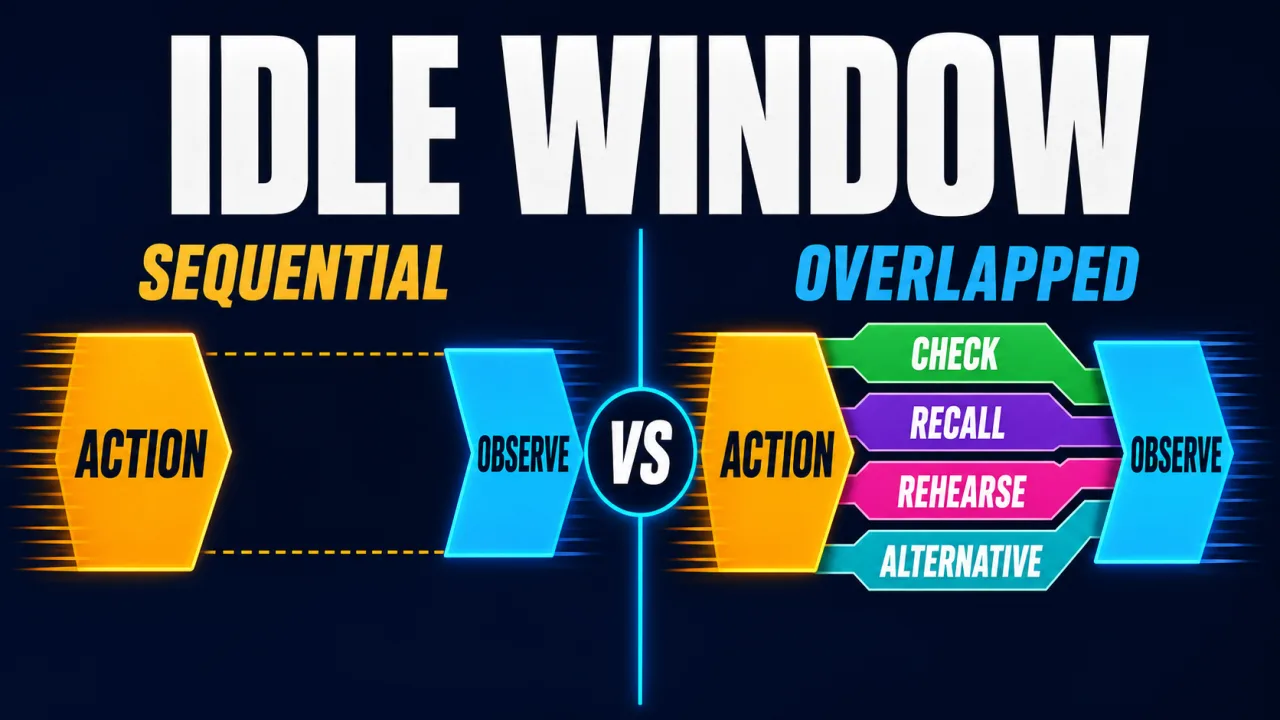
Second Thought is a training-free inference framework that lets an LLM agent reason while its action is being executed or its environment response is still arriving. The paper’s central claim is that a ReAct agent has a recurring reasoning idle window between Thought and the next observation, and that this window can host useful preparation for future turns. For agent operators, the practical promise is less sequential decoding without changing the model’s weights. The pattern builds on the same agent loop of reasoning, tool use, verification, and escalation that underlies practical LLM-agent systems.
Definition: Second Thought runs auxiliary reasoning branches during the Action–Observation wait in a ReAct-style LLM agent.
Example: While a coding agent waits for a command result, auxiliary branches can check assumptions, recall constraints, rehearse fallback steps, and prepare an alternative plan.
Key takeaway: The method moves some reasoning off the main thread instead of making every extra token wait in sequence.
Operational implication: The gain depends on the environment providing enough Action–Observation time to hide useful branch decoding, so latency and cost must be measured together.
What problem does Second Thought target?
Second Thought targets the sequential bottleneck in ReAct-style LLM agents. In the standard loop, an agent generates a Thought, serializes an Action, waits for an Observation, and then starts thinking again. The main thread is doing no deliberate reasoning during the action and observation phases, even though the next turn may benefit from checking the current plan or preparing for possible results. The paper names this recurring Action–Observation interval the reasoning idle window and uses it as parallel capacity rather than extending the next Thought phase.
Second Thought differs from ordinary parallel reasoning inside a single Thought phase. Self-consistency and tree-search methods generate competing solution paths and later aggregate them, while Second Thought starts after the current Thought has already produced its action. The paper therefore uses Second Thought’s branches for complementary advice that cannot change the current action and avoids branch voting or ranking. For an operator, the design is most relevant when the environment response lasts long enough to produce useful advice before the next turn.
How does the parallel agent loop work?
Second Thought forks four auxiliary branches as soon as the main Thought phase ends, then runs them alongside action serialization and tool execution. The full paper on arXiv describes the branch roles as Check, Recall, Rehearse, and Alternative: each addresses a different way an agent can lose a turn or commit too early. The branches share the trajectory available at the fork, including the completed Thought, and their outputs are harvested when the observation arrives.
Second Thought’s four branches target different agent failure modes documented in the paper. Check looks for unverified assumptions that the observation might disprove; Recall brings older constraints back into attention; Rehearse prepares likely next steps for plausible tool outcomes; and Alternative keeps a fallback strategy available. The practical takeaway is to treat these branches as targeted preparation for the next turn, not as competing final answers that require voting.
Second Thought also makes interruption part of the protocol. Each branch emits short atomic thoughts, with each unit intended to stand on its own. When the observation arrives, the framework stops in-flight generation, keeps completed units, discards an incomplete unit, and appends the surviving thoughts to the tool-observation message. The next main Thought therefore sees the original trajectory plus whatever auxiliary reasoning fit inside the previous wait.
What did the experiments measure?
The authors evaluated Second Thought across three agentic benchmarks and three reasoning LLMs, covering repository-level software engineering, terminal operation, and multi-turn tool-calling dialogue. The benchmark set was SWE-Bench Pro, Terminal-Bench 2.1, and τ³-bench; the models were DeepSeek-V4-Flash, Qwen3.6-Plus, and MiniMax-M3. This combination tests whether the idle-window idea transfers across different tasks and model families rather than depending on one agent harness.
The paper compares the unmodified agent with Second Thought and, where supported, a compute-matched control that places an equivalent extra reasoning budget on the main thread. That control matters because a raw token reduction could otherwise be mistaken for a fairer use of the same compute. The relevant question is whether overlapping the reasoning with environment work is better than simply forcing the main Thought to continue.
| Comparison | What the paper reports | Why it matters |
|---|---|---|
| Second Thought vs. base agent | Lower average turn count in all nine model–benchmark pairs | The agent reaches outcomes with fewer loop iterations |
| Main-thread decoding | Reduced in six pairs, by up to 43% | Less reasoning remains on the sequential critical path |
| Pass@1 | No significant change in seven of nine pairs; the two significant differences were +12.4 and +10.2 points | The reported speed-oriented change did not generally trade away measured task accuracy |
| Compute-matched control | Higher Pass@1 with 1.3× to 3.2× less sequential decoding in all four applicable settings | Overlap can outperform putting the same budget back on the main thread |
The paper reports a paired wall-clock replay with 10.9% lower median per-task latency, but that measured result is narrower than the decoding result. Second Thought can turn branch work into wall-clock savings only when the branch generation overlaps with real action or observation time. For a broader view of how model, orchestration, memory, and integrations fit together, see the AI automation stack. Operators should therefore segment latency results by tool speed instead of assuming the 10.9% figure transfers to every environment.
What does Second Thought cost?
Second Thought shifts work away from the critical path; it does not make the work disappear. In the paper’s SWE-Bench Pro cost analysis, running four auxiliary branches increases total API cost by 66.4% to 181.5% across the tested models. The authors say the increase is driven mainly by input prompt processing and cached-prefix reads, while output-token cost varies by less than $0.02 per task across models. Keeping only the strongest branch reduces the reported added cost to 16.3%–35.5%.
The reported 66.4%–181.5% cost increase changes the deployment question. A team evaluating Second Thought should not ask only whether sequential tokens or median latency fell; it should compare tool latency, completed branch generation, cache pricing, total API spend, task success, retries, and human corrections. Second Thought is most attractive where the Action–Observation window is long enough to hide useful reasoning and where a faster turn has material value.
Where does the paper leave agent builders?
Second Thought presents a new place to look for inference-time capacity: the wait after an agent has committed to an action but before the environment answers. The method is modular because branches can be pruned, expanded, or specialized for a task, while the baseline fallback is simple: if no branch completes a thought before the observation, the agent behaves like the ordinary ReAct loop for that turn.
Second Thought is not a universal speedup or a free accuracy gain; the paper’s nine model–benchmark comparisons show why the scheduling idea must be evaluated by workload. Auxiliary reasoning must be useful, interruptible, and overlapped with an environment wait long enough to matter. For production agents, the concrete test is to segment results by tool latency and track quality and total cost alongside sequential decoding, showing whether the reasoning idle window is an asset or an expensive background queue.
FAQ
What is Second Thought for LLM agents?
Second Thought is a training-free inference framework for ReAct-style LLM agents. After the agent finishes its main Thought phase and starts an action or waits for an observation, the framework launches four auxiliary reasoning branches. Those branches check assumptions, recall relevant context, rehearse likely next steps, and prepare alternatives. When the environment responds, completed atomic thoughts are appended to the next turn. The goal is to use time that would otherwise contain no model reasoning without adding those tokens to the main thread’s sequential path.
How does Second Thought reduce sequential decoding?
A ReAct-style agent normally generates a Thought, performs an Action, waits for an Observation, and then generates the next Thought. Second Thought forks auxiliary branches when the first Thought ends, so those branches decode during the Action–Observation interval. The branches stop when the observation arrives, and only completed thought units are carried forward. Because the additional generation overlaps the tool call and environment wait, the main agent can begin its next reasoning phase with extra context instead of generating all of it sequentially after the observation.
Which branches does Second Thought add?
The reference implementation adds four complementary branches: Check, Recall, Rehearse, and Alternative. Check looks for assumptions that the incoming observation could invalidate. Recall resurfaces important constraints from earlier in the trajectory. Rehearse prepares reactions to plausible tool outcomes. Alternative keeps another strategy available if the current plan fails. The branches are advisory rather than competing answer candidates, so Second Thought merges their usable outputs by concatenation instead of voting or ranking them.
Does Second Thought make LLM agents cheaper?
Not automatically. Second Thought can reduce the amount of reasoning decoded sequentially and may reduce end-to-end latency when the environment provides a long enough wait window, but the paper reports higher total API cost in its SWE-Bench Pro analysis because four auxiliary branches add input processing. The authors report a 66.4% to 181.5% increase across the tested models, while keeping output-token cost nearly flat. Teams considering the method should measure task quality, total API cost, tool latency, and sequential decoding together.
Frequently asked questions
What is Second Thought for LLM agents?
Second Thought is a training-free inference framework for ReAct-style LLM agents. After the agent finishes its main Thought phase and starts an action or waits for an observation, the framework launches four auxiliary reasoning branches. Those branches check assumptions, recall relevant context, rehearse likely next steps, and prepare alternatives. When the environment responds, completed atomic thoughts are appended to the next turn. The goal is to use time that would otherwise contain no model reasoning without adding those tokens to the main thread’s sequential path.
How does Second Thought reduce sequential decoding?
A ReAct-style agent normally generates a Thought, performs an Action, waits for an Observation, and then generates the next Thought. Second Thought forks auxiliary branches when the first Thought ends, so those branches decode during the Action–Observation interval. The branches stop when the observation arrives, and only completed thought units are carried forward. Because the additional generation overlaps the tool call and environment wait, the main agent can begin its next reasoning phase with extra context instead of generating all of it sequentially after the observation.
Which branches does Second Thought add?
The reference implementation adds four complementary branches: Check, Recall, Rehearse, and Alternative. Check looks for assumptions that the incoming observation could invalidate. Recall resurfaces important constraints from earlier in the trajectory. Rehearse prepares reactions to plausible tool outcomes. Alternative keeps another strategy available if the current plan fails. The branches are advisory rather than competing answer candidates, so Second Thought merges their usable outputs by concatenation instead of voting or ranking them.
Does Second Thought make LLM agents cheaper?
Not automatically. Second Thought can reduce the amount of reasoning decoded sequentially and may reduce end-to-end latency when the environment provides a long enough wait window, but the paper reports higher total API cost in its SWE-Bench Pro analysis because four auxiliary branches add input processing. The authors report a 66.4% to 181.5% increase across the tested models, while keeping output-token cost nearly flat. Teams considering the method should measure task quality, total API cost, tool latency, and sequential decoding together.
Alex
Founder & Lead AI Writer
Alex is the founder of Yowox and lead AI writer since 2024, breaking down complex information into clear, actionable insights for thousands of readers every day. Alex has built AI automation systems for businesses since 2024, focusing on AI agents, workflow automation, and business process optimization.
Save hours. Save thousands.
Practical guides, real workflows, and the latest AI and automation news that matters — straight to your inbox.