 By Alex
 How GPT-5.6 fuses frontier intelligence with frontier efficiency
OpenAI says GPT-5.6's efficiency gains come from the whole stack: model training, inference infrastructure and the agentic harness around Codex and ChatGPT Work.
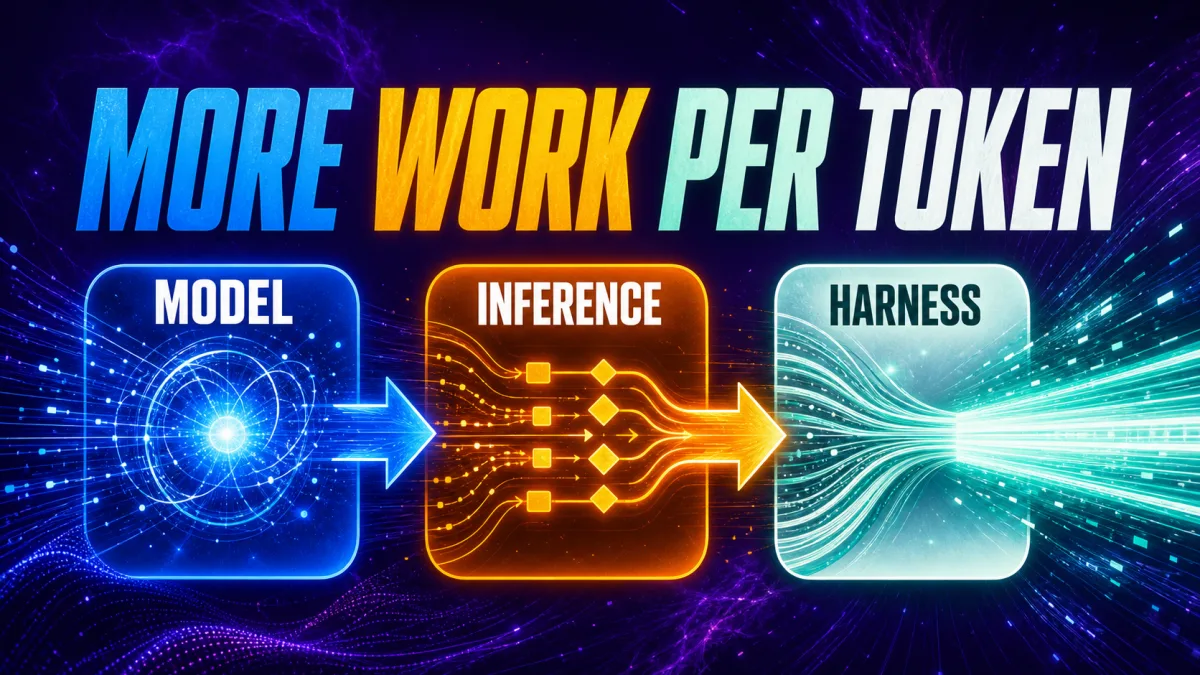
GPT-5.6's efficiency gains come from the whole system, not only from the model. In its technical account of GPT-5.6's frontier intelligence and efficiency, OpenAI describes improvements in model training, inference and the agentic harness behind Codex and ChatGPT Work; the takeaway for operators is to measure cost and latency per completed workflow, not just tokens per response.
Definition: GPT-5.6's efficiency is a stack-wide design spanning the model, inference infrastructure and the harness that manages agent loops.
Example: OpenAI says GPT-5.6 Sol helped optimize routing, production kernels and speculative decoding while the harness reduced repeated context and tool overhead.
Key takeaway: A frontier model can become cheaper to use when every repeated operation around it is optimized.
Business impact: Teams evaluating GPT-5.6 should benchmark the complete workflow—model calls, tool calls, caching, latency and recovery—not the model in isolation.
Where does GPT-5.6's efficiency come from?
GPT-5.6's efficiency comes from three compounding layers: model behavior, inference and the agentic harness. OpenAI says the model is trained to achieve more useful work per token, while inference improvements serve more tokens from the same hardware and the harness removes repeated work around tools and context. The practical action is to assign one owner to the full cost curve instead of optimizing only prompts or GPU utilization.
| Layer | OpenAI-described focus | Reported outcome |
|---|---|---|
| Model | More work per token and a more direct path through tasks | Higher intelligence-per-token efficiency |
| Inference | Routing, scheduling, kernels, speculative decoding and caching | 20% lower end-to-end serving cost from combined kernel work; more than 15% higher token-generation efficiency from the improved speculator |
| Agentic harness | Context discovery, tool output, prompt caching and repeated work | Lower overhead across multi-request agent loops |
How did GPT-5.6 improve inference?
GPT-5.6 improves inference by treating request routing, GPU execution and cached work as one optimization problem. OpenAI says requests are balanced across geography, capacity, accelerator type, context length and cache availability, while each model instance also partitions work across accelerators and computing cores. The takeaway is that a high-performing model can still waste capacity when routing or scheduling leaves hardware idle.
GPT-5.6 Sol helped reduce serving cost through production-kernel optimization. OpenAI says GPT-5.6 Sol, running in Codex, found work that could be precomputed, avoided or parallelized and autonomously rewrote production kernels in Triton and Gluon; OpenAI reports that the combined kernel improvements reduced end-to-end serving costs by 20%. Teams serving tool-heavy workloads should profile memory movement, synchronization and data layout before assuming a larger hardware fleet is the only path to capacity.
GPT-5.6 also uses speculative decoding to reduce sequential generation work. OpenAI describes a smaller draft model proposing tokens for the primary model to verify in parallel, and says GPT-5.6 Sol improved that draft model through hundreds of architecture experiments; OpenAI reports more than a 15% increase in token-generation efficiency. The operational takeaway is to evaluate accepted tokens per primary-model pass, not only raw generation speed.
GPT-5.6 applies workload-specific configuration to cached input and output generation. OpenAI says the best batching, sharding and key-value-cache management depend on prompt length, output length, batch size and cache hit rate, making broad heuristics insufficient; GPT-5.6 Sol in Codex analyzed production workloads and evaluated candidate configurations. Operators should therefore measure cache behavior and workload shape before applying one serving configuration to every request class.
How does the agentic harness remove repeated work?
GPT-5.6's agentic harness targets the repeated region inside a multi-step task. OpenAI describes Codex and ChatGPT Work as sequences of model requests and tool calls that may inspect code, search history, read reports, edit files and run tests; when a task needs 30 requests, one extra second per request accumulates. The concrete takeaway is to optimize the loop around the model whenever a workflow performs the same setup or transport work repeatedly.
The harness reduces context bloat through deferred discovery and bounded tool output. OpenAI says tools, MCP integrations, skills and plugins become surfaceable only when needed, and that individual tools cannot unexpectedly consume the context window; tool output is capped at 10,000 tokens by default unless the model asks for a different limit. Teams building an AI agent can use the same principle: expose the smallest relevant capability set and make oversized intermediate results an explicit decision.
For a broader explanation of how an AI agent completes multi-step work with tools, the key distinction is useful here: the model response is only one step, while the harness controls the sequence of context, actions and results that turns a request into a completed task. See also Advancing the price-performance frontier with GPT-5.6. More on this: OpenAI Launches GPT-5.6 Sol, Terra and Luna: Pricing, Access and What Changes. See also Jalapeno, the inference accelerator OpenAI designed with Broadcom. See also Model ML turns GPT-5.6 Sol into finance-ready files. Background: GPT-5.6 for builders: lower-cost agent architecture. Related reading: OpenAI’s new flagship model deletes files on its own, people keep warning. More on this: ChatGPT expands free access as GPT-5.6 Sol gets sharper. Related reading: GPT-5.6 in Kiro cuts task cost by about 82%.
The harness preserves exact prompt prefixes so prompt caching can reuse computation. OpenAI says model-visible history is append-only, tools are presented in deterministic order and runtime settings are applied during execution rather than embedded in tool definitions; those choices preserve a reusable prefix across requests. The practical takeaway is to treat context order and tool-definition stability as performance inputs, not merely implementation details.
What role did GPT-5.6 Sol play in the stack?
GPT-5.6 Sol was used as an engineering collaborator inside Codex, not only as the model being served. OpenAI says Sol analyzed production traffic, identified overlooked load imbalance, tested routing strategies, optimized kernels and improved its own draft model; OpenAI also says Sol launched and monitored speculator training and intervened when failures or instability appeared. The source supports an important but bounded conclusion: the model helped accelerate optimization loops, while OpenAI's engineers still owned verification and production control.
OpenAI pairs model-generated kernel changes with verification tooling. OpenAI highlights FpSan, its open-source floating-point sanitizer, as part of validating kernels written by GPT-5.6 Sol, and describes inference optimization as a feedback loop of measuring production behavior, implementing changes and checking whole-system effects. The takeaway for operators is that AI-assisted infrastructure work needs automated correctness checks and production-wide measurements before deployment.
What does the GPT-5.6 approach change for operators?
GPT-5.6 makes efficiency a systems KPI because model quality, inference cost and orchestration overhead compound inside one workflow. OpenAI says its improvements span research, inference and the agentic harness, and that individually limited gains accumulate into lower latency, more capacity and lower user cost. Operators should record accepted task quality, total tokens, model turns, tool calls, cache hits, latency and failure recovery together so a local optimization is not mistaken for a production improvement.
GPT-5.6's story is a case for measuring completed work rather than isolated model output. OpenAI's reported 20% serving-cost reduction from combined kernel work and more-than-15% token-generation improvement from speculative decoding show that the biggest gains can sit below the visible answer; the harness discussion adds context and tool overhead to the same accounting. The next useful test for a team is a fixed workload replay that compares total cost and accepted outcomes before and after each layer changes.
What remains uncertain?
OpenAI's technical post reports engineering results from its own systems, so it does not establish a universal saving for every deployment. The reported serving-cost and token-generation figures depend on OpenAI's traffic, hardware, models, workloads and verification process, while the harness benefits depend on how many tools and requests a particular agent uses. The responsible takeaway is to use the post as a map of optimization levers and validate each lever against a team's own latency, quality, reliability and cost data.
The central lesson is not that one optimization wins, but that frontier efficiency is cumulative. GPT-5.6 combines more work per token with better routing, kernels, speculative decoding, caching and harness behavior; OpenAI says the gains compound across the stack. For operators, that means a model migration should include an end-to-end performance plan rather than a single API benchmark.
Frequently asked questions
What is the main efficiency idea behind GPT-5.6?
OpenAI's GPT-5.6 efficiency strategy is broader than making a model generate fewer tokens. OpenAI describes improvements across model training, inference and the agentic harness that connects models to tools and user environments. The model is trained to complete more work per token; inference serves more output from the same hardware; and the harness reduces repeated context, tool and orchestration overhead. The practical implication is that teams should evaluate the cost and latency of a complete workflow, not only the model's raw benchmark score.
Which inference improvements does OpenAI describe?
OpenAI describes load balancing, kernel optimization, speculative decoding, caching and workload-specific configuration as the main inference levers behind GPT-5.6's efficiency. OpenAI says GPT-5.6 Sol helped optimize production kernels and that the combined kernel work reduced end-to-end serving costs by 20%. OpenAI also reports that changes to the draft model used for speculative decoding increased token-generation efficiency by more than 15%. These are OpenAI-reported system results, so teams should measure the same effects on their own traffic and workloads.
How does GPT-5.6's agentic harness reduce waste?
GPT-5.6's agentic harness reduces waste by limiting repeated work around model calls and tool use. OpenAI says the Rust orchestration layer uses deferred discovery for tools and skills, caps tool output at 10,000 tokens by default, preserves append-only model-visible history for prompt caching, and presents tools in a deterministic order. Those choices help an agent avoid loading irrelevant context and recomputing the same prompt prefix. The result is a design pattern for measuring full agent-loop cost, rather than treating each model request as an isolated event.
Did GPT-5.6 Sol contribute to the optimizations?
Yes. OpenAI says GPT-5.6 Sol running in Codex helped analyze production traffic, identify load imbalance, test routing strategies, optimize production kernels and improve its own speculative-decoding draft model. OpenAI also says Sol launched and monitored speculator training and intervened when hardware failures or training instability appeared. The article describes these as OpenAI's account of the engineering process, not as an independently verified measure of how much work the model replaced or how much every team should expect to save.
What should an operator take away from the GPT-5.6 story?
An operator should treat GPT-5.6 efficiency as a systems question. Model choice matters, but routing, scheduling, kernels, caching, tool-output size, context growth and repeated agent steps can also determine the cost and latency of a production workflow. OpenAI's reported 20% serving-cost reduction from kernel work and more-than-15% token-generation gain from speculative decoding show why those layers deserve measurement. Before changing a production stack, compare accepted task quality, total tokens, tool calls, latency, cache behavior and failure recovery on the same workload.
Alex
Founder & Lead AI Writer
Alex is the founder of Yowox and lead AI writer since 2024, breaking down complex information into clear, actionable insights for thousands of readers every day. Alex has built AI automation systems for businesses since 2024, focusing on AI agents, workflow automation, and business process optimization.
Save hours. Save thousands.
Practical guides, real workflows, and the latest AI and automation news that matters — straight to your inbox.