 By Alex
 ChatGPT expands free access as GPT-5.6 Sol gets sharper
OpenAI is giving Free and Go users unlimited text chats with GPT-5.6 Luna while adding deeper-reasoning controls and a more focused GPT-5.6 Sol for Plus and Pro users.
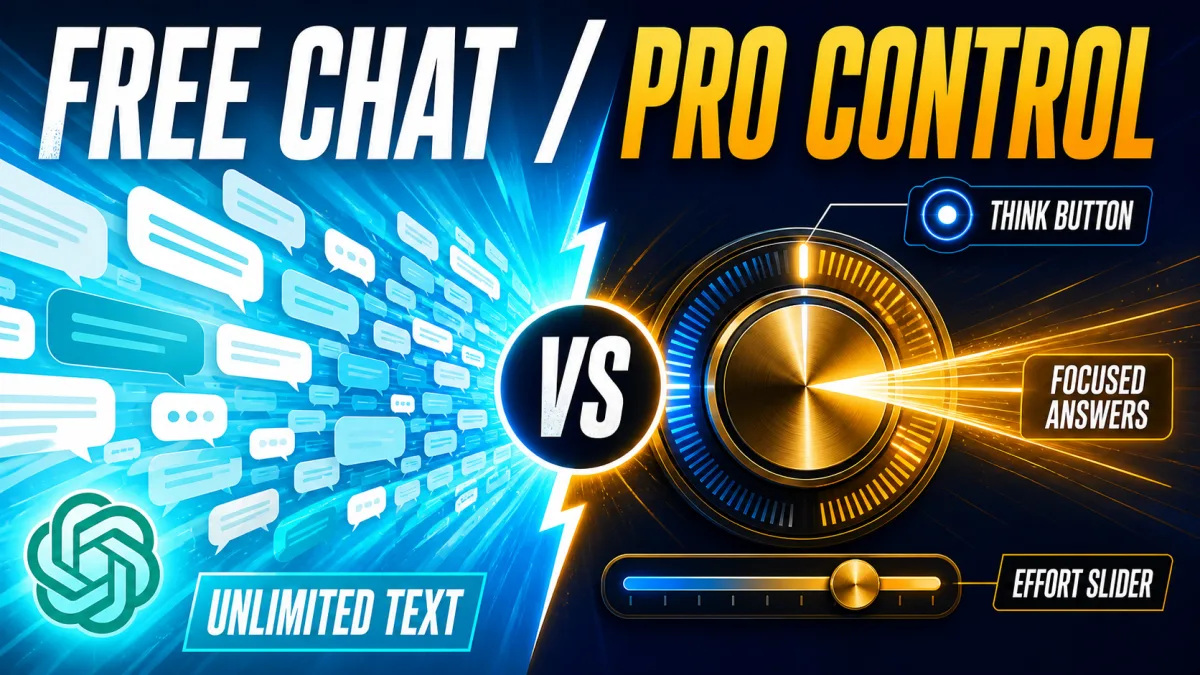
OpenAI is widening ChatGPT access while making response effort more deliberate: Free and Go users are getting GPT-5.6 Luna as the default with unlimited text chats, while Plus and Pro users receive a sharper GPT-5.6 Sol and a thinking slider. The August 6 announcement says the rollout still keeps separate limits for files, images and other tools. The practical takeaway is that ChatGPT is changing both who can keep chatting and how users ask for deeper reasoning.
Definition: This ChatGPT update combines a stronger everyday GPT-5.6 Sol experience for Plus and Pro with broader text access and an optional Think control for Free and Go users.
Example: A Free user can keep a text conversation going with GPT-5.6 Luna and tap Think for a harder question, while a Plus user can move the reasoning slider higher for planning or research.
Key takeaway: Unlimited text access does not mean unlimited access to files, images or every ChatGPT tool.
Business impact: Teams can expect more flexible ChatGPT experimentation, but production workflows still need model-specific testing, quota checks and human review for consequential work.
What changes for ChatGPT Free and Go users?
ChatGPT Free and Go users get GPT-5.6 Luna as the default model, followed by unlimited text chats and a Think button for harder questions. OpenAI says Luna becomes the default during the week of the announcement, while unlimited text chats and Think arrive the following week, subject to abuse guardrails. The practical step is to check the account after each rollout stage instead of assuming the model, quota and reasoning control appear at the same time.
ChatGPT's new free access is limited to text conversations, not every input or tool. OpenAI explicitly keeps separate limits for file uploads, images and other tools, so a user may be able to continue a text discussion while still hitting a different quota when attaching a document or image. That boundary matters for teams exploring AI automation stacks: broader chat access can support research and drafting, but it does not automatically provide the integrations, permissions or monitoring needed for production work.
How does GPT-5.6 Sol change ChatGPT for Plus and Pro?
The updated GPT-5.6 Sol is designed to make Plus and Pro answers more focused and more reliable with factual detail. OpenAI says the model is tuned to answer directly, adapt detail to the question, avoid unnecessary formatting and correct a user when simple agreement would be unhelpful. OpenAI also reports that responses containing at least one factual error were about 68% less common for GPT-5.6 Sol in an internal evaluation of financial, medical and legal prompts; the takeaway is to treat the result as evidence for testing, not as a promise of error-free answers.
GPT-5.6 Sol now connects quick ChatGPT replies and deeper reasoning through one consistent experience. OpenAI says Plus and Pro users can use a slider on web, mobile and desktop to choose how much thought ChatGPT puts into a response, from everyday questions to planning, research, writing, coding and decisions. Teams should test the slider against accepted output, review time and latency before changing a workflow, just as they would evaluate the model family in the earlier GPT-5.6 Sol, Terra and Luna launch.
Why does the Think button matter for business users?
The Think button gives Free and Go users an explicit way to request higher reasoning on a difficult question without applying deeper effort to every message. OpenAI describes the control as a way for GPT-5.6 Luna to spend more time working through harder questions, which makes the user decision visible: quick path for simple work, Think for multi-step reasoning. The business takeaway is to use Think for planning, comparison or careful drafting, while keeping an approval step for actions that affect customers, records or money.
The Think button improves conversation control, but it does not turn ChatGPT into a tool-connected AI agent. A chatbot can reason and reply inside the conversation, while an AI agent also needs defined tools, permissions and verification to complete work in external systems. Teams should therefore evaluate Think as a reasoning setting inside ChatGPT, not as evidence that a free account can safely run an autonomous workflow.
Does the update change GPT-5.6 across OpenAI products?
The ChatGPT release does not change the GPT-5.6 Sol version used by ChatGPT Work or Codex. OpenAI says the updated Sol in this announcement is optimized for everyday conversations and is available only in the Chat experience in ChatGPT; the Sol version powering Work and Codex is unchanged. The practical consequence is that a team must map the announced behavior to the exact product surface it uses rather than applying the ChatGPT notes to every OpenAI deployment.
The release also adds safety boundaries for users OpenAI believes are under 18. OpenAI says the update includes protections against romantic roleplay, age-restricted challenges, dangerous activities, graphic violence and other risks, together with encouragement to connect with trusted people when a teen may need support. Businesses serving younger users should read the linked safety evaluation and test the relevant user journeys instead of assuming a general model-quality update covers their product obligations.
What should teams watch after the rollout?
The useful measure after this ChatGPT rollout is whether each new control improves a real task without hiding a separate quota or review risk. The announcement supplies the product changes—GPT-5.6 Luna for Free and Go, Think for harder questions, a reasoning slider for Plus and Pro, and a more focused Sol—but account availability still rolls out in stages and tool limits remain separate. Teams should record which plan, model, control, input type and review path each workflow uses, then update guidance only when those conditions are verified in the live account.
Frequently asked questions
What is changing for ChatGPT Free and Go users?
OpenAI is making GPT-5.6 Luna the default model for ChatGPT Free and Go users, then adding unlimited text chats and a Think button for harder questions. The rollout is not unlimited access to every ChatGPT feature: OpenAI says separate limits still apply to file uploads, images and other tools. Free and Go users should therefore treat the change as broader text access plus an optional higher-reasoning control, not as an unrestricted replacement for every paid capability.
What does the GPT-5.6 Sol update add for Plus and Pro users?
The updated GPT-5.6 Sol is designed to give Plus and Pro users more focused answers, tighter formatting and fewer factual mistakes, especially when a response depends on dates, numbers, sources, rules or assumptions. OpenAI reports that responses with at least one factual error were about 68% less common for GPT-5.6 Sol in an internal evaluation of financial, medical and legal prompts. The result is an improvement claim, not a guarantee that consequential answers no longer need verification.
What is the Think button in ChatGPT?
The Think button lets ChatGPT Free and Go users give GPT-5.6 Luna more time to work through a difficult question. It is meant for problems that need higher reasoning rather than for every quick message. A practical pattern is to use the normal response path for simple questions and choose Think when the task involves several steps, planning or careful comparison. The button changes reasoning effort inside ChatGPT; it does not by itself grant access to external business systems or make the model an AI agent.
Does the new GPT-5.6 Sol update change Codex or ChatGPT Work?
No. OpenAI says this version of GPT-5.6 Sol is optimized for everyday conversations and is available only in the Chat experience in ChatGPT. The GPT-5.6 Sol version powering Work and Codex is not changing as part of this release. Businesses should therefore avoid treating the ChatGPT update as a blanket model change across all OpenAI products. Check the product surface, plan and controls that actually run a workflow before updating internal model guidance.
Alex
Founder & Lead AI Writer
Alex is the founder of Yowox and lead AI writer since 2024, breaking down complex information into clear, actionable insights for thousands of readers every day. Alex has built AI automation systems for businesses since 2024, focusing on AI agents, workflow automation, and business process optimization.
Save hours. Save thousands.
Practical guides, real workflows, and the latest AI and automation news that matters — straight to your inbox.