 By Alex
 GPT-5.6 in Kiro cuts task cost by about 82%
OpenAI says GPT-5.6 is now available in Kiro, where Terra completed successful Terminal-Bench 2.1 tasks at roughly 82% lower cost in testing with AWS.
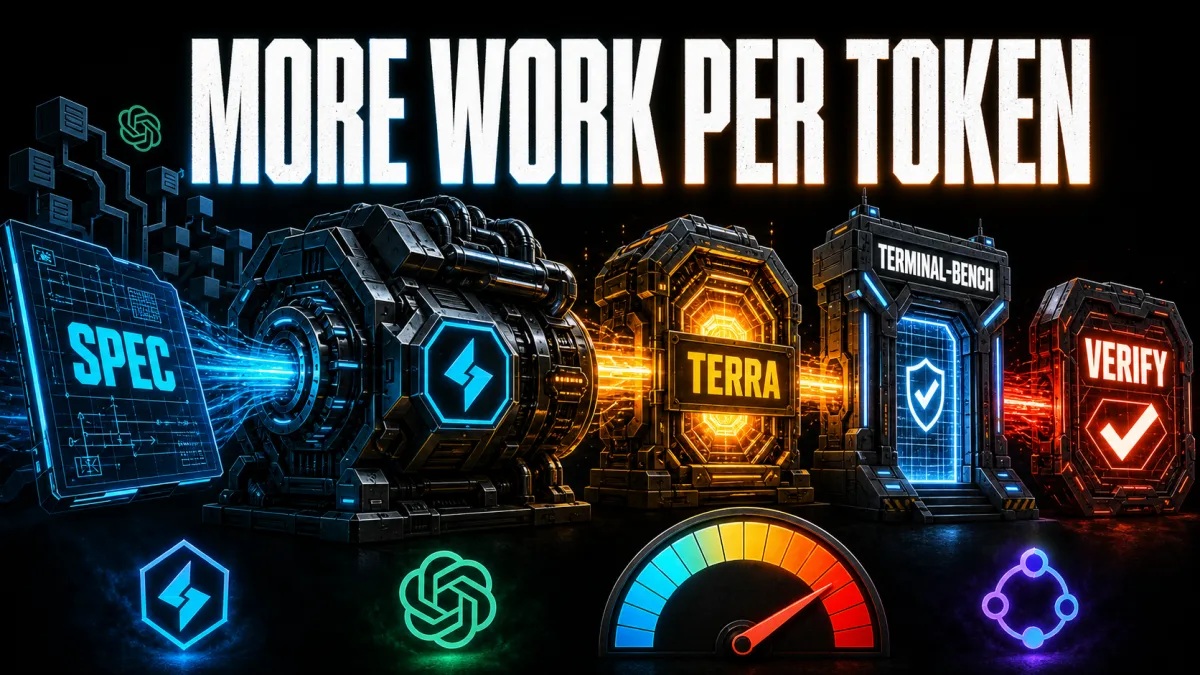
OpenAI says the GPT-5.6 family is now available in Kiro, with testing showing GPT-5.6 Terra completed successful Terminal-Bench 2.1 tasks at roughly 82% lower cost. The August 24 announcement describes a developer workflow that combines OpenAI's models with Kiro's requirements, design and testing structure. The practical takeaway is narrower than the headline: developers now have a new model-and-workflow combination to evaluate for long-running coding tasks.
Definition: GPT-5.6 in Kiro combines OpenAI's Sol, Terra and Luna models with Kiro's structured software-development workflow.
Example: A team can turn product requirements into an implementation plan, use GPT-5.6 to execute multi-step coding work, and review the result before changes are applied.
Key takeaway: The reported 82% saving belongs to successful Terminal-Bench 2.1 tasks in Kiro, not to every coding project.
Business impact: Teams can test whether structured context lowers the cost of completed development work without giving up review and verification.
What changed for GPT-5.6 in Kiro?
GPT-5.6 is now available in Kiro across the development work where teams plan, build, review and test software. OpenAI names Sol, Terra and Luna as the model family added to Kiro and positions the combination for complex, long-running development tasks. Developers evaluating the update should treat Kiro as part of the result: model quality and the surrounding engineering process are being offered together.
Kiro's role is to turn high-level intent into structured requirements, technical designs and executable tasks. OpenAI says that context helps GPT-5.6 understand what a team is building, how the system should work and what the implementation must accomplish. For developers, the useful action is to keep requirements and team standards explicit before asking the model to change a codebase.
The broader model context is covered in Yowox's earlier overview of GPT-5.6 Sol, Terra and Luna, while this announcement is specifically about how the family fits into Kiro's development environment.
Why does Kiro's structured context matter?
Kiro's spec-driven approach gives GPT-5.6 a more explicit target than a standalone coding prompt. The OpenAI announcement says Kiro grounds the model in requirements, designs, task context, codebase information and team standards before implementation begins. Developers can use that structure to reduce ambiguity at the start of a long task, then inspect the model's work at checkpoints instead of waiting until the entire change is complete.
GPT-5.6 in Kiro is aimed at multi-step engineering work rather than isolated code completion. The source says developers can create implementation plans, complete complex coding tasks, use spec-driven development, work with codebase context, review changes and check correctness with property-based testing. That list gives teams a concrete evaluation scope: test the full loop from requirement to verified implementation, not only the quality of one generated function.
This is the same distinction that makes an AI agent different from a chatbot: the useful system is not only the model's reply, but the sequence of planning, tool use, action and verification that produces a completed task.
What did the 82% cost result measure?
OpenAI and AWS report that GPT-5.6 Terra completed successful Terminal-Bench 2.1 tasks in Kiro at roughly 82% lower cost. The figure comes from testing in the Kiro environment and is attached to successful tasks, which makes it more relevant than a token-price comparison alone. Developers should reproduce the same kind of measurement on representative repositories before assuming that the benchmark result transfers to their own work.
The reported result does not mean every GPT-5.6 coding session will be 82% cheaper. Terminal-Bench 2.1 is the named test, Terra is the named model, and Kiro's spec-driven context is part of the setup. A production team may see a different outcome when tasks require more retries, larger context, extra review or different tools. The safe takeaway is to measure cost per accepted change, not to multiply a list price by one prompt.
Which coding tasks can developers try first?
GPT-5.6 in Kiro is positioned for development tasks that benefit from explicit requirements and multiple execution steps. OpenAI lists implementation planning, complex coding work, spec-driven development, codebase-wide context, checkpoint review and property-based testing as practical uses. A team can start with one repeatable task in each of those categories, keep the same acceptance checks and compare the number of iterations required to reach a working result.
The source does not claim that GPT-5.6 removes developer oversight. Kiro's workflow instead makes review and refinement part of the process, while property-based testing supplies one way to check implementation correctness. Developers should keep ownership of requirements and acceptance criteria, especially when a generated change affects production systems or shared interfaces.
What should teams measure before switching?
Teams should compare GPT-5.6 in Kiro by completed-task cost, quality and iteration count rather than by benchmark percentage alone. The announcement provides a useful starting point—a roughly 82% cost reduction for successful Terra tasks in Kiro—but it does not publish a result for every repository, language or workflow. A fixed evaluation set should therefore record accepted output, retries, review time, test failures and total spend before a routing decision is made.
Model routing remains a whole-workflow decision when a coding agent can plan, call tools, revise code and run tests. Yowox's analysis of model routing in production explains why the cheapest first call can lose once retries, latency and execution paths are included. GPT-5.6 in Kiro makes the same operational question concrete for software teams: does the structured environment help a chosen model reach an accepted result with less total work?
What is available now?
The GPT-5.6 family is available in Kiro, and OpenAI directs developers to Kiro to get started. The source says OpenAI and AWS will continue working together to improve model performance in Kiro and deliver more value across the software development lifecycle. Developers should verify the current availability, account requirements and model options in Kiro before planning a migration, because the announcement does not provide a universal access or pricing table.
The immediate news is therefore a new combination, not a blanket promise: GPT-5.6 brings Sol, Terra and Luna into Kiro's structured coding workflow, and the reported Terra result gives teams a concrete cost hypothesis to test. The next step is a small, controlled evaluation that measures finished engineering work under the same requirements, tests and review standards.
Frequently asked questions
What is new about GPT-5.6 in Kiro?
OpenAI says the GPT-5.6 family is now available inside Kiro, a software development agent that structures work around requirements, technical designs and executable tasks. The announcement names Sol, Terra and Luna as the available model family and describes workflows covering planning, implementation, review and testing. The practical change is that developers can use the models inside Kiro's spec-driven development process rather than treating model choice as a separate step from engineering context.
Which GPT-5.6 models are available in Kiro?
OpenAI says Kiro includes GPT-5.6 Sol, Terra and Luna. The source presents them as one family that gives developers more options for complex and long-running development tasks, with the model choice matched to the work being done. The announcement does not publish a separate Kiro price table for each model, so teams should check their Kiro account and current product documentation before estimating a production budget.
What does the roughly 82% cost reduction mean?
OpenAI says testing by OpenAI and AWS found that GPT-5.6 Terra completed successful Terminal-Bench 2.1 tasks in Kiro at roughly 82% lower cost. That is a reported result for the named benchmark and Kiro environment, not a promise that every repository or coding task will cost 82% less. Developers should compare successful-task cost, retries and review effort on their own workloads before using the figure as a planning assumption.
How should teams evaluate GPT-5.6 in Kiro?
Teams should evaluate GPT-5.6 in Kiro against a fixed set of representative development tasks and keep the acceptance criteria unchanged. Record whether the implementation works, how many iterations it needs, how much human review is required and what the completed task costs. Start with the model tier that fits the task, then compare the result with alternatives. A lower token or credit cost is useful only when the workflow still reaches an accepted result.
Alex
Founder & Lead AI Writer
Alex is the founder of Yowox and lead AI writer since 2024, breaking down complex information into clear, actionable insights for thousands of readers every day. Alex has built AI automation systems for businesses since 2024, focusing on AI agents, workflow automation, and business process optimization.
Save hours. Save thousands.
Practical guides, real workflows, and the latest AI and automation news that matters — straight to your inbox.