 By Alex
 Meta is using AI to ship more standalone apps
Meta says large language models are speeding product development, helping it launch standalone apps and scale new ideas through recommendation systems.
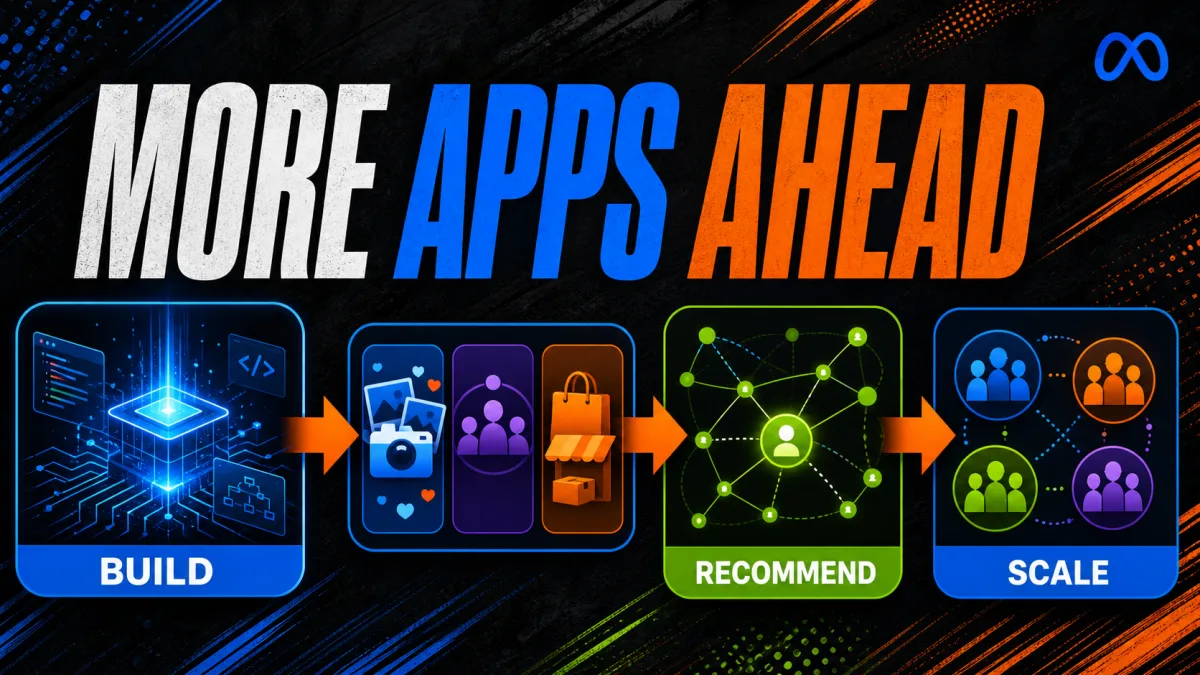
Meta is using large language models to make standalone app development faster, and Mark Zuckerberg says more consumer products are coming soon. The claim came during Meta's second-quarter 2026 earnings call, where Zuckerberg pointed to recent launches and said Meta plans to use its recommendation systems to scale new ideas. TechCrunch's report is the immediate source for the announcement and its product context.
Definition: Meta's new app strategy combines faster AI-assisted development with Meta's existing recommendation and distribution systems.
Example: Meta cited Instagram Instants, Forum for Facebook Groups and Seller for Marketplace as recent standalone launches.
Key takeaway: AI can reduce the cost of testing app ideas, but recommendation quality and user adoption still determine which products survive.
Business impact: The change could increase the number of specialized consumer apps Meta can test while making product discovery more dependent on algorithmic distribution.
What did Meta announce about standalone apps?
Meta says AI is helping its teams ship standalone apps faster, especially as large language models support product development and engineering work. During the July 29 earnings call, Mark Zuckerberg named Instagram Instants, Forum and Seller as recent examples, then said Meta is planning more ideas and will use recommendation systems to scale them to people likely to find them interesting. For operators, the practical signal is a shorter test-and-learn cycle, not a guarantee that every new app becomes a durable product.
Meta's recent app activity spans different use cases rather than one obvious replacement for its main platforms. Instagram Instants is a photos product, Forum is a standalone Groups app and Seller is a standalone Marketplace app; the TechCrunch report also lists Pocket, a vibe-coded gaming app, and an AI bedtime-story experiment. The useful distinction is between a faster pipeline for experiments and a proven portfolio of successful businesses: Meta has announced the former, not the latter.
Why is AI changing Meta's app pipeline?
AI is changing Meta's app pipeline by reducing the time needed to build, evaluate and iterate on software ideas. Zuckerberg told investors that AI is helping Meta's teams speed product development, while Meta's earnings transcript connects the same investment to recommendation systems, product launches and new AI products. The takeaway for businesses is that AI-assisted development matters most when it is paired with a distribution loop that can test ideas with real users.
The technology involved is broader than code generation alone. Meta says LLM-powered agents help with engineering development by evaluating content quality, detecting trends and testing ranking changes, while LLMs also help recommendation systems understand content and generate better training data. That makes Meta's approach closer to an AI-enabled product loop than to a simple coding assistant: models help build the app, then help decide what content and experiences users see inside it.
For a broader explanation of the difference between a model that answers and an AI agent that uses tools and completes a task, the key concept is action. Meta is describing models and agents inside its development and recommendation systems, not claiming that every new app is autonomously built from one prompt.
How will recommendation systems scale new apps?
Meta says recommendation systems will help new apps reach the users most likely to value them, which is important because faster shipping only creates more experiments to distribute. Zuckerberg described Meta's plan as building more ideas and using recommendations to scale them, with Threads as the example of a product that benefited from Meta's existing user base and cross-platform promotion. The practical test is whether recommendation systems can find durable communities rather than only generate an initial burst of attention.
Meta's official earnings transcript gives more detail on the recommendation layer: the company says every public Reels and Feed post on Instagram is automatically processed through an LLM and analyzed across dimensions including topic and tone. Meta also says LLMs are increasingly useful for ranking and recommendations because they improve content understanding and training data. Those are Meta's own claims, so readers should treat them as company-reported product and system updates rather than independent proof of long-term user outcomes. Background: Meta is making its AI chatbot more like an assistant.. See also Meta AI Mac app adds screen context and dictation. More on this: Meta AI Links Small-Business Data to Daily Work. See also Zuckerberg Tells Meta Staff AI Agent Development Is Slower Than Expected. Related reading: Zuckerberg: billions on personal AI agents within 5 years.
Threads is the most relevant comparison because Meta said the app crossed 500 million monthly active users in the quarter. Meta's transcript connects Threads' growth with its recommendation work and existing distribution, but the number does not show that every future standalone app will follow the same path. A large installed base can help seed a product; it cannot manufacture a reason for people to keep using it.
What did Meta learn from earlier app experiments?
Meta's earlier app experiments show why a faster launch process is not the same as a successful product strategy. TechCrunch reports that Facebook's Creative Labs produced apps such as Slingshot, Rooms, Paper, Moments and Riff before the effort ended in 2015, while the later NPE Team tested products including Bump, Aux, Venue, Hotline, Super, Tuned and BARS. The lesson for product teams is to judge the new pipeline by retention and usefulness, not by how many names appear in an app-store announcement.
Meta's current advantage is the combination of a very large user base, recommendation infrastructure and AI-assisted development. Meta reported 3.6 billion people using at least one of its apps each day in the second quarter, while Threads crossed 500 million monthly active users. Those figures explain why Meta can test distribution at a scale that smaller app companies cannot, but they do not remove the need for a clear product purpose or a sustainable user experience.
What does this mean for app builders?
Meta's announcement suggests that the scarce resource in consumer software may shift from initial implementation to validated attention. When AI makes prototypes and narrow products faster to create, product teams can explore more ideas, but they also create more competition for users, data and distribution. The appropriate response is to connect AI-assisted building to a measurable loop: define the user problem, ship a narrow experience, measure repeat use and stop ideas that do not earn continued attention.
The same principle applies to business automation. An AI automation stack still needs context, tool access, orchestration, guardrails and monitoring after a model can write code or make recommendations. Teams evaluating AI-assisted development should therefore measure completed user outcomes, error rates, review effort and retention rather than counting generated features or prototype speed alone.
What should readers watch next?
The next evidence will be the products Meta actually releases and the behavior those products earn after launch. Zuckerberg said more new consumer products are coming soon, but the earnings call did not provide a detailed list or launch schedule. The meaningful questions are whether Meta can turn faster experimentation into products with durable demand, how recommendation systems introduce those products to existing users and what role Meta's AI infrastructure plays in the economics of running them.
Meta has shown that AI can make its app pipeline more prolific. The unresolved question is whether a larger stream of standalone apps will produce more lasting value, or simply make the company faster at repeating the same cycle of launch, recommendation and shutdown.
Frequently asked questions
Why does Meta say AI will help it launch more apps?
Meta says large language models are helping its teams speed up product development, which lowers the effort required to test and ship standalone consumer apps. On its July 2026 earnings call, Mark Zuckerberg pointed to Instagram Instants, Forum for Facebook Groups and Seller for Marketplace as recent launches, then said Meta plans to build more ideas and use its recommendation systems to find the right audiences for them.
Which new standalone apps did Meta mention?
Meta mentioned Instagram Instants, Forum, a standalone Groups app, and Seller, a standalone Marketplace app. The TechCrunch report also describes recent experiments including the vibe-coded gaming app Pocket and an AI bedtime-story app. The article does not establish that every experiment has the same launch status or long-term support.
How are LLMs involved in Meta's recommendation systems?
Meta says LLMs help its recommendation systems understand what content is about, generate better training data and improve ranking decisions. Meta's CFO also said LLM-powered agents help evaluate content quality, detect trends and test ranking changes. Meta reported that every public Reels and Feed post on Instagram is automatically processed through an LLM for analysis across topics and tone.
Does faster app development mean Meta's new apps will succeed?
No. Faster development can make it cheaper and quicker for Meta to test new ideas, but it does not prove that users will adopt or keep using them. Meta has previously launched experimental apps through Creative Labs and its NPE Team, and the TechCrunch report says those efforts did not produce a breakout success. Distribution, product quality and sustained user value still decide whether a new app lasts.
What should businesses watch next?
Businesses should watch whether Meta's faster app cycle produces products with durable user demand, not just a larger launch count. The immediate signals are which new consumer products Meta releases, how recommendation systems seed them, whether users return and whether Meta explains the data, privacy and business model behind each experiment. Zuckerberg said more new consumer products are expected soon, but he did not provide a detailed roadmap on the call.
Alex
Founder & Lead AI Writer
Alex is the founder of Yowox and lead AI writer since 2024, breaking down complex information into clear, actionable insights for thousands of readers every day. Alex has built AI automation systems for businesses since 2024, focusing on AI agents, workflow automation, and business process optimization.
Save hours. Save thousands.
Practical guides, real workflows, and the latest AI and automation news that matters — straight to your inbox.