 By Alex
 Zuckerberg: billions on personal AI agents within 5 years
Mark Zuckerberg says billions of people could use personal AI agents within five years, while Meta is betting on messaging, infrastructure and business adoption to make that future real.
Mark Zuckerberg predicts that billions of people will have personal AI agents within five years, but the forecast is still a bet on adoption, infrastructure and trust rather than a confirmed product milestone. He made the prediction during Meta's July 29, 2026 earnings call, where he described agents that understand a person's goals and work on their behalf continuously. For businesses, the signal is to track what Meta actually ships and what users permit agents to do—not to treat a five-year forecast as a delivery date.
Definition: A personal AI agent is an AI system designed to pursue a person's goals across multiple tasks, not merely generate a reply.
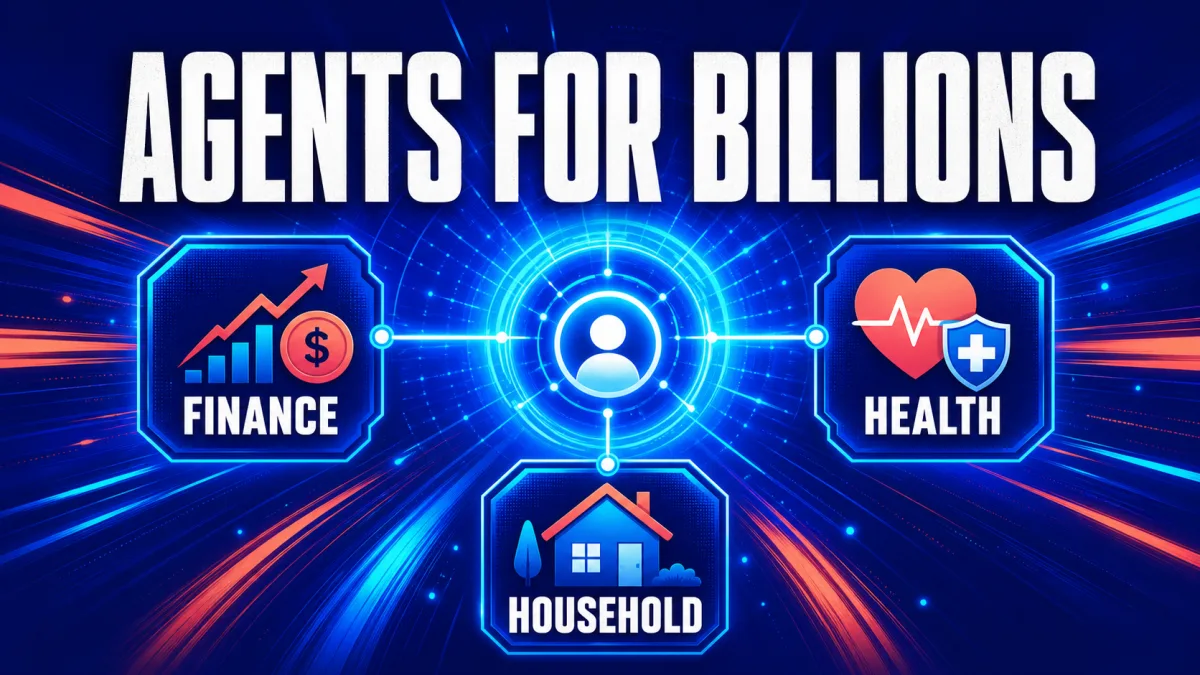
Example: Zuckerberg named finances, health, relationships and household management as areas where people could use such agents.
Key takeaway: Meta is presenting agentic AI as a future consumer interface, with messaging as a likely access point.
Business impact: Companies building around AI agents should separate the size of the forecast from the evidence of present adoption, reliability and user trust.
What exactly did Zuckerberg predict?
Mark Zuckerberg said it is “extremely unlikely” that, looking five years ahead, billions of people will not have a personal agent that understands their goals and works on their behalf 24/7, according to TechCrunch's report from the earnings call. The statement is a forecast about the direction of consumer AI, not a promise that every agent will have the same capabilities or that Meta will supply all of them. Readers assessing the claim should watch adoption and shipped product behavior rather than repeat the forecast as a fact.
Zuckerberg framed the personal agent as a system that understands goals and operates across a domain a user cares about. He listed finances, health, interpersonal relationships and household management as possible areas of use, but the public comments did not define the permissions, human review, privacy controls or error boundaries such agents would need. The practical question for users is therefore not only whether an agent can act, but which actions a person is willing to delegate.
Why is Meta putting messaging at the center?
WhatsApp and Meta's other messaging surfaces are likely to become more important if people interact with multiple agents, Zuckerberg said, because messaging already gives users a familiar place to ask for help and receive updates. Zuckerberg also said WhatsApp is already the leading platform where users interact with Meta AI. For operators, that makes messaging a strategic distribution channel to monitor, not proof that WhatsApp has already become a general-purpose personal-agent operating system.
The messaging angle also changes the competitive question. A personal agent may need to coordinate with other agents, services and people, so the interface could matter as much as the underlying model. Meta's advantage would come from putting agents inside surfaces people already use; the unresolved issue is whether users will accept agents acting in sensitive domains through those same conversations.
What evidence does Meta have today?
Meta's clearest adoption figure in the report is on the business side: its business agents, rolled out globally on WhatsApp and Messenger during the quarter, had been adopted by more than one million businesses. That number shows a starting point for Meta's agent strategy, but it does not demonstrate consumer adoption at the billions scale Zuckerberg predicts. Businesses and individuals also face different requirements around authority, privacy, liability and willingness to let an agent act without approval.
Meta's financial results show why infrastructure is part of the story. In its second-quarter 2026 results, Meta reported $784 million in free cash flow, down from $8.55 billion in the same quarter last year. The change shows that the buildout is expensive; it does not establish that the resulting capacity will translate into reliable personal agents or sustained consumer demand.
What is the business implication of the forecast?
The forecast matters because Meta is describing personal agents as a foundation for a new product and revenue wave, while investors are being asked to fund the infrastructure before that outcome is proven. Meta's plan combines a broad consumer use case, messaging distribution and large-scale compute investment. Businesses evaluating the opportunity should therefore separate three questions: whether agents can complete useful tasks, whether users will grant them enough access to be useful, and whether the economics work at scale.
Meta is also making this argument in a crowded market. The report notes that Google is emphasizing custom AI agents in Search and that Anthropic's Claude Code has gained traction among engineers. Those examples show that multiple companies are trying to move AI from answering questions toward acting on a user's behalf. They do not show that any one company has solved the trust, reliability or unit-economics problems required for mass personal-agent adoption.
What should readers watch next?
The next useful test is not whether Zuckerberg's prediction sounds plausible; it is whether Meta's products become dependable enough for people to delegate consequential tasks. Watch for clearly defined agent permissions, human-approval controls, evidence of repeat usage and explanations of how Meta handles mistakes in finances, health or household decisions. Those details will turn a broad five-year forecast into something that can be evaluated.
For businesses, the immediate takeaway is narrower: treat consumer agents as an emerging distribution and automation opportunity, while measuring actual task completion and user consent. Meta has described the destination—billions of people with personal agents—but the route still depends on products, infrastructure and trust that have not yet been fully demonstrated.
Frequently asked questions
What did Mark Zuckerberg predict about personal AI agents?
Mark Zuckerberg said on Meta's July 2026 earnings call that it is extremely unlikely that, five years from now, billions of people will not have a personal AI agent. He described an agent that understands a user's goals and works on that person's behalf around the clock across areas such as finances, health, relationships and household management. The statement is a forecast, not a published adoption target or a guarantee that Meta's products will reach that scale.
What would Meta's personal AI agents do?
Meta's personal AI agents are described as systems that understand a person's goals and work on their behalf rather than only answer questions. Zuckerberg named finances, health, interpersonal relationships and household management as possible domains. His comments do not specify a final product design, autonomy limit, pricing model or launch schedule for a consumer agent that performs all of those tasks.
Why does Zuckerberg think WhatsApp will matter?
Zuckerberg said WhatsApp and Meta's other messaging surfaces will become increasingly important as people interact with multiple agents. He also said WhatsApp is already the leading platform where users interact with Meta AI. The strategic idea is that messaging could become the place where people ask agents to act, coordinate with other agents and receive updates, although the earnings-call comments do not establish that every future personal-agent task will run inside WhatsApp.
Is Meta already seeing adoption of AI agents?
Meta said its business agents, which rolled out globally on WhatsApp and Messenger in the quarter, had been adopted by more than one million businesses, according to the reporting. That is business adoption, not evidence that billions of consumers already use personal agents. The distinction matters because Meta's forecast concerns consumer-scale, goal-oriented assistants, while the current figure describes a separate business-agent rollout.
What could make Meta's prediction difficult?
Meta must turn an ambitious consumer forecast into reliable products while funding the infrastructure behind them. In its second-quarter 2026 results, Meta reported $784 million in free cash flow for the quarter, down from $8.55 billion in the same quarter last year. The cash-flow change shows that the buildout is expensive, but it does not prove that consumer agents will reach billions of users or that people will trust agents with sensitive decisions.
Alex
Founder & Lead AI Writer
Alex is the founder of Yowox and lead AI writer since 2024, breaking down complex information into clear, actionable insights for thousands of readers every day. Alex has built AI automation systems for businesses since 2024, focusing on AI agents, workflow automation, and business process optimization.
Save hours. Save thousands.
Practical guides, real workflows, and the latest AI and automation news that matters — straight to your inbox.