 By Alex
 Claude text watermarks use low-stakes word choices
Anthropic says Claude will mark generated text by changing the source of randomness behind ordinary word choices, creating a hidden pattern that can be checked without adding characters, tokens, user data, or visible labels.
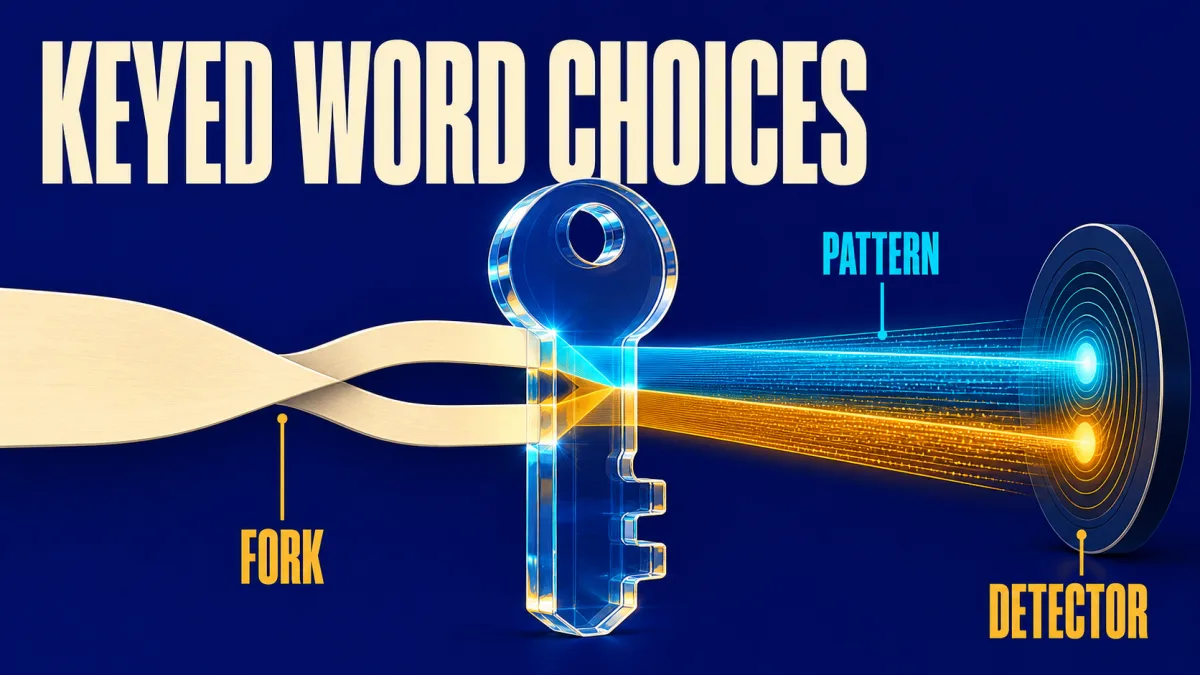
Claude-generated text will carry an invisible watermark that lives in the model's word choices, not in hidden characters or an added label. Anthropic says the system changes the source of randomness used when Claude chooses between similarly suitable words, creating a pattern that readers cannot see but a detector with the right key can test. In Anthropic's full explanation, the company connects the approach to its EU AI Act compliance work; the clarification was also reported by The Verge.
Definition: Claude text watermarking is a keyed pattern in Claude's normal token-selection process that can indicate whether Claude was likely involved in producing text.
Example: When “overcast” and “grey” would both preserve the meaning of “The weather today was cold and…”, the watermark can use the preceding words and its key to choose between them.
Key takeaway: The mark travels with the generated words as a statistical pattern, not as visible text or an invisible character inserted into the document.
Business impact: Teams using Claude for drafting, translation or research should treat future detection as an additional provenance signal, while keeping human review because the watermark is probabilistic and has known limits.
How does Claude's invisible watermark work?
Claude's watermark changes how randomness is selected among plausible next words, rather than adding data to the finished text. Large language models choose a next token from candidates with different probabilities, and many ordinary sentences contain moments where two options would be equally acceptable. Anthropic says its watermark uses a secret key plus a few preceding words to settle those low-stakes choices, so a later detector can compare the observed sequence with the pattern expected from that key.
The mechanism is therefore closer to changing a hidden coin flip than stamping a document. Anthropic says the watermark contains no hidden characters, does not identify a user or organization, and does not require extra tokens. For a business, that means copied text can retain the signal without carrying a visible badge or a separate metadata file—but only while enough of the original word-choice pattern survives.
Why is Anthropic using SynthID-Text?
Anthropic says Claude's method is a version of the SynthID-Text approach developed by Google DeepMind. The Verge describes SynthID-Text as a system that creates detectable patterns through wording probabilities, which matches Anthropic's explanation of changing low-stakes choices during generation. The practical distinction is that the mark is created while Claude chooses text, not added later as a visible label.
The important distinction is between a watermark and a conventional AI writing detector. A detector that does not possess Anthropic's key may look for stylistic patterns or other statistical signals. Anthropic's watermark detector is instead checking for consistency with a particular generation-time key, so its strongest answer is narrow: Claude was probably involved, not “this was definitely written by AI” or “this person used Claude.”
Does the watermark change Claude's quality or price?
Anthropic says Claude's text watermark will not make responses more expensive and should have no practical effect on quality or content. The company says watermarking creates no extra tokens and has negligible impact on model speed; its explanation also points to internal testing, Google's SynthID-Text research and a controlled human-rating study that found no statistically significant quality difference.
That claim has a clear technical boundary: the watermark only nudges choices where alternatives are already acceptable. It should not make Claude choose an obscure synonym when an exact term is required, and it should not override a factually necessary word. The practical takeaway for teams is to evaluate watermarked Claude outputs with the same quality, accuracy and review checks as before rather than assuming the compliance feature changes the model's capability.
What text is hardest to watermark?
Claude watermark detection is weaker when the model has fewer safe choices or when the sample is too short. Anthropic says a passage about a precise fact may contain almost no interchangeable words, while proofreading may alter only a few words that Claude selected; code also has less room for watermarking when an exact token is required for the program to work.
The watermark is also not a permanent seal against rewriting. Anthropic says light editing may leave enough of the pattern to detect, but a complete rewrite can remove it because the original choices no longer remain. A detector should therefore report a probability about Claude's involvement, not issue an absolute human-versus-AI judgment. This matters for editorial, education and compliance workflows that may otherwise treat a detector result as conclusive evidence.
What does this mean for businesses using Claude?
Businesses should treat Claude's future watermark as one provenance layer, not as a replacement for process controls. Teams can use it to support a review question—whether Claude likely contributed to a draft, translation or report—but the signal cannot identify the user, establish legal ownership, or show that every sentence came from Claude. Teams already comparing model behavior can track provenance alongside the quality, cost and reliability dimensions described in this practical AI model evaluation guide.
Anthropic says it will offer a watermark-detection API and publish more implementation details. Until those details are available, operators should avoid building hard automated decisions around an untested detector. The sensible next step is to record where Claude enters a workflow, preserve human approvals for consequential outputs, and use the eventual API as supporting evidence rather than as an authorship verdict. This matters across the surfaces where Claude sessions move between devices, including the web, desktop and mobile workflows described in Anthropic's Claude Cowork rollout. More on this: Claude Code CLAUDE.md: A Lean Project Memory Guide. See also Claude Sonnet 5 Is Anthropic's New Agentic Workhorse. What Changed?. Background: Claude Gmail replies can now go out unattended.
How are Claude-generated files marked?
Claude-generated supported files will use a different mechanism: C2PA content credentials in file metadata, where applicable. Anthropic says files such as PNG, JPG and SVG can carry a small cryptographically signed note saying that Claude made or processed the file. C2PA is an open provenance standard, so a compatible tool can read the credential; the metadata label is not the same as the text watermark and does not contain identifying information.
This split is practical: text gets a statistical signal embedded in generation, while supported files get signed provenance metadata. Both can help platforms or reviewers check whether Claude was involved, but neither is indestructible. Text can be rewritten, and metadata can be stripped, so provenance remains useful evidence only when combined with workflow records and human judgment.
Claude's watermarking plan makes generated text easier to test without making it visibly different, but it does not solve AI attribution on its own. The signal is strongest when Claude has made many low-stakes word choices and weakest when text is short, exact, lightly edited or fully rewritten. For teams, the durable lesson is to use provenance checks as one control inside a documented content workflow—not as a substitute for source review, authorship policy or approval.
Frequently asked questions
How will Claude text watermarks work?
Claude text watermarks will use a keyed pattern in the model's existing word-selection process. When several next words are similarly suitable, Claude will use the key and preceding words to determine the random choice rather than an arbitrary random number. The resulting pattern is invisible to readers but can be tested by someone with the detection key. Anthropic says the watermark adds no hidden characters and no extra tokens.
Will a Claude watermark change the quality of the answer?
Anthropic says the watermark should not practically change Claude's quality, meaning, readability, creativity, speed or price. The method acts only where Claude has low-stakes alternatives, such as choosing between two natural words that preserve the same meaning. It is not supposed to force Claude to select an unusual word or change an exact answer. Anthropic cites its own testing and Google's SynthID-Text research when describing the expected quality impact.
Can a Claude watermark identify the person who used Claude?
No. Anthropic says the watermark can indicate that Claude was likely involved in producing or processing text, but it carries no identifying information about a user, organization or chat. It cannot prove that Claude wrote every word, distinguish Claude from a human co-author, or identify a person who pasted the text elsewhere. A detector is therefore a provenance signal, not a user-tracking system or an authorship verdict.
Can editing remove a Claude text watermark?
Light editing may leave enough of a watermark to detect, according to Anthropic, but a complete rewrite can remove it because the original word choices are gone. Detection is also weaker on short passages, factual text with few interchangeable words, proofreading that changes only a handful of tokens, and code that must use exact syntax. A positive result means Claude was likely involved; a negative result does not prove that no AI was used.
Alex
Founder & Lead AI Writer
Alex is the founder of Yowox and lead AI writer since 2024, breaking down complex information into clear, actionable insights for thousands of readers every day. Alex has built AI automation systems for businesses since 2024, focusing on AI agents, workflow automation, and business process optimization.
Save hours. Save thousands.
Practical guides, real workflows, and the latest AI and automation news that matters — straight to your inbox.