 By Alex
 Why AI writing detectors weaken trust
AI writing detectors are spreading through schools and publishing despite uncertain accuracy, turning a probabilistic signal into a new source of suspicion.
AI writing detectors are turning uncertainty about authorship into a new workplace and classroom trust problem. In The Verge's report, Emma Roth describes how educators and publishers are adopting tools such as GPTZero, Pangram, and Turnitin even though the tools make probabilistic judgments rather than proving who wrote a text.
Definition: An AI writing detector estimates whether language resembles AI-generated text; it does not verify authorship.
Example: A detector may flag a human essay or miss AI-assisted writing, so the same score can lead to either a false accusation or false reassurance.
Key takeaway: A detector result is a review signal, not a verdict.
Business impact: Treating uncertain scores as proof can replace a culture of evidence with a culture of suspicion.
Why AI writing detectors are different from plagiarism checkers
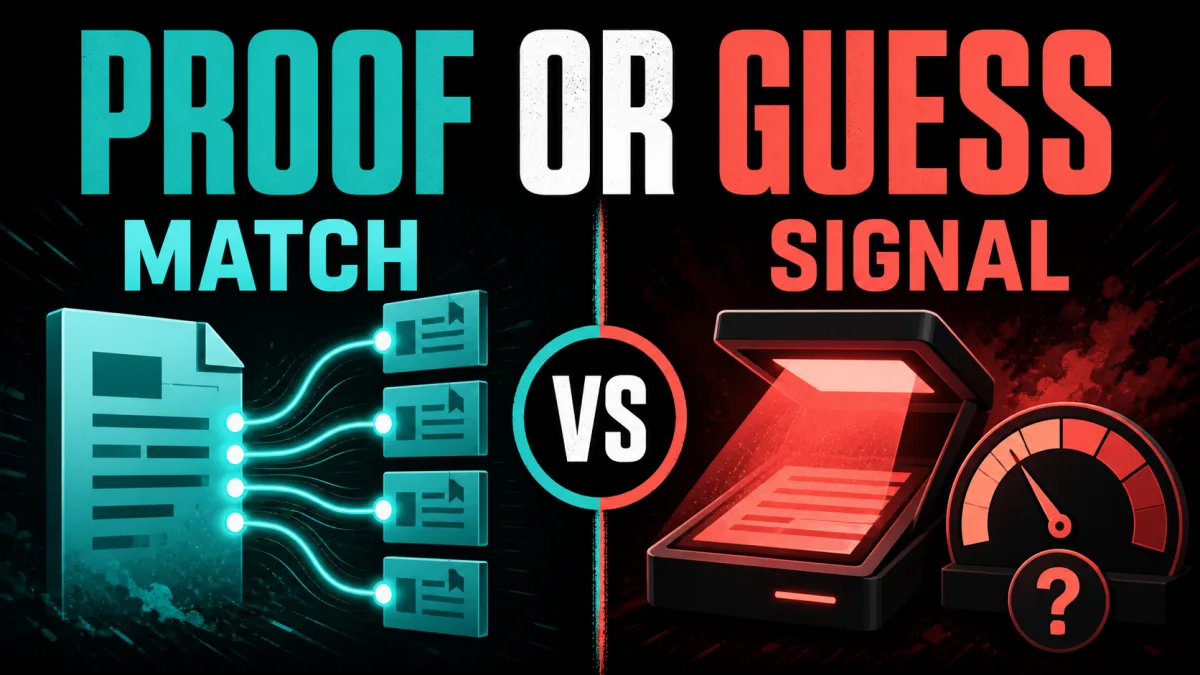
AI writing detectors and plagiarism checkers answer different questions. A plagiarism checker compares phrases against indexed webpages, academic publications, and submitted documents; an AI detector uses its own model to guess whether the prose has statistical features associated with machine generation. The Verge's account describes that shift from matching text to inferring authorship, so educators and publishers should not treat an AI score as the same kind of evidence as a cited textual match. Related reading: AI authorship reaches 35% of post-ChatGPT web pages.
The difference changes the burden of proof. A matching passage can be opened and compared with its source, while a detector score usually cannot show the hidden reasoning that produced it. A review process can use both kinds of tools, but it should require human evidence before imposing a penalty.
What the evidence says about detector reliability
AI writing detectors can fail unevenly across groups, which makes an unexplained score unsafe as a disciplinary shortcut. Stanford HAI reported that seven detectors classified 61.22% of TOEFL essays written by non-native English students as AI-generated, while 97% of the 91 essays were flagged by at least one detector; the study therefore warns that the tools can create unfair accusations when language proficiency affects the measured patterns.
The failure is not only about false positives. AI writing detectors can also miss generated text when a writer edits or asks an AI system to rewrite it in more sophisticated language, according to the Stanford researchers. A tool that can both wrongly accuse human writers and miss machine-assisted writing cannot settle authorship on its own, so institutions should validate its error patterns before giving its score formal power.
Why adoption can outpace confidence
AI detector adoption can spread faster than confidence in the underlying evidence because the tools promise a simple answer to a difficult governance problem. The Center for Democracy & Technology reported that 43% of US sixth- to 12th-grade teachers regularly used AI detectors between 2024 and 2025, showing how quickly the category moved from experiment to routine school practice.
That adoption creates a feedback loop: the more often a detector appears in a workflow, the more its score can look authoritative even when the operator still needs to interpret it. The same CDT report says teachers who use AI for many school-related reasons are more likely to report negative consequences that harm students and undermine trust, which is a reason to pair adoption with transparent policy rather than automatic enforcement.
How institutions should use an AI detector
An AI detector should trigger a conversation about evidence, not an automatic finding of misconduct. Purdue University said its Turnitin guidance should be used cautiously because the system could produce false positives and miss AI-generated material; Turnitin itself said the indicator should not be the sole basis for action or a definitive grading measure. Schools and publishers should therefore ask for drafts, sources, revision history, or a verbal explanation of the work before drawing conclusions.
The safest workflow separates screening from judgment. A score can help an editor decide which submission deserves a closer look, but a person should record what was checked, what remains uncertain, and why the final decision follows from evidence beyond the score. That distinction keeps a fallible classifier from becoming an invisible credibility label.
What this means for AI operations
Businesses adopting AI should treat detector governance as a measurement problem, not as a substitute for trust. The same discipline used to evaluate AI agents and the workflows they complete applies here: define the task, test failure modes, set an escalation path, and keep a human accountable for high-impact decisions.
The broader AI market is also moving quickly, which makes static assumptions about what “AI writing” looks like less durable. Our practical guide to evaluating AI model changes argues that organizations should test systems against real workflow outcomes rather than rely on headlines or generic benchmarks. AI detectors deserve the same skepticism: measure where they fail on your population before turning a score into policy.
The trust question remains unresolved
AI writing detectors are not useless, but their output is too uncertain to carry the moral weight institutions often place on it. The Verge's reporting captures the central tension: educators and publishers want a way to distinguish human work from AI-generated work, while the available tools can be dubious and still become part of high-stakes decisions.
The practical answer is not to pretend the uncertainty away. Institutions should disclose when detection is used, test for unequal error rates, preserve an appeal path, and require corroborating evidence before taking action. Until a tool can show that its signal is reliable for the people and writing it evaluates, trust should come from a fair process—not from a percentage on a dashboard.
Frequently asked questions
What do AI writing detectors actually detect?
AI writing detectors do not prove who wrote a document. They use models to estimate whether language resembles text produced by an AI system, often by measuring statistical patterns in the wording. That makes the result a probability or signal, not a record of authorship. The distinction matters because human writing can be flagged and AI-generated writing can be missed. A detector score can justify a closer conversation about a draft or its sources, but it cannot by itself establish misconduct, dishonesty, or intent.
Why can AI detectors produce false positives?
AI detectors can produce false positives because they infer authorship from language patterns rather than observing the writing process. Stanford HAI reported that detectors classified 61.22% of TOEFL essays by non-native English students as AI-generated in one study. Language proficiency, formulaic phrasing, editing, and the detector's training data can all affect the result. A false positive is especially damaging when a teacher, editor, or manager treats a score as a verdict instead of one uncertain input.
Should a school use an AI detector as proof of cheating?
A school should not use an AI detector as proof of cheating. Purdue's guidance on Turnitin's 2023 AI-writing feature warned that the system could miss AI-generated text and falsely flag human writing, and said the score should not be the sole basis for action or grading. A fair process should compare the result with drafts, sources, discussion, and the student's normal work, while giving the student a meaningful chance to explain the process.
What should editors and managers do with detector scores?
Editors and managers should treat a detector score as a prompt for review, not a hidden credibility rating. Ask for evidence that can be checked: drafts, citations, revision history, source notes, or a conversation about the work. Keep the threshold for adverse action higher than the threshold for asking a neutral question. If a tool cannot explain its uncertainty, measure its error patterns on the writing and people it will evaluate before making it part of a formal workflow.
Alex
Founder & Lead AI Writer
Alex is the founder of Yowox and lead AI writer since 2024, breaking down complex information into clear, actionable insights for thousands of readers every day. Alex has built AI automation systems for businesses since 2024, focusing on AI agents, workflow automation, and business process optimization.
Save hours. Save thousands.
Practical guides, real workflows, and the latest AI and automation news that matters — straight to your inbox.