 By Alex
 AI authorship reaches 35% of post-ChatGPT web pages
Pew Research Center found signs of AI authorship on 35% of English-language webpages published after ChatGPT launched, while warning that detection signals are not proof of who wrote an individual page.
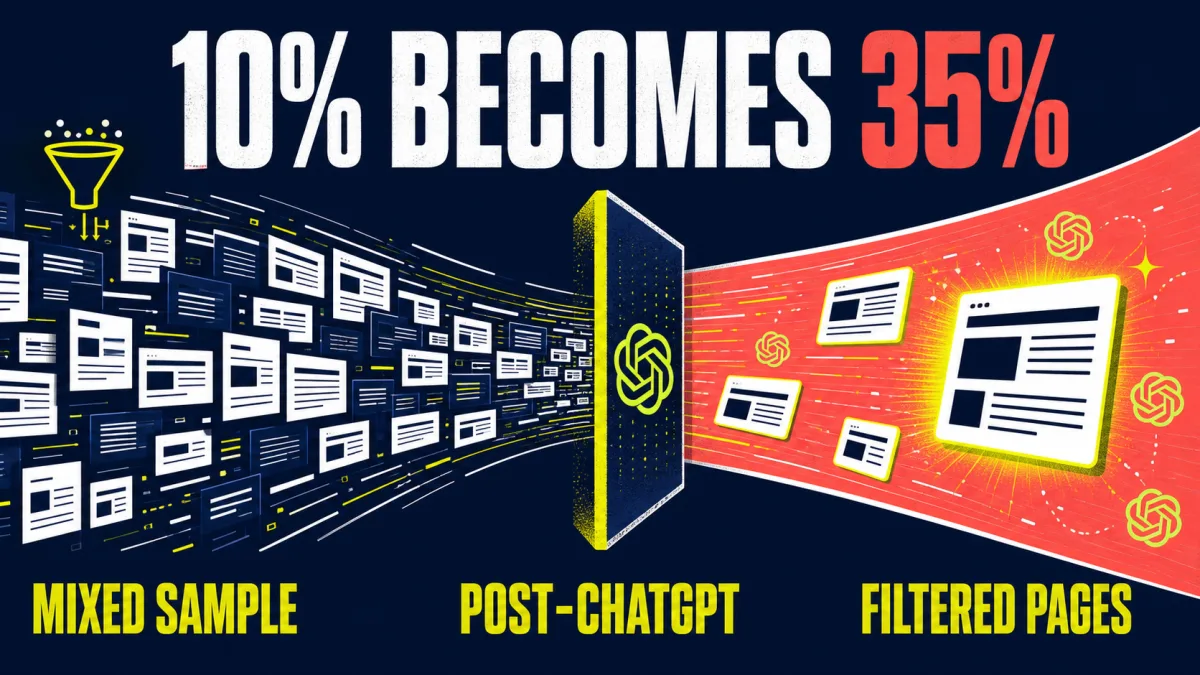
An analysis from Pew Research Center found significant signs of AI authorship on 35% of English-language webpages published after ChatGPT's public release in November 2022. The estimate comes from an AI detection model, so it should be read as evidence of a growing pattern in web text — not proof that a detector can identify the author of any individual page. That distinction echoes why AI writing detectors weaken trust: a statistical signal is not a verified record of who wrote a page. TechCrunch's report places the finding alongside a wider shift toward bots producing and consuming more of the web.
Definition: Pew's "AI authorship" measure means significant statistical signs that a webpage was written or substantially edited by AI, not a verified statement about the human or model that produced it.
Example: A page can contain AI-shaped language without the detector proving whether an AI wrote the full draft, edited a human draft, or was not involved at all.
Key takeaway: The 35% figure is a population-level signal about recently published webpages, not a verdict on one article.
Business impact: Publishers and companies need editorial review and source transparency because AI-shaped text is becoming a normal part of the information environment.
What did Pew find about AI authorship on new webpages?
Pew Research Center found signs of AI authorship on 35% of webpages published after ChatGPT's November 2022 release in its July 2026 snapshot, a result based on nearly half a million English-language webpage texts collected from Common Crawl and analyzed with Open Pangram. For publishers, the practical takeaway is to treat AI detection as a trend signal across a corpus, not as a standalone accusation against an individual writer or page.
The same Pew Research Center snapshot produced a lower figure when older pages were included: around 10% of 10,000 randomly sampled webpages showed significant signs of AI authorship. The lower overall rate matters because the sample contained pages published before public AI writing tools existed, so readers comparing the two percentages should not treat them as competing estimates of the same population.
Why does the post-ChatGPT rate matter?
The post-ChatGPT rate matters because it isolates the part of the web most likely to have been created or revised during the era of mainstream generative AI. Pew Research Center says the 35% result is in line with other studies of recently published webpages, but the detector still identifies signals rather than proving intent; businesses using the number should therefore invest in review, attribution and primary-source links instead of assuming that every flagged page is machine-written.
The finding also changes what readers should expect from web copy. Pew Research Center observed that several patterns associated with AI-generated writing have become more common over time: em dashes appeared about twice as frequently as in 2023, Oxford commas increased by 63%, selected AI-typical words more than doubled, and negative parallelism — constructions such as "it's not X, it's Y" — nearly tripled. None of these features identifies AI use on its own, so they are useful as aggregate clues, not a human-authorship test.
Which domains show the most AI-shaped text?
Pew Research Center found that domain type correlates with the rate of AI-authorship signals in its 2026 samples: roughly one in ten .com pages showed signs, compared with 4.6% of .org pages and around 1% of both .edu and .gov pages. The concrete takeaway for a publisher is not to generalize from a domain ending; it is to verify claims and preserve editorial accountability wherever content is produced.
| Domain group | 2026 share showing signs of AI authorship |
|---|---|
| .com | Around 10% |
| .org | 4.6% |
| .edu | Around 1% |
| .gov | Around 1% |
What can the study not prove?
Pew Research Center's study cannot prove that a particular webpage was written by AI, because AI detection models can misclassify human writing and miss AI-assisted writing. The study's evidence is strongest at scale: repeated statistical patterns across hundreds of thousands of pages can show that AI-shaped language is spreading, while a single em dash, Oxford comma or familiar phrase says almost nothing about one author's process.
Pew Research Center's finding is also the useful conclusion for operators. A company publishing AI-assisted content should keep a human accountable for factual accuracy, cite the original evidence behind consequential claims, and make review part of the workflow; the same human-accountability principle used for AI agents applies here. A detector score can prompt a closer look, but it cannot replace source checking. Readers who are deciding whether to trust an article should ask where its claims come from and whether the page distinguishes reported facts from interpretation.
What should publishers watch next?
The next question is not whether AI will appear on the web — Pew Research Center's data already shows that it does — but whether publishers can preserve reliable provenance as AI writing and editing become routine. The 35% post-ChatGPT signal is a reason to strengthen attribution, verification and disclosure practices, while keeping the uncertainty visible: the study measures language patterns across webpages, not a perfect census of machine-written content. That source-first discipline also matters when evaluating fast-moving AI model news, where headlines can outrun what the evidence supports.
Frequently asked questions
Does the 35% figure prove that 35% of webpages were written by AI?
No. Pew Research Center says the figure represents webpages with significant signs of AI authorship or substantial AI editing, identified by an AI detection model. Detection models can misclassify individual pages, so the result is a large-scale estimate of a pattern, not a definitive authorship label for every page. The safest reading is that AI-shaped writing is now common across recently published English-language web content, while any single page still needs separate evidence before its authorship can be established.
How did Pew Research Center measure AI authorship on the web?
Pew Research Center analyzed nearly half a million English-language webpage texts collected from Common Crawl snapshots between January 2021 and July 2026. It used Open Pangram, an AI detection model, to look for statistical patterns associated with AI-written or heavily AI-edited text. Pew also drew a random sample of 10,000 pages in July 2026 and compared the overall result with pages published after ChatGPT's public release in November 2022.
Why was the post-ChatGPT rate higher than the overall rate?
The overall July 2026 sample included older pages that existed before public AI writing tools became available, which lowers the combined rate. After Pew filtered the same snapshot to pages published after ChatGPT's November 2022 release, 35% showed significant signs of AI authorship. The comparison is therefore about two different populations: all pages in the snapshot versus the newer pages most exposed to AI writing and editing tools.
Which web domains showed the most signs of AI authorship?
In Pew Research Center's 2026 samples, .com pages showed signs of AI authorship at roughly 10 times the rate of .edu and .gov pages, which were each around 1%. The .org rate was 4.6%, while the .com rate was around one in ten. These are aggregate differences across domain groups, not a judgment about every website using one top-level domain or about the quality of its individual articles.
Alex
Founder & Lead AI Writer
Alex is the founder of Yowox and lead AI writer since 2024, breaking down complex information into clear, actionable insights for thousands of readers every day. Alex has built AI automation systems for businesses since 2024, focusing on AI agents, workflow automation, and business process optimization.
Save hours. Save thousands.
Practical guides, real workflows, and the latest AI and automation news that matters — straight to your inbox.