 By Alex
 What the Latest AI Models Mean for Your Business
A practical, hype-free guide to evaluating new AI model releases by automation value, cost per task, tool use and production reliability.
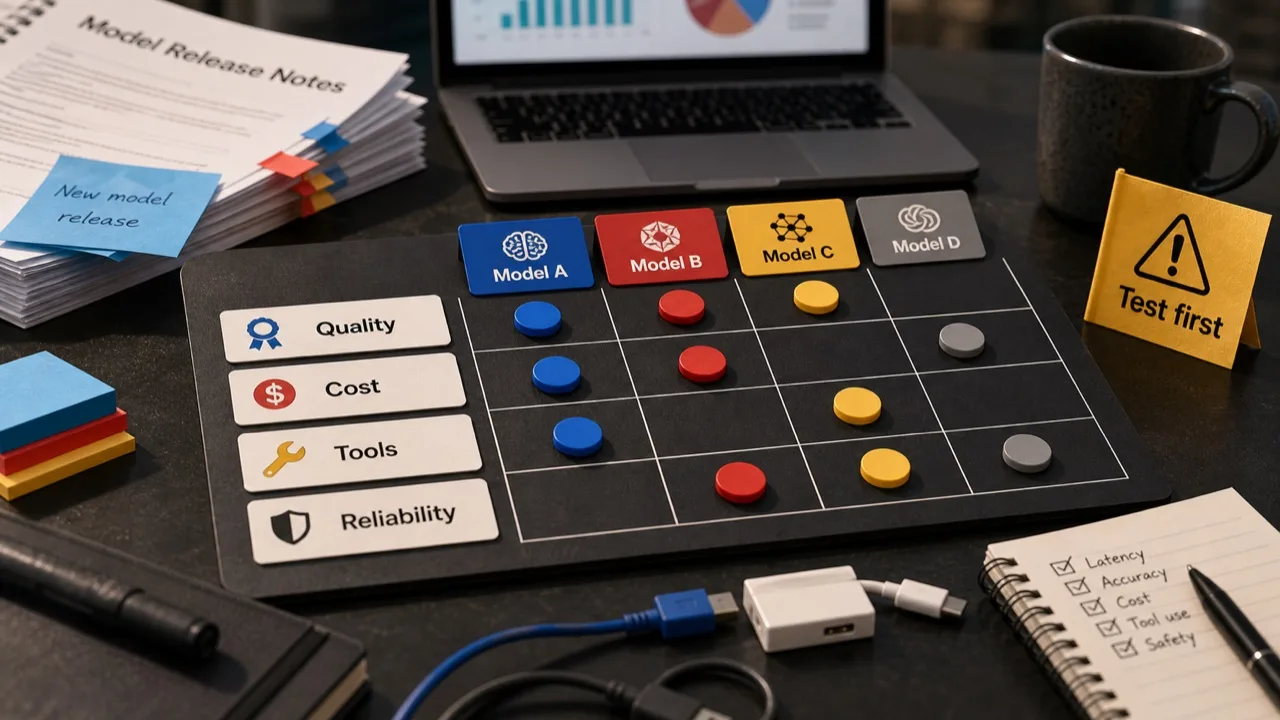
The latest AI models matter for business only when they change what can be automated, how reliably the automation runs or how much each completed task costs. As of July 7, 2026, the model market is moving toward long-context, tool-using and agentic systems, but the practical decision is still workflow-specific: choose the model that clears the bar for the job. Picking between them per request is its own discipline: model routing is simple until it isn't. The competitive picture is also shifting, with Chinese models now at 46% of US enterprise tokens. The frontier keeps moving on the open-weight side too — Kimi K3 raises the stakes for open-weight AI — while newer models keep the same advantage and Microsoft starts swapping OpenAI and Anthropic for its own MAI models.
Definition: A business-relevant AI model upgrade is a model change that improves workflow accuracy, cost, latency, tool use, context handling or safety for a real task.
Example: A new model matters if it can reliably process longer contracts, call tools with cleaner arguments or reduce support-ticket classification cost.
Key takeaway: Do not chase model announcements; test models against your workflow and route each task to the cheapest reliable option.
Business impact: Better model selection reduces operating cost and expands the set of workflows that are worth automating.
What changed in AI models by July 2026?
AI models in 2026 are increasingly optimized for agentic work: longer context, tool use, structured output, multimodal inputs and lower cost for everyday tasks. OpenAI's current model documentation now surfaces GPT-5.5 in model navigation, Anthropic's model overview lists Claude Fable 5, Claude Opus 4.8, Claude Sonnet 5 and Claude Haiku 4.5, and Google Cloud's model catalog lists Gemini 3.1 Pro and Gemini 3.5 Flash among current Gemini options.
The business implication is not "switch everything immediately." The business implication is that model choice has become an operations decision. A company can route simple tasks to cheaper fast models and reserve stronger models for high-value reasoning, long-context review or agentic workflows.
Which model capabilities matter for business automation?
The most important model capabilities for business automation are tool use, structured output, context handling, latency, cost and evaluation stability. A model that writes beautifully but fails tool arguments is weak for AI agents. A model that handles long documents but costs too much for high-volume triage may be wrong for support automation.
Use the workflow as the test. For lead qualification, compare scoring consistency and CRM-note usefulness. For support, compare draft acceptance and escalation accuracy. For documents, compare extraction pass rate and validation failures. Public model benchmarks can guide shortlisting, but workflow evaluation should decide production routing.
The Yowox Model Routing Matrix
The Yowox Model Routing Matrix assigns models by task risk and task complexity. Low-risk, low-complexity work should use a fast, inexpensive model. High-risk, high-complexity work should use a stronger model plus human review. This avoids the two common mistakes: using frontier models for cheap classification and using small models for workflows that need deeper reasoning.
| Task type | Model choice | Review pattern |
|---|---|---|
| Simple classification | Fast low-cost model | Sample audit |
| Drafting from known context | Mid-tier model | Edit review |
| Long document reasoning | Long-context model | Required approval |
| Tool-using AI agent | Model tested for tool calls | Logs and escalation |
| High-risk decision | Strong model plus rules | Human decision |
How should businesses test a new model?
Businesses should test a new model on a fixed workflow test set. The test set should include normal cases, edge cases, bad inputs, missing data, tool failures and examples where the correct answer is "escalate." A model upgrade should not be judged by a few impressive prompts. A model upgrade should be judged by repeatable task outcomes.
Track the same metrics each time: accuracy, structured-output validity, tool-call success, latency, cost per completed task, review time and failure mode. The strongest model is not always the winner. A slightly weaker model can be better if the workflow is high-volume and the quality difference does not affect outcomes.
What does model-agnostic architecture mean?
Model-agnostic architecture means the workflow is not hardcoded to one model provider. The automation stack defines tasks, tools, context, evaluation and output schemas separately from the model choice. This lets the business swap a classification model, route long-context work to a different provider or test a new frontier model without rebuilding the workflow. More on this: How to run an LLM locally?. See also How much VRAM and GPU do you need for a local LLM?.
This architecture is especially important for AI agents. Tool schemas, permissions, logs, validation and escalation rules should outlive any one model release. For the stack layers behind this, see The AI Automation Stack. For build-vs-buy decisions around that stack, see Build vs Buy: Custom AI Agents or Off-the-Shelf Tools?.
When is a new model worth adopting?
A new model is worth adopting when it improves a business metric, not when it wins a headline. Good reasons include lower cost per completed task, higher accepted-draft rate, fewer extraction failures, better tool-call validity, longer reliable context, faster latency or fewer escalations. Weak reasons include novelty, vague benchmark gains or pressure to "use the latest."
Run an A/B evaluation before changing production routing. Keep the old model as a fallback until the new model proves reliability. If the workflow touches customers, money, legal risk or private data, require stricter testing than for internal summarization.
What should businesses ignore in model news?
Businesses should ignore model news that cannot be tied to their own workflows. Leaderboards, naming changes and social-media demos can be useful signals, but they are not a business case. A model that excels at coding may not improve support triage. A model with a huge context window may not matter if the workflow only needs a short CRM note.
The useful question is always concrete: does this model let the business automate a task that previously failed, or does this model reduce the cost or risk of a task already automated? If the answer is no, keep the current model and revisit later.
What should a business do next?
A business should build a model evaluation habit before it builds a model migration habit. Pick one workflow, create a test set, define pass/fail criteria and compare candidate models. Then route production tasks to the cheapest reliable model and revisit the routing when a major model release changes the trade-off. See also Thinking Machines Releases Inkling: Open Weights, Closed-Scale Hardware. See also Arcee, a US open source AI lab, says Chinese models are not inherently dangerous.
The market will keep moving. The stable advantage is not guessing the next winner. The stable advantage is owning a workflow stack that can evaluate and swap models without disrupting the business.
We keep AI automation model-agnostic so workflows can improve when the model market changes, without rebuilding the whole system.
Frequently asked questions
Do businesses need the newest AI model?
Most businesses do not need the newest AI model for every workflow. A business needs the cheapest reliable model that clears the quality, latency, context and safety bar for one specific task. New frontier models matter when they unlock a workflow that older models could not complete, reduce cost per completed task or improve tool use and long-context reliability. For routine classification or drafting, a smaller model may be the better business choice.
How should a business compare AI models?
A business should compare AI models on its own workflow data, not only on public benchmark scores. The comparison should include accuracy, refusal behavior, structured-output reliability, tool-call quality, latency, cost per completed task, context handling and review time. The winning model is not always the most capable model. The winning model is the model that completes the workflow reliably at the best operating cost.
What model capabilities matter most for AI agents?
The most important model capabilities for AI agents are tool use, reasoning over context, structured output, long-context handling, reliability under instructions and safe escalation. Chat quality alone is not enough. A business AI agent must read current context, choose the right tool, pass valid arguments, use the tool result and stop when the workflow exceeds its permissions. These capabilities determine whether a model can complete work, not just answer questions.
Should businesses use one AI model or several?
Many businesses should use several AI models through a model-agnostic stack. One model might handle low-cost classification, another might handle complex reasoning, and another might handle long-context document work. A model-agnostic architecture keeps the workflow from depending on one provider's pricing, latency or release cycle. The important layer is evaluation and routing: each workflow should know which model clears its quality bar.
How often should AI automation teams reevaluate models?
AI automation teams should reevaluate models when a major model release changes cost, context, tool use, latency or reliability for a workflow. For active workflows, a quarterly review is a practical default, with faster testing after major releases from OpenAI, Anthropic, Google or other providers. Reevaluate against the same test set so the team can see whether a new model actually improves the business workflow.
Alex
Founder & Lead AI Writer
Alex is the founder of Yowox and lead AI writer since 2024, breaking down complex information into clear, actionable insights for thousands of readers every day. Alex has built AI automation systems for businesses since 2024, focusing on AI agents, workflow automation, and business process optimization.
Save hours. Save thousands.
Practical guides, real workflows, and the latest AI and automation news that matters — straight to your inbox.