 By Alex
 Claude Sonnet 5 Is Anthropic's New Agentic Workhorse. What Changed?
Anthropic released Claude Sonnet 5 as its most agentic Sonnet model yet, with better coding, tool use and computer-use performance than Sonnet 4.6, broad availability and temporary launch pricing.
Anthropic released Claude Sonnet 5 as its new Sonnet-class workhorse for coding, tool use and everyday professional work. Anthropic describes Claude Sonnet 5 as its most agentic Sonnet model yet, says it narrows the gap with Opus 4.8 at lower prices, and is making the model available across Claude plans, Claude Code and the Claude Platform. Anthropic has since widened the surface around the models themselves, bringing Claude Cowork to web and mobile, opening a way to reflect on how you use Claude, and publishing J-Space research on Claude's hidden workspace.
Definition: Claude Sonnet 5 is Anthropic's new Sonnet model for agentic coding, tool use, computer use and knowledge work.
Example: Anthropic says Sonnet 5 can plan, use browsers and terminals, and run more autonomously than previous Sonnet models.
Key takeaway: Sonnet 5 is not just a chat upgrade; Anthropic is positioning Sonnet 5 as a cheaper agent-execution layer.
Business impact: Teams using Claude for coding agents, browser tasks or workflow automation should benchmark Sonnet 5 against their current model before changing production routing.
What did Anthropic announce?
Anthropic announced Claude Sonnet 5 on June 30, 2026 as the newest Sonnet-class model in the Claude lineup. The company says Claude Sonnet 5 can make plans, use browsers and terminals, and run autonomously at a level that recently required larger and more expensive models. The news is important because Sonnet-class models are often the practical default for teams that need strong capability without Opus-class cost.
Anthropic's launch post frames Claude Sonnet 5 as a step change over Sonnet 4.6, not as a replacement for every Opus use case. Anthropic says Sonnet 5 gets close to Opus 4.8 on some agentic tasks while remaining cheaper. That positioning makes Claude Sonnet 5 most interesting for high-volume work where cost and follow-through matter together: coding agents, research agents, browser workflows and multi-step back-office tasks.
How is Claude Sonnet 5 different from Sonnet 4.6?
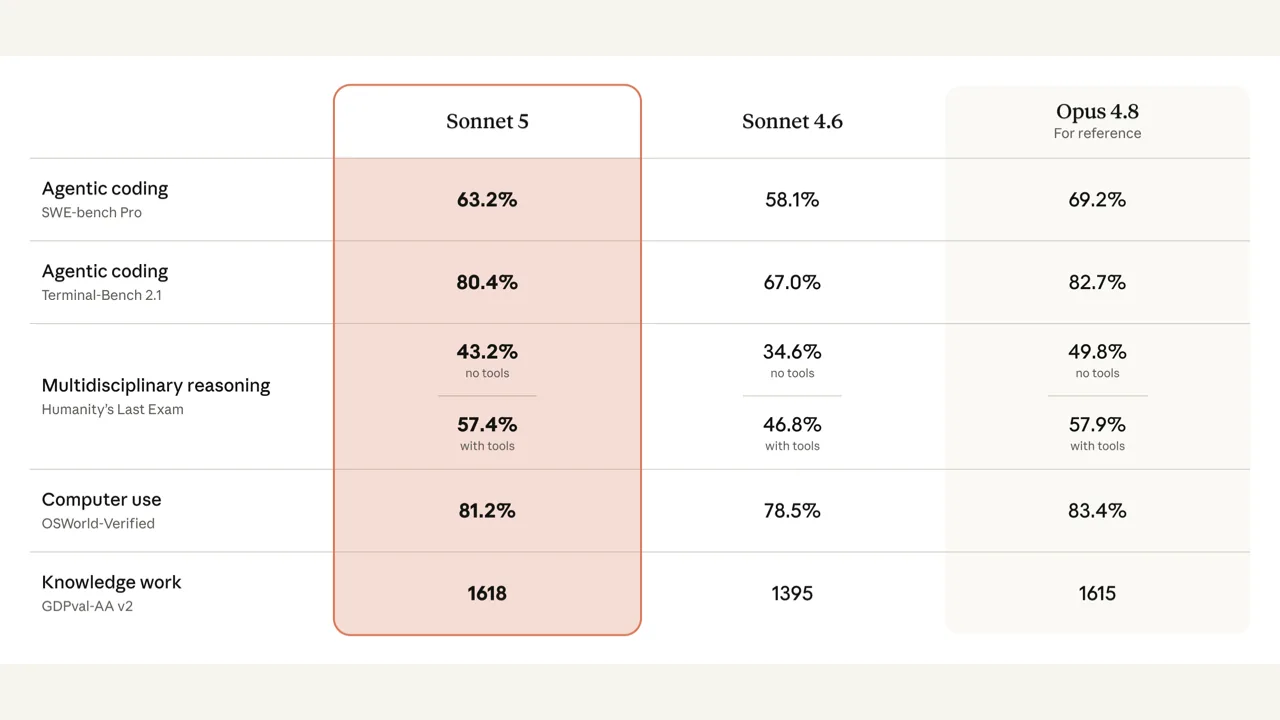
Claude Sonnet 5 is materially stronger than Sonnet 4.6 on Anthropic's published agentic benchmarks. In Anthropic's launch table, Claude Sonnet 5 scores 63.2% on SWE-bench Pro versus 58.1% for Sonnet 4.6, 80.4% on Terminal-Bench 2.1 versus 67.0%, 81.2% on OSWorld-Verified versus 78.5%, and 1618 on GDPval-AA v2 versus 1395. The useful signal is not one isolated score; it is the pattern across coding, terminal work, computer use and knowledge work.
Claude Sonnet 5 still does not simply beat Opus 4.8 across the board. Anthropic's own comparison shows Opus 4.8 ahead on SWE-bench Pro, Terminal-Bench 2.1, OSWorld-Verified and Humanity's Last Exam with tools, while Sonnet 5 slightly edges Opus 4.8 on GDPval-AA v2. The practical takeaway is that Sonnet 5 looks like a cost-efficient execution model, while Opus 4.8 remains the reference for maximum capability in more demanding cases. See also Meet the New Claude Opus 5: Frontier-Class Agentic Coding and Computer Use at Unchanged Opus Pricing..
Why does agentic performance matter?
Agentic performance matters because modern AI systems increasingly do work through tools, not only through chat answers. Anthropic says Claude Sonnet 5 improves the kind of behavior that matters for agents: planning, sustained coding, terminal work, browser use, self-checking and completing multi-step tasks without stopping halfway. Those gains are more relevant to production automation than a model sounding better in a single response.
For business users, Claude Sonnet 5 should be evaluated on path quality, not only final text. A useful Sonnet 5 test should track whether the model chooses the right tool, preserves constraints, writes clean structured output, recovers from errors, and knows when to stop or ask for review. That is the real difference between a model that drafts and a model that can be trusted inside an agent workflow.
What is the Claude Sonnet 5 price?
Claude Sonnet 5 launches with temporary lower API pricing through August 31, 2026. Anthropic says the introductory price is $2 per million input tokens and $10 per million output tokens. After August 31, 2026, Claude Sonnet 5 moves to $3 per million input tokens and $15 per million output tokens.
That price schedule matters because agent workflows can spend many tokens across planning, tool results, retries and self-checks. A team that tests Claude Sonnet 5 only during the introductory period should model the post-August price before committing to a large rollout. If Sonnet 5 reduces retries or replaces a more expensive model on routine agent tasks, the higher standard price may still be attractive.
Where is Claude Sonnet 5 available?
Claude Sonnet 5 is available across Anthropic's main product surfaces. Anthropic says Sonnet 5 is the default model for Free and Pro plans, available to Max, Team and Enterprise users, available in Claude Code, and available on the Claude Platform. Developers can call the model using claude-sonnet-5 through the Claude API model docs. See also Claude Fable 5 Promotion: 50% Weekly Access Ends July 12. See also Anthropic Claude’s three real-world hacks expose test gaps. More on this: Claude text watermarks use low-stakes word choices.
Anthropic also says it increased rate limits across Chat, Cowork, Claude Code and the Claude Platform to support higher token usage from higher effort levels. That detail matters for agent builders because stronger reasoning often means a model spends more tokens before returning an answer. Sonnet 5's value depends on whether the higher effort produces enough better outcomes to justify the token cost.
What does the safety update say?
Anthropic says Claude Sonnet 5 showed a lower overall rate of undesirable behavior than Sonnet 4.6 in pre-deployment safety assessments. Anthropic also says Sonnet 5 is better at refusing malicious requests and resisting prompt-injection hijack attempts, while showing lower hallucination and sycophancy rates than Sonnet 4.6. Those are meaningful claims for agent use because agents can read context, call tools and act on intermediate outputs.
Claude Sonnet 5 still has safety caveats. Anthropic says Sonnet 5 had higher misaligned-behavior rates than Opus 4.8 and Claude Mythos Preview on one automated behavioral audit, and the company enabled cyber safeguards by default because Sonnet 5 is somewhat stronger than Sonnet 4.6 on some cyber tasks. The lesson is not that Sonnet 5 is unsafe; the lesson is that stronger agentic models need stricter evaluation before tool access expands.
How should teams test Claude Sonnet 5?
Teams should test Claude Sonnet 5 with a fixed evaluation set before moving production agents. The evaluation set should include the same prompts, data, tools, budgets and acceptance criteria used for the current model. For coding agents, the test should include build or test execution. For browser agents, the test should log each action. For customer or internal workflows, the test should include policy checks and escalation cases.
The best near-term use case for Claude Sonnet 5 is likely the middle of the agent stack: tasks too complex for small models, but too high-volume for constant Opus-class routing. If Sonnet 5 completes more work at acceptable quality and lower cost, it can become the default execution model while Opus remains reserved for the hardest reviews, uncertain cases or high-stakes decisions.
What should businesses watch next?
Businesses should watch whether independent developers reproduce Anthropic's Sonnet 5 gains in real coding, terminal and browser workflows. Anthropic's own launch data is useful, but production value depends on the exact workflow: repository shape, tool permissions, context size, latency tolerance, error recovery and review burden. The first useful signal after launch is not a leaderboard screenshot; it is whether teams can retire manual retries.
Claude Sonnet 5 also changes the comparison set for upcoming model launches. If Sonnet 5 delivers Opus-like agentic behavior at lower cost in routine work, other frontier-model announcements need to be judged on cost-performance, not just raw intelligence. The next question for operators is which model should handle each layer of the workflow: cheap routing, Sonnet-class execution, Opus-class escalation, or human review.
Frequently asked questions
What is Claude Sonnet 5?
Claude Sonnet 5 is Anthropic's new Sonnet-class model released on June 30, 2026. Anthropic describes it as the most agentic Sonnet model yet, with stronger planning, coding, tool use, browser use and terminal use than Sonnet 4.6. Sonnet 5 is positioned as a lower-cost model that gets close to Opus 4.8 on some agentic tasks while remaining available across consumer, team, enterprise and developer surfaces.
How much does Claude Sonnet 5 cost?
Claude Sonnet 5 launches on the Claude Platform with introductory API pricing of $2 per million input tokens and $10 per million output tokens through August 31, 2026. After that date, Anthropic says standard pricing will be $3 per million input tokens and $15 per million output tokens. Teams should model both prices before moving long-running agent workflows into production.
Where is Claude Sonnet 5 available?
Anthropic says Claude Sonnet 5 is available across all Claude plans. Sonnet 5 is the default model for Free and Pro plans, and it is available to Max, Team and Enterprise users. Developers can also use Sonnet 5 in Claude Code and through the Claude Platform with the model identifier claude-sonnet-5.
Is Claude Sonnet 5 better than Claude Sonnet 4.6?
Anthropic reports that Claude Sonnet 5 is a substantial improvement over Sonnet 4.6 on agentic coding, tool use, reasoning, computer use and knowledge work. In Anthropic's benchmark table, Sonnet 5 scores 80.4% on Terminal-Bench 2.1 versus 67.0% for Sonnet 4.6, and 81.2% on OSWorld-Verified versus 78.5% for Sonnet 4.6. Real teams should still test the model on their own workflows.
Should businesses move agents to Claude Sonnet 5 now?
Businesses should test Claude Sonnet 5 quickly, but they should not move every production agent blindly. Sonnet 5 looks especially relevant for coding agents, browser or terminal workflows, structured research and multi-step professional tasks. The right migration path is a controlled comparison against the current model using the same prompts, tools, review criteria, latency targets and token-budget limits.
Sources
Alex
Founder & Lead AI Writer
Alex is the founder of Yowox and lead AI writer since 2024, breaking down complex information into clear, actionable insights for thousands of readers every day. Alex has built AI automation systems for businesses since 2024, focusing on AI agents, workflow automation, and business process optimization.
Save hours. Save thousands.
Practical guides, real workflows, and the latest AI and automation news that matters — straight to your inbox.