 By Alex
 Claude Opus 5: long-horizon coding at unchanged pricing
Anthropic’s Claude Opus 5 is a major Opus 4.8 upgrade for long-horizon coding, computer use and knowledge work while keeping the $5/$25 base API price. The release also changes default thinking, effort controls and migration behavior.
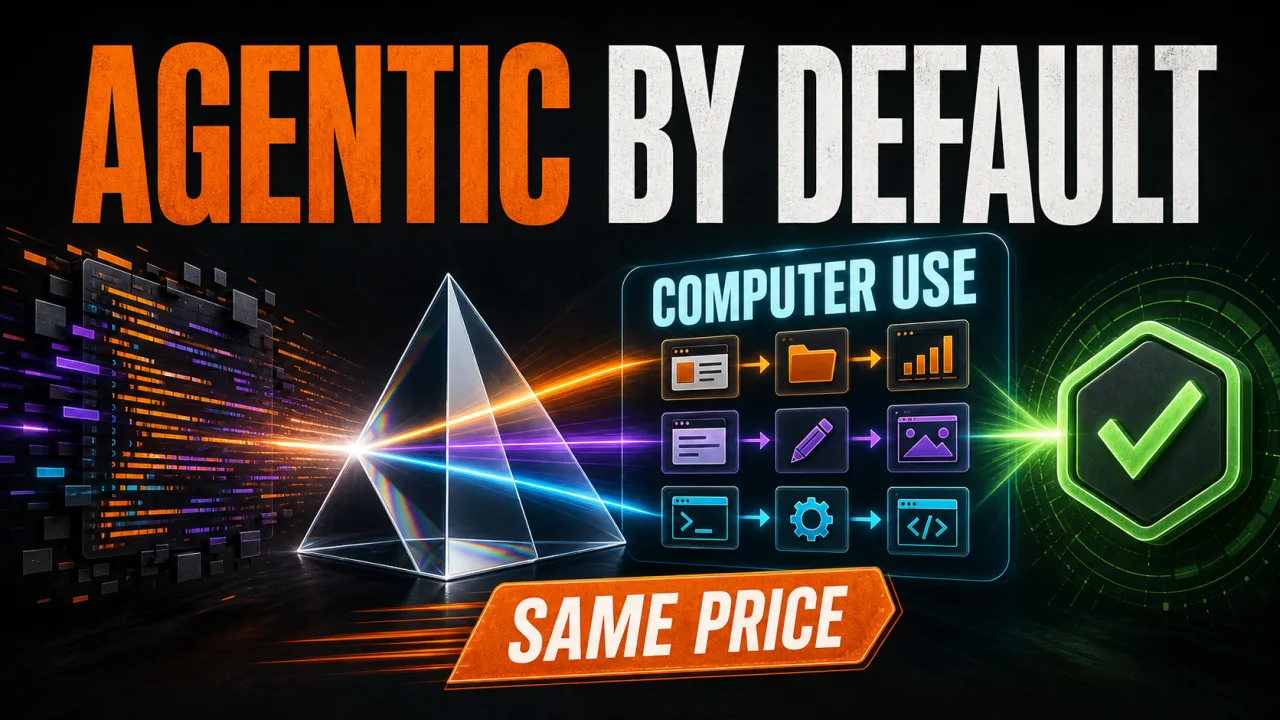
Definition: Claude Opus 5 is Anthropic’s new Opus model for long-horizon agentic coding, computer use, enterprise work and deep reasoning.
Example: Anthropic describes Opus 5 reconstructing a machine part from raw pixels by writing its own computer-vision pipeline, then generating a 3D model.
Key takeaway: The release is as much about reliable follow-through and test-time effort control as it is about a higher benchmark score.
Business impact: Teams get a more capable Opus model at the same base $5/$25 API price, but must revisit token budgets, thinking settings and verification prompts.
Anthropic has released Claude Opus 5 as the successor to Claude Opus 4.8, keeping the Opus tier’s base API price unchanged at $5 per million input tokens and $25 per million output tokens. In Anthropic’s launch announcement, the company positions Opus 5 as a major improvement in coding, knowledge work, computer use and long-horizon agentic tasks. See also Claude Sonnet 5 Is Anthropic's New Agentic Workhorse. What Changed?.
The price headline is easy to understand. The migration headline is more important. Opus 5 thinks by default, exposes a broader effort ladder, has a 1 million token context window, and changes what happens when developers combine disabled thinking with the highest effort settings.
What did Anthropic launch?
Claude Opus 5 is Anthropic’s model for complex agentic coding and enterprise work. The company highlights deep reasoning, long-horizon tasks, test-time compute scaling, vision, office and document work, and multi-agent coordination.
The model ID is claude-opus-5. Anthropic keeps the base price unchanged from Opus 4.8 while also offering a faster, separately priced mode. The launch combines a capability upgrade with more controls over how each request spends computation.
| Product change | What it means in practice |
|---|---|
| Same $5 input / $25 output base price | A capability upgrade without a base-rate increase |
| 1M-token context | Long codebases, documents and tool histories can stay together |
| Thinking on by default | Existing requests may spend tokens on reasoning automatically |
| Effort from low to max | Teams can trade quality, latency and token use per workload |
| 128k maximum synchronous output | More headroom for large artifacts and long agent runs |
| Mid-conversation tool changes in beta | Tool access can change without invalidating the prompt cache |
| Default API fallbacks in beta | Safety refusals can route to recommended fallback models |
The important story is not simply that Opus 5 is smarter. Anthropic is exposing more control over how the model spends computation and how a long-running session changes its tools and fallback path.
Why unchanged pricing matters for agentic coding
Agentic coding is expensive in a way one-shot chat is not. A coding agent may read a repository, inspect tests, plan a change, call a terminal, revise a patch, run the test suite, inspect a failure and try again. Every loop adds tokens.
Anthropic says Opus 5 improves software engineering performance at the same base price as Opus 4.8 and can achieve better results at a lower cost per task in some evaluations. That is more useful to operators than a raw model score: the unit that matters is a completed change, not a clever completion.
The MarkTechPost report summarizes the launch’s reported benchmark results, including large gains over Opus 4.8 on coding and computer-use evaluations. Those figures are directional evidence, not a guarantee for every repository. Harness design, tool permissions, context loading and acceptance tests can change the outcome.
The pricing advantage becomes real only when a team measures cost per accepted deliverable. A model that costs the same per token but needs fewer retries, fewer tool calls or less human repair can be cheaper at the workflow level.
Thinking is now on by default
On Opus 4.8, a request could run without thinking unless the developer enabled adaptive thinking. Opus 5 changes that default. Anthropic’s model documentation says Opus 5 thinks by default and uses the effort setting to control reasoning depth.
That affects request budgets immediately. max_tokens is a hard limit covering both thinking and visible response text. A request that previously reserved enough output for a response without thinking may now need a larger budget or a lower effort level.
A practical migration checklist is short:
- Review every
max_tokenssetting. - Record current effort and thinking behavior for each workload.
- Measure latency and token use before and after the model switch.
- Keep thinking enabled unless there is a specific integration reason not to.
- Re-test structured output and tool-call parsing under the new defaults.
Disabling thinking has a breaking constraint
Opus 5 still accepts disabled thinking, but Anthropic restricts the combination. If a request sets thinking: {"type": "disabled"} together with effort: xhigh or effort: max, the API returns a 400 error.
A migration must choose one of two paths:
- keep thinking disabled and cap effort at high or below; or
- keep xhigh or max effort and remove the disabled-thinking field.
Teams should add a request-contract test for the combinations their application can emit. Do not discover this 400 response in production after a configuration flag changes.
Opus 5 verifies more of its own work
Anthropic says Opus 5 is stronger at verifying its work and iterating until it succeeds. The company advises developers to remove instructions such as “include a final verification step” from prompts written for older models, because those instructions can cause over-verification with Opus 5.
The right response is not to delete all evaluation. Separate model-internal checking from workflow acceptance. Keep tests, type checks, permissions and external review gates that protect the system. Remove only redundant prose that asks for a generic verification ritual the model now performs by default.
This is one reason the launch matters for the practical AI-agent stack. The model is being evaluated not only on producing code, but on managing a loop of planning, tool use, inspection and correction.
What improves in agentic coding and computer use?
Anthropic’s central capability claim is about long-horizon work: Opus 5 can sustain multi-step analysis, interact with tools, keep track of a large task and finish more complete deliverables.
One launch example describes Opus 5 receiving a drawing of a machine part without a direct way to view it, then writing a computer-vision pipeline to extract geometry from raw pixels and reconstruct the part as a 3D FreeCAD model. The model had to notice a missing capability, build an intermediate tool, use the result and continue toward the original deliverable.
That is the difference between “can write code” and “can operate as an agent.” For computer-use workflows, the same loop appears in another form: understand a visual state, decide whether to use a script or direct interaction, act, inspect the consequence and recover when the interface differs from expectations.
A strong benchmark result matters because it suggests progress on that loop, not only on language generation. Teams should still measure how often the system stops cleanly, asks for review at the right moment and avoids turning a small interface error into a long retry chain.
What does the 1M-token context window change?
Opus 5 has a 1 million token context window, and Anthropic says that is both the default and maximum context size with no smaller context variant. The synchronous Messages API supports up to 128,000 output tokens.
A large context can simplify long-running tasks: a repository can remain available while the agent edits several areas, research notes can stay together, and a long tool trace can be summarized less aggressively.
Large context is not perfect memory. More tokens can also mean more irrelevant material, slower requests and higher spend. Teams still need retrieval, compaction and context-selection policies. The practical question is not “can we put everything in the prompt?” but “which information should remain active for this step?”
Effort levels turn reasoning into an operating decision
Anthropic’s effort documentation says additional effort converts into better results more reliably than in earlier Opus models, while low and medium effort can preserve strong quality with fewer tokens and lower latency.
That turns effort into a routing decision. A team can use lower effort for routine transformations, high effort for normal agent execution and xhigh or max for difficult debugging, research or planning tasks.
A useful benchmark should compare more than final quality:
| Measure | Why it belongs in an Opus 5 evaluation |
|---|---|
| Accepted-task rate | Shows whether the workflow finishes correctly |
| Tool calls and retries | Reveals whether higher effort reduces wasted loops |
| Input and output tokens | Converts model behavior into cost |
| Wall-clock latency | Matters for interactive computer use |
| Human repair time | Captures work left after the model says it is done |
| Escalation rate | Shows where Opus 5 still needs a stronger model or person |
The best effort level is workload-specific. “Max everywhere” is not a strategy; it is a budget setting.
What changed in tools and API orchestration?
Mid-conversation tool changes let developers add or remove tools between turns while preserving the prompt cache. That can reduce the need to expose every capability for an entire session.
Default fallbacks add another operational option. Anthropic says the API can route requests flagged by safety classifiers to recommended fallback models instead of leaving the application to maintain every fallback list manually.
Both features affect orchestration design. A tool list can narrow or broaden as the task changes, and a refusal can become a controlled route rather than a hard stop. Teams should log those transitions because a fallback can change capability, cost, output format or safety behavior.
What does the safety material say?
Anthropic says Opus 5 is behind Claude Mythos 5 on biology and offensive cybersecurity tasks. It also says Opus 5 is close to Mythos 5 at finding vulnerabilities but substantially behind it at turning those vulnerabilities into exploits.
Anthropic’s cyber safeguards allow vulnerability finding in source code but block binary-based scanning, penetration testing and exploit generation. Requests flagged in Claude.ai, Claude Code and Claude Cowork fall back to Opus 4.8 by default, and API fallbacks can also be enabled.
The Claude Opus 5 system card is the right source for the detailed risk and safeguard claims. The operational lesson is straightforward: higher general capability can raise performance on sensitive tasks even without targeted training, so tool permissions and fallback behavior remain part of deployment design.
What should developers change before switching?
Start with a migration slice, not a global model swap. Choose representative coding, tool-use and document tasks. Run Opus 4.8 and Opus 5 with the same inputs, permissions, acceptance tests and human review rules.
Then test the changes most likely to break integrations:
- requests that omit a thinking field;
- requests that disable thinking;
- requests that set xhigh or max effort;
- requests with tight
max_tokensvalues; - long sessions that change their tool list;
- safety-classifier refusals and fallback routing;
- structured tool calls emitted after extended reasoning.
Do not compare only model answers. Compare completed work, review burden, tool-call traces, latency and spend. Opus 5’s unchanged base price is strategically useful only if stronger execution reduces the total cost of getting a task accepted.
The bigger takeaway
Claude Opus 5 is a major Opus 4.8 upgrade wrapped in a familiar price point. Anthropic is offering stronger agentic coding, computer use, long-context work and self-checking while keeping base API pricing at $5 per million input tokens and $25 per million output tokens.
The real migration work is in the details: thinking is now on by default, effort controls more of the quality-cost tradeoff, disabled thinking is incompatible with xhigh and max effort, and old verification prompts may now create redundant work.
For developers, the best first move is a controlled benchmark that measures completed tasks rather than model theater. If Opus 5 completes more long-horizon work with fewer retries and less human repair at the same base price, it is not merely a better model. It is a better operating point for agentic software.
FAQ
Is Claude Opus 5 more expensive than Opus 4.8?
No. Anthropic lists the same base API rates: $5 per million input tokens and $25 per million output tokens. Fast mode has separate premium pricing.
Do I need to enable thinking on Opus 5?
No. Thinking is on by default. The effort setting controls reasoning depth, so developers should review effort and token budgets rather than automatically adding an old adaptive-thinking field.
Can I disable thinking at max effort?
No. Anthropic says disabled thinking with xhigh or max effort returns a 400 error. Keep effort at high or below if thinking must be disabled, or remove the disabled-thinking field if you want the highest effort levels.
Does Opus 5 have a smaller context option?
Anthropic says the model has a 1 million token context window as both the default and maximum, with no smaller context variant.
Is Opus 5 fully autonomous?
No. It is stronger at long-horizon, tool-using work and can verify and iterate more effectively, but production systems still need permissions, acceptance tests, monitoring, fallbacks and human escalation for consequential actions.
Frequently asked questions
What is Claude Opus 5?
Claude Opus 5 is Anthropic’s newest Opus model for complex agentic coding, enterprise work, long-horizon tool use and computer-use tasks. Anthropic says it is a step-change improvement over Claude Opus 4.8 while keeping the same base API pricing as its predecessor.
How much does Claude Opus 5 cost?
Anthropic lists Claude Opus 5 at $5 per million input tokens and $25 per million output tokens, unchanged from Claude Opus 4.8. Fast mode is priced separately at $10 per million input tokens and $50 per million output tokens on the Claude Platform.
What is the Claude Opus 5 context window?
Claude Opus 5 has a 1 million token context window, and Anthropic says 1 million is both the default and maximum context size with no smaller context variant. The model supports up to 128,000 output tokens on the synchronous Messages API.
What changed for Claude Opus 4.8 API users?
Thinking is on by default in Claude Opus 5, and the effort setting controls reasoning depth. Disabling thinking with xhigh or max effort returns a 400 error, so integrations that carried over old thinking settings need review. Anthropic also says developers should remove prompts that explicitly ask for a final verification step because Opus 5 verifies its work more readily on its own.
Is Claude Opus 5 better for coding agents and computer use?
Anthropic reports its strongest gains in deep reasoning, agentic coding, long-horizon tasks, vision, tool use and computer use. The launch describes Claude Opus 5 as state of the art on several coding and knowledge-work evaluations, while noting that it remains behind Claude Mythos 5 on cybersecurity tasks. Teams should still benchmark their own tools, repositories and review process.
Alex
Founder & Lead AI Writer
Alex is the founder of Yowox and lead AI writer since 2024, breaking down complex information into clear, actionable insights for thousands of readers every day. Alex has built AI automation systems for businesses since 2024, focusing on AI agents, workflow automation, and business process optimization.
Save hours. Save thousands.
Practical guides, real workflows, and the latest AI and automation news that matters — straight to your inbox.