 By Alex
 Claude Cowork on web and mobile: most users aren't coding
Anthropic brought Claude Cowork to web and mobile, letting tasks move across devices and keep running in the background. Usage data Anthropic published shows over 90% of Cowork sessions are business and content work, not software development.
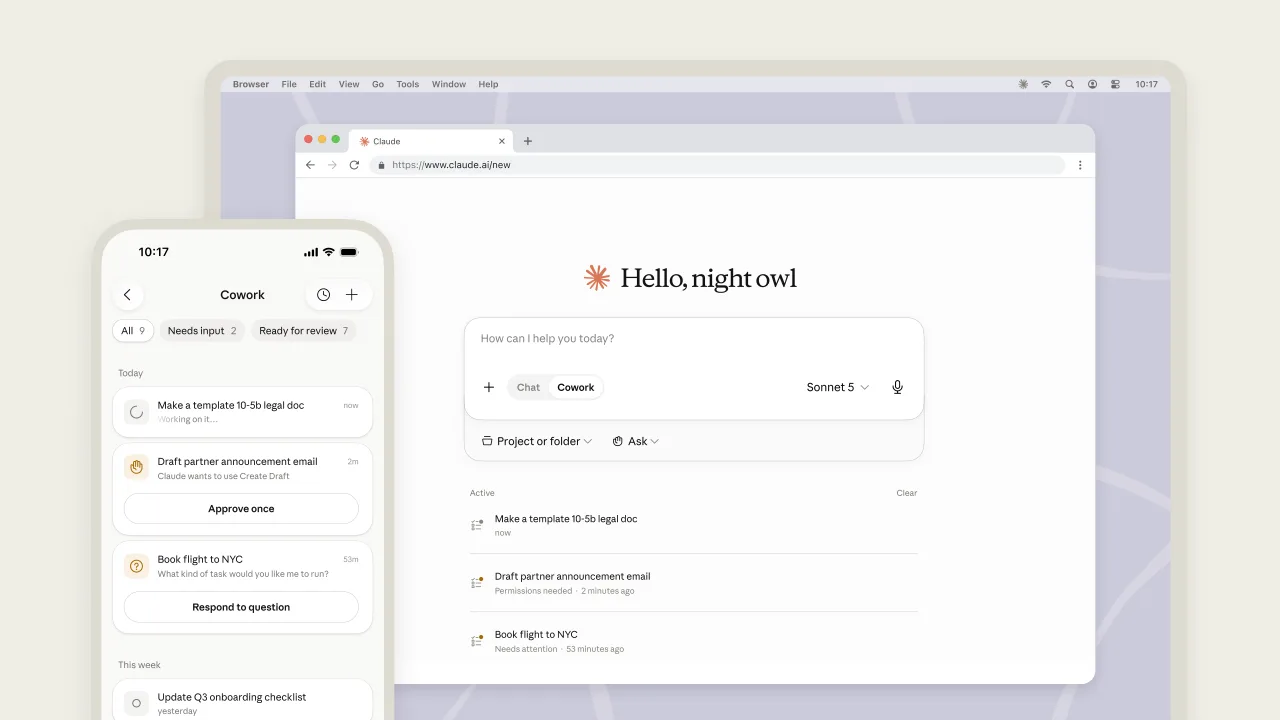
Anthropic brought Claude Cowork to web and mobile, turning what was a desktop-only agent into something that follows a task across devices — start it on a laptop, check it from a phone, get the result back later. The rollout itself is a routine platform expansion. The more interesting detail is usage data Anthropic published alongside it: more than 90% of Cowork sessions aren't software development at all.
Definition: Claude Cowork is Anthropic's AI agent mode that takes on a task end-to-end — across files, connected tools and the web — instead of answering in a single chat reply.
Example: A session can start on a laptop, keep running after the laptop closes, and get checked or steered later from the Claude app on a phone.
Key takeaway: Cowork's own usage numbers show business operations and content work outpacing coding by a wide margin — it's positioned as a general office tool now, not a developer tool that happens to also do other things.
Business impact: Teams evaluating AI agents for non-technical work (reporting, drafts, research) now have a cross-device option live in beta, gated to Max subscribers first.
What did Anthropic announce?
Anthropic expanded Claude Cowork from a desktop-only app to web and mobile (iOS and Android), rolling out in beta to Max subscribers first, with Max users getting doubled usage limits through August 5, 2026 before wider plans get access. Chat and Cowork now share one interface, so projects and in-progress tasks show up in the same place regardless of which device started them.
The core change is that Cowork sessions run remotely rather than only on one machine: work continues in the background after a laptop closes, and a phone can be used to check status, approve a permission request, or review a finished result. Anthropic frames this as removing the requirement to stay at one device for a task to keep moving.
What can Claude Cowork actually do?
Cowork takes an outcome — a report, a spreadsheet, a deck, a folder of research turned into a tracker — and works toward it across connected files and tools, opening a browser for web-based steps and asking for a permission decision when one is needed rather than guessing. It's designed to split larger projects into pieces it can work on concurrently and to hand back a result ready for review, not a rough draft that still needs heavy editing.
Availability spans web, desktop (macOS, Windows, Windows ARM64, Linux, ChromeOS) and mobile in beta. Cowork is included on Pro, Max, Team and Enterprise plans; what's new here specifically is the web/mobile beta, starting with Max.
Why is the usage data the real story here?
Anthropic published data from 1.2 million anonymized Cowork sessions sampled between May 11 and May 31, across more than 600,000 organizations. Software development accounted for only 8.7% of that usage. Business process work — reports, checklists, spreadsheets — led at 33.4%, and content creation and copywriting (drafts, presentations, proposals) came next at 16.4%.
That matters because Cowork descends from Anthropic's coding-agent lineage, and Claude itself is closely associated with developer tools. Data showing the large majority of real usage is ordinary knowledge work, not code, is the actual signal in this announcement — it's evidence the product's center of gravity has already shifted, not just a stated ambition.
How does this fit the wider AI agent market?
TechCrunch's framing places this alongside OpenAI's parallel move with Codex, which has been expanding from a developer-focused tool toward broader workplace use in a similar way. Neither company is unique in this shift — coding-agent vendors moving into general office work is the pattern, and this launch is one data point in it, not an isolated move by Anthropic.
What should teams take from this?
Teams already using Claude for coding or research have a lower-friction way to try Cowork for non-technical work now that it isn't tied to staying at a desktop. Given the beta is Max-first, teams on other plans should expect a wait before broader access lands, per Anthropic's own stated timeline. For anyone evaluating agent tools for business-process or content work specifically, Cowork's own usage numbers are a reasonable signal that this is now a mainstream use case for the product, not an edge case.
Frequently asked questions
What is Claude Cowork?
Claude Cowork is Anthropic's agentic mode for Claude that takes on a task and works toward an outcome across files, connected tools, and the web, asking for permission when a decision or access requires it. It's built for everyday knowledge work, not just writing code.
What changed with this announcement?
Cowork moved from a desktop-only app to web, desktop and mobile (iOS and Android in beta). A session can start on a laptop, keep running in the background after the laptop closes, and be checked or steered later from a phone, since sessions and files are tied to the Claude account rather than one device.
Who can use Claude Cowork on web and mobile right now?
Anthropic is rolling this out in beta to Max subscribers first, with doubled usage limits through August 5, 2026, before expanding to other plans in the following weeks. Cowork itself is also available on Pro, Team and Enterprise plans, but the new web/mobile beta access is starting with Max.
Do most people use Claude Cowork for coding?
No. Anthropic's own usage data, drawn from 1.2 million sessions across more than 600,000 organizations in May, found software development was only 8.7% of usage. Business process work such as reports and spreadsheets led at 33.4%, and content creation like drafts and presentations was next at 16.4%.
How does this compare to what OpenAI is doing with Codex?
Reporting on the announcement noted OpenAI has been expanding Codex in a similar direction, moving it from a developer-focused coding tool toward broader workplace tasks. Both companies are pushing their agents past coding into general office work, which is the wider trend this launch is part of, not something unique to Cowork.
Sources
Alex
Founder & Lead AI Writer
Alex is the founder of Yowox and lead AI writer since 2024, breaking down complex information into clear, actionable insights for thousands of readers every day. Alex has built AI automation systems for businesses since 2024, focusing on AI agents, workflow automation, and business process optimization.
Save hours. Save thousands.
Practical guides, real workflows, and the latest AI and automation news that matters — straight to your inbox.