 By Alex
 What's the Difference Between an AI Agent and ChatGPT?
ChatGPT can be a conversational assistant or an agentic product, depending on its tools and mode. The practical difference is whether it only responds or can pursue a goal, choose actions and complete work.
ChatGPT and an AI agent are not mutually exclusive categories. Ordinary ChatGPT is primarily a conversational interface that generates answers, while an AI agent is a system that pursues a goal through multiple steps, tools and decisions. ChatGPT becomes agentic when the product gives the model the permissions, tools and orchestration needed to act on a task rather than only describe what a person should do. OpenAI keeps moving that boundary: it is shutting down the Atlas browser, giving ChatGPT a live voice model and reportedly building a screenless AI companion.
Definition: ChatGPT is a product and conversational interface; an AI agent is a goal-directed system that can reason, use tools and take controlled actions.
Example: ChatGPT can draft a meeting email; an AI agent can check calendars, choose an available slot, send invitations and confirm the result.
Key takeaway: The difference is not the model brand. It is what the surrounding system can do after the user sends the request.
Business impact: Choosing ordinary chat, tool-assisted AI or a full agent should depend on the required action, permissions and risk—not on whether the interface looks like a chat window.
What is the difference between ChatGPT and an AI agent?
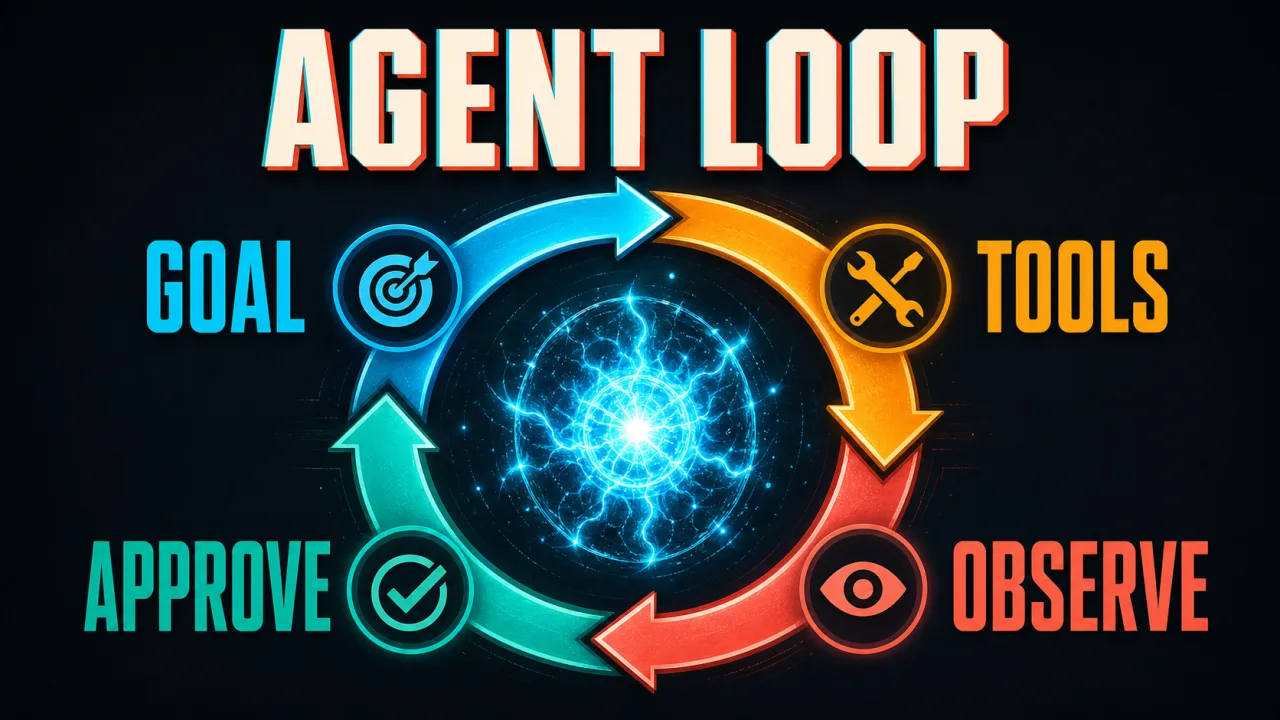
The practical difference is answer generation versus goal completion. ChatGPT in a normal conversation responds to the current prompt and usually leaves the next real-world step to the user. An AI agent receives an outcome, decides which steps are needed, calls tools, observes results and continues until it reaches a stopping condition or escalates to a person.
That boundary is not absolute. A ChatGPT conversation can use tools, browse the web or run code without becoming a fully autonomous business agent. Conversely, an AI agent may use ChatGPT or another large language model as its reasoning component. The model generates decisions; the agent system supplies the loop, tools, state and permissions around those decisions.
Is ChatGPT already an AI agent?
Sometimes—but “ChatGPT” needs a mode qualifier. Standard ChatGPT is best described as a conversational AI assistant when it answers questions, drafts text or explains a concept. OpenAI's current ChatGPT agent documentation describes a distinct agent mode that can navigate websites, use a code interpreter and terminal, connect to apps, fill forms and work with files while pausing for clarification or confirmation.
OpenAI therefore uses “ChatGPT” for both the familiar chat product and a product that can expose agentic capabilities. Saying “ChatGPT is not an agent” is too broad in 2026; saying “every ChatGPT conversation is an agent” is also wrong. The correct answer depends on whether the selected mode can independently plan and execute a multi-step task with real tools.
The three levels: chat, tool use and agent execution
A useful way to remove the naming confusion is to separate three operating levels:
| Level | What the system does | Typical user role | Example |
|---|---|---|---|
| Conversational AI | Generates an answer, draft or recommendation | Reads, decides and acts | Draft a reply to a customer |
| Tool-assisted AI | Uses a specific tool when asked, often one step at a time | Directs the next action | Search a document or run a calculation |
| AI agent | Plans a sequence, selects tools, observes results and continues toward an outcome | Sets the goal, approves risk and reviews exceptions | Research suppliers, compare options and prepare a purchase request |
The levels form a spectrum rather than three separate brands. A single ChatGPT product can offer all three, depending on the mode, enabled tools and permissions. For a broader foundation, see what an AI agent actually does.
What makes a system an AI agent?
An AI agent normally combines five elements: a goal, a reasoning model, tools, state and an execution loop. The goal defines the desired outcome. The model interprets context and proposes the next step. Tools connect the system to calendars, CRMs, browsers, databases or APIs. State preserves what has already happened. The loop lets the system observe a tool result and decide what to do next.
Anthropic makes the distinction more precise in its guide to building effective agents: workflows follow predefined code paths, while agents dynamically direct their own process and tool use. That distinction matters because a fixed sequence of three prompts can automate a task without being a fully autonomous agent.
An AI agent also needs boundaries. Production systems require narrow permissions, logging, validation, clear stop conditions and human approval for high-impact actions. Without those controls, a system may be able to act, but it is not necessarily safe or reliable enough to run a business workflow.
What can ChatGPT do without being an agent?
Ordinary ChatGPT is valuable when the human remains the operator. It can explain a policy, summarize a report, brainstorm campaign ideas, translate a message, draft code or suggest the next steps in a process. These tasks may involve substantial reasoning, but the system does not need to own the workflow or make external changes.
This distinction is useful because not every business problem needs autonomy. If a manager wants five options and will choose one, a conversational assistant may be the right tool. Adding integrations, memory and autonomous execution would increase cost, latency and operational risk without improving the decision.
What does an AI agent add?
An AI agent adds execution across a process. Given a goal such as “prepare a qualified lead handoff,” an agent could read an inbound message, retrieve the company record, classify the opportunity, check required fields, draft a summary and route it to a CRM or Slack channel. The value comes from completing the chain, not from producing a more eloquent paragraph.
The agent still needs explicit business rules. It should not invent a discount, delete a customer record or send an irreversible message simply because a prompt sounds confident. A well-designed system keeps high-risk actions behind approval and uses deterministic APIs or workflow steps wherever the rule is known.
ChatGPT agent mode is still not magic autonomy
OpenAI's agent mode shows why product labels can blur the distinction. The official description says ChatGPT agent can complete online tasks, connect to data sources and interact with websites, but it also says the user remains in control and the system may pause for clarification or confirmation. That is agentic execution with supervision—not unlimited independence.
This supervised model is usually the practical target for businesses. The agent can perform routine steps, while a person controls sensitive logins, approvals, payments, external communications and exceptions. The right question is not “Is it fully autonomous?” but “Which actions can it take safely without waiting for a person?”
Which should a business choose?
Choose ordinary ChatGPT when the output is information, a draft or a recommendation and a person will perform the next action. Choose a tool-assisted setup when one controlled lookup, calculation or transformation removes friction. Choose an AI agent when the workflow is multi-step, crosses systems and has a clear outcome that can be checked.
Start with the simplest level that solves the problem. If the workflow is predictable, a normal API automation may be safer than an agent. If the input is messy but the downstream action is fixed, combine an AI model for classification or extraction with deterministic automation. Use a full agent only when the system genuinely needs to choose its path under changing conditions. See also Do AI Agents Need RAG? A Practical Decision Guide.
The short answer is: ChatGPT is the conversational product; an AI agent is the action-oriented system around a model. ChatGPT can be one component of an agent—and, in agent mode, it can also be the user-facing agent product. See also How avatarin built a 24/7 retail agent with GPT-Realtime. See also Vint Cerf is working on a plan to unleash AI agents on the open internet.. More on this: Microsoft's Five-Step Guide to Building AI Agents. Related reading: What Can AI Agents Actually Do? Real Tasks and Limits. Background: OpenAI AI agents target everyday work, not just code.
Frequently asked questions
Is ChatGPT an AI agent?
Sometimes. Standard ChatGPT is usually a conversational AI assistant: you ask a question and it generates a response. ChatGPT agent mode is different: OpenAI says it can browse websites, use a terminal, work with files and apps, fill forms and complete multi-step tasks while asking for confirmation when needed. The name ChatGPT describes a product family, not one fixed level of autonomy.
What is the simplest difference between ChatGPT and an AI agent?
ChatGPT in ordinary chat primarily produces an answer. An AI agent is designed to achieve an outcome by planning steps, selecting tools, taking actions and checking progress. A ChatGPT conversation can draft a meeting email; an agent can inspect calendars, find a suitable slot, send an invite and report what happened, subject to the permissions and approvals it has.
Does an AI agent need ChatGPT?
No. An AI agent needs a model capable of interpreting instructions and choosing or following actions, but that model could come from OpenAI, Anthropic, Google or another provider. The agent is the complete system around the model: instructions, tools, memory or state, permissions, orchestration, validation and human escalation.
When should a business use ChatGPT instead of an AI agent?
Use ordinary ChatGPT when the task ends with an explanation, draft, brainstorm, summary or answer that a person will review and act on. Use an AI agent when the work requires repeated multi-step execution across business systems, such as triaging requests, updating records or coordinating a workflow. Start with the simpler option when no real action or tool access is needed.
Alex
Founder & Lead AI Writer
Alex is the founder of Yowox and lead AI writer since 2024, breaking down complex information into clear, actionable insights for thousands of readers every day. Alex has built AI automation systems for businesses since 2024, focusing on AI agents, workflow automation, and business process optimization.
Save hours. Save thousands.
Practical guides, real workflows, and the latest AI and automation news that matters — straight to your inbox.