 By Alex
 OpenAI AI agents target everyday work, not just code
OpenAI is adapting coding-agent ideas for ChatGPT Work, aiming to move AI agents into the connected, permission-heavy workflows of everyday knowledge work.
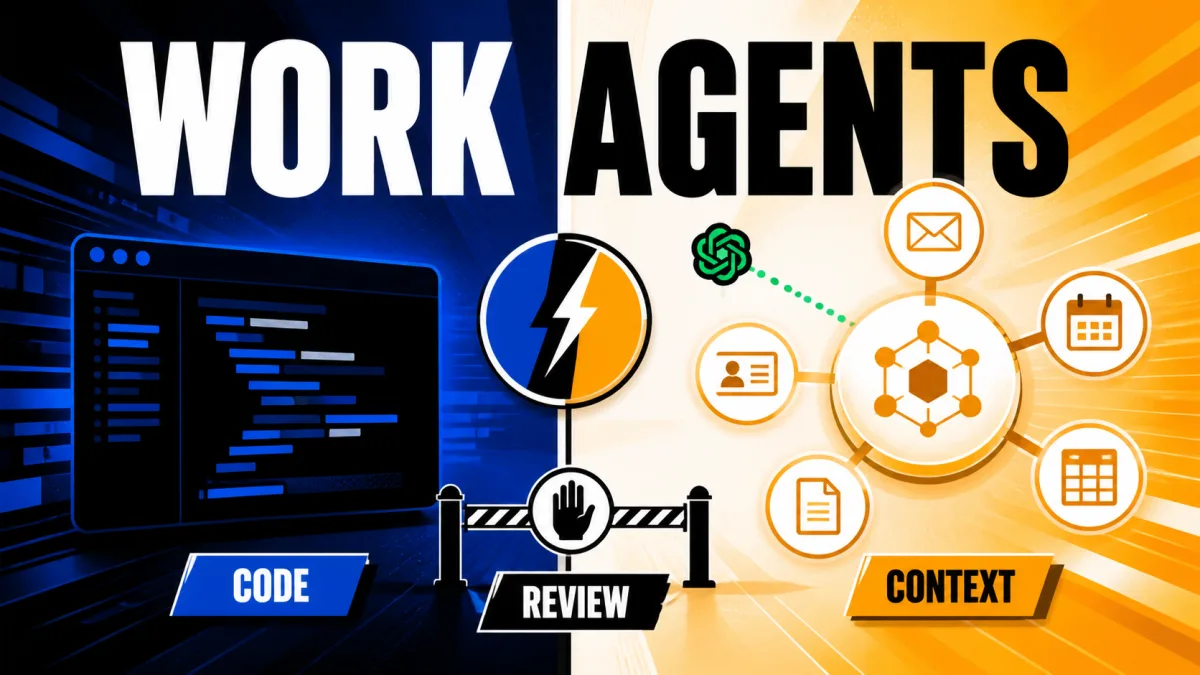
OpenAI is moving its AI-agent strategy from coding toward everyday knowledge work. The company’s ChatGPT Work is designed to connect an LLM to workplace apps and let it complete multistep projects, while a study cited by TechCrunch shows a large gap between agent use inside OpenAI and adoption among external subscribers. For operators, the signal is clear: the next adoption test is not whether agents can write code, but whether ordinary teams will trust them with context, permissions and reversible actions.
Definition: ChatGPT Work is OpenAI’s attempt to turn a general ChatGPT interface into an action-taking work agent.
Example: The product is aimed at tasks that coordinate information across email, calendars, Slack, documents, spreadsheets and other workplace tools.
Key takeaway: OpenAI is adapting a coding-agent model for non-engineers, but the user experience still has to hide technical complexity without hiding risk.
Business impact: Companies evaluating AI agents should measure adoption through completed, reviewable workflows—not sign-ups or impressive demonstrations.
Why is OpenAI moving AI agents beyond coding?
OpenAI is expanding AI agents beyond coding because software engineering is only one slice of professional work. ChatGPT Work is positioned for accountants, investors, doctors and other white-collar workers whose days are dominated by computer-based systems, while OpenAI’s engineers describe the product as a way to complete complicated tasks rather than merely answer questions. The practical implication for business leaders is to look for information-heavy coordination work where an agent can produce a verifiable deliverable.
OpenAI’s commercial case is broader model usage tied to useful work. TechCrunch reports that longer-running agents consume more tokens per user and that reaching professions outside software engineering matters to AI labs trying to support very large training and compute investments. That does not prove that every workflow will be profitable or that every employee will adopt an agent; it means the business model increasingly depends on agents being useful beyond developer tools.
OpenAI’s own workforce illustrates both the opportunity and the gap. An OpenAI-backed study cited by TechCrunch found that 98% of OpenAI employees used Codex in June, versus 17% of organizational subscribers and less than 1% of individual subscribers. The useful lesson is not that internal usage guarantees external adoption; it is that the product must convert expert familiarity into a simpler experience for people who do not think in terms of terminals, diffs or agent harnesses.
What does ChatGPT Work change for non-engineers?
ChatGPT Work changes the agent interface by putting the harness behind a familiar conversational product. In the official ChatGPT Work announcement, OpenAI describes an agent that can work across apps and files, break a project into steps, and produce materials such as sheets, slides, documents and web apps. For a non-engineer, that means the starting point can be a goal stated in ordinary language; the trade-off is that the underlying context and permissions still need careful configuration.
An AI agent differs from a chatbot because the agent can use tools and continue through a task. A harness decides what information the model sees, which tools it can call and how results return for the next step; that is the operational layer behind the answer. The distinction matters for understanding what an AI agent is and for comparing AI agents with ChatGPT, because a business should evaluate not only the quality of generated text but also the agent’s ability to observe, act, report progress and stop safely.
| Capability | Chatbot interaction | AI-agent workflow |
|---|---|---|
| Starting point | A question or request | A goal with context and permissions |
| Main output | An answer or draft | A deliverable plus actions taken |
| Tool use | Usually explicit or limited | Connected apps, files and services |
| Human role | Reviews the response | Sets boundaries, reviews actions and handles exceptions |
| Main risk | Incorrect information | Incorrect information plus unintended actions |
OpenAI’s target use cases are routine, data-intensive coordination tasks. The TechCrunch report describes weekly metrics reports, spreadsheet planning tools, dashboards, data visualizations and calendar updates as examples of work that can benefit from connected context. Operators should start with tasks that have a clear input, a defined output and a human-checkable result, because those conditions make an early agent deployment measurable.
Why is mainstream adoption still difficult?
OpenAI’s hardest adoption problem is permission design, not prompting. TechCrunch describes access setup that was confusing, errors when trying to grant limited read access, and cases where a connected service required broader access than expected. That evidence makes the operational recommendation concrete: an organization should map data access and write permissions separately, test the smallest useful scope, and require approval before an agent changes a system of record; the same principle appears in the five control layers for AI-agent security.
ChatGPT Work also inherits the messy interfaces and inconsistent rules of existing business software. OpenAI’s engineers describe an agent that must work with inboxes, SaaS tools and websites built for older workflows, while the report notes that some settings are available only on the web and that connected calendars may support creating events but not creating new calendars. Businesses should treat cross-application reliability as a deployment question, not assume that a smooth chat surface means every downstream integration is equally mature.
OpenAI faces a harder evaluation problem outside coding because many knowledge-work outputs are subjective. Software can be checked through tests and execution results, but the quality of a presentation, strategy, sales pitch or business decision is less binary, according to the report. A sensible rollout therefore needs workflow-specific acceptance criteria—such as required sources, named owners, reconciliation checks or review gates—rather than a generic claim that the model is “good enough.”
OpenAI is using GDPval and user feedback as part of its answer to the evaluation problem. The company’s GDPval evaluation spans 44 occupations and real-world knowledge-work tasks, but OpenAI also says the early version is one-shot and does not capture every interactive, context-building workflow. The takeaway for operators is to use benchmarks as directional evidence, then test the complete human-and-agent process that the business actually intends to run.
What are the cost and lock-in questions behind the agent push?
OpenAI’s agent economics can become difficult to see when a simple subscription hides variable work. TechCrunch reports that the reporter used more than 80 million tokens in four days on a $20-a-month subscription, with the model estimating a $65 cost and no in-app usage dashboard. The figure is one reported usage example, not a universal price, but it shows why teams should track task cost, retries, duration and output value before scaling agent access.
OpenAI’s connected-work strategy may also increase switching costs. Once an agent is configured around email, documents, calendars, CRM data and other plug-ins, the friction of changing permissions and moving context can become part of the product’s value. The report identifies data retention and the pain of configuring access as possible lock-in factors, so buyers should ask for export paths, permission visibility and clear controls before making one agent the only interface to critical work.
OpenAI’s rivalry with Anthropic exposes a design choice between magic and supervision. TechCrunch describes Claude Code as an earlier example of a more iterative pattern that presents options, asks for decisions and reports progress, while OpenAI’s products initially leaned harder toward autonomous execution before adding more interaction. For higher-risk workflows, businesses should prefer an agent that makes plans, evidence and approval points visible even if that requires more user input.
What business operators should watch next
OpenAI’s next proof point is repeatable adoption outside its own walls. The gap between 98% internal Codex use, 17% organizational-subscriber use and less than 1% individual-subscriber use shows that expert enthusiasm has not automatically become mass usage. The indicators worth watching are completed tasks per active user, permission failures, human correction rates, cost per accepted deliverable and retention after the first experiment.
OpenAI’s agent strategy is directionally important, but it does not make unrestricted autonomy the default for business. ChatGPT Work shows how a model provider can combine a general interface, a tool-using harness and access to workplace context; the same combination also creates privacy, cost, evaluation and operational risks. The most durable deployments will likely begin with bounded coordination tasks, explicit permissions and human review, then expand only when the evidence shows that the agent is reliable in the workflow that matters.
Frequently asked questions
What is OpenAI building with ChatGPT Work?
OpenAI is adapting the agentic capabilities of Codex into ChatGPT Work, a product intended to connect an AI model to the apps and digital workflows used by knowledge workers. The goal is not only to answer a question, but to carry out a multistep task across tools such as email, calendars, Slack, documents and other workplace software. The product still depends on permissions, context and human judgement, so it is better understood as an action-taking work interface than as a universal autonomous employee.
Why does OpenAI want AI agents beyond software engineering?
Coding has been an important early market for AI agents, but software development is only a small part of professional work. OpenAI is trying to reach finance, operations, communications, sales and other departments because wider adoption would create more utility for users and more usage of its models. The move also addresses a practical gap: many workers need help coordinating information across existing systems, not learning a command-line interface or writing code.
What is the biggest barrier to using AI agents at work?
The biggest barrier is the trust-and-control boundary between asking for an answer and allowing an agent to act. Users must connect applications, choose permissions and decide which actions require review. The TechCrunch account describes confusing access setup, limitations across web and mobile, and workflows that are harder to evaluate than code. Businesses should therefore start with bounded, reversible tasks and explicit approvals rather than granting an agent unrestricted access to sensitive systems.
Will everyone use OpenAI’s AI agents?
OpenAI has evidence of strong internal use, but the available adoption gap does not show that everyone is ready. A study cited by TechCrunch found that 98% of OpenAI employees used Codex in June, compared with 17% of organizational subscribers and less than 1% of individual subscribers. That contrast suggests that mainstream adoption will depend on simpler setup, clearer value, better evaluation and credible controls. AI agents may spread widely, but the pace will differ by workflow, risk tolerance and the quality of the surrounding product experience.
Alex
Founder & Lead AI Writer
Alex is the founder of Yowox and lead AI writer since 2024, breaking down complex information into clear, actionable insights for thousands of readers every day. Alex has built AI automation systems for businesses since 2024, focusing on AI agents, workflow automation, and business process optimization.
Save hours. Save thousands.
Practical guides, real workflows, and the latest AI and automation news that matters — straight to your inbox.