 By Alex
 How avatarin built a 24/7 retail agent with GPT-Realtime
avatarin and Yamada Denki used OpenAI's GPT-Realtime to turn retail expertise into a 24/7 multilingual shopping conversation that helps customers discover products and make decisions.
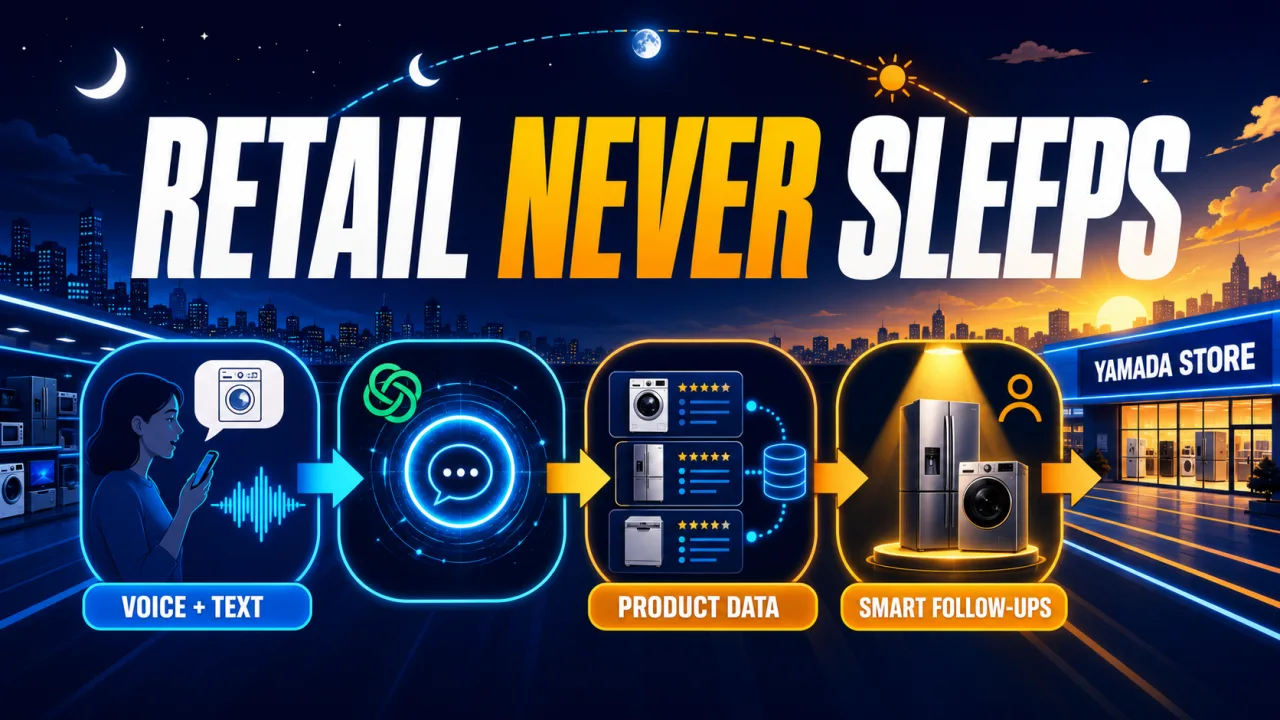
avatarin built a 24/7 multilingual shopping agent with GPT-Realtime for Yamada Denki, combining voice, text and visual understanding with product retrieval and retail-specific conversation design. During a two-week public campaign on Yamada Denki's online store, approximately 30,000 people used the agent and 92% of post-use survey responses were positive, according to OpenAI's customer story.
Definition: The Kurashi-Marugoto AI Agent is a retail AI agent that guides shoppers through product discovery and purchase decisions instead of stopping at a one-shot chatbot reply.
Example: A shopper can describe a household need, answer follow-up questions about constraints such as family size or kitchen space, and receive product guidance in a voice or text conversation.
Key takeaway: The Kurashi-Marugoto AI Agent combines fast GPT-Realtime interaction with retrieval-augmented generation and Yamada Denki's sales expertise.
Business impact: The campaign shows how a retailer can extend expert shopping support beyond store hours while capturing questions and hesitation that ordinary online shopping may leave invisible.
What problem was avatarin solving for Yamada Denki?
avatarin was solving the retail gap between expert in-store advice and an online store that remains available after business hours. Japan's home-appliance retailers face pressure to extend support while staffing remains tight, so avatarin and Yamada Holdings turned experienced associates' knowledge into a multilingual agent that could guide shoppers around the clock. The practical lesson for retailers is to start with a defined service model—product discovery and decision support—rather than label a generic FAQ bot as an agent.
The Kurashi-Marugoto AI Agent was designed for questions that depend on context, not only product keywords. A shopper asking for a refrigerator for a family of four with a small kitchen is expressing several constraints at once, and avatarin describes the agent as listening for those changing requirements. Retail teams evaluating a shopping agent should therefore map the questions associates ask before recommending a product, because that conversation structure is part of the service being automated.
How does GPT-Realtime change the shopping conversation?
GPT-Realtime gave avatarin one conversational layer for voice, text and image understanding, with the source describing the interaction as responsive and low-latency. That matters in retail because shoppers often explain needs in incomplete, interrupted or evolving language rather than submit a perfectly structured query. The useful design choice is to let the customer communicate naturally while the agent keeps the product-discovery goal in view.
avatarin paired GPT-Realtime with retrieval-augmented generation so product information could ground the agent's responses without making the conversation feel like a database lookup. GPT-Realtime supplies the live conversational experience; retrieval supplies relevant product facts. For an e-commerce AI agent, that separation is a practical boundary: the model can make the interaction natural, but the catalog and product-information layer must remain the source of truth.
What did avatarin add beyond a chatbot?
avatarin made the agent proactive by having it ask follow-up questions instead of waiting for the shopper's next command. The design incorporates Yamada Denki's category-specific sales knowledge into conversation flows and prompting, while guardrails help keep a discussion focused when a shopper changes requirements or briefly goes off topic. Retail operators can apply the same principle by defining the information an associate needs for each product category before choosing prompts or model settings.
The Kurashi-Marugoto AI Agent also turns conversation into a source of customer insight. In the public campaign, shoppers' questions revealed what they cared about, where they hesitated and what might help them decide; OpenAI says those insights were difficult to see in conventional online shopping. A retailer should treat those conversations as service data to review for recurring needs, not only as a way to deflect support requests.
What happened during the public campaign?
The two-week Yamada Denki online campaign reached approximately 30,000 users and recorded 92% positive post-use survey responses, while offering 24/7 multilingual support by voice and text. Those numbers are the clearest reported result of avatarin's public test, so they should be read as campaign evidence rather than a universal benchmark for retail AI agents. A retailer planning a similar launch should publish the population, time window and survey method alongside its headline result.
The avatarin and Yamada Denki public campaign also created lower-pressure moments for shoppers: customers could ask questions after stores closed and speak candidly about budgets or uncertainty without feeling sales pressure. That detail changes the success criterion from "answered more questions" to "helped people articulate a purchase need." It is a useful distinction when comparing a retail AI agent with a conventional chatbot that only returns a response.
What does avatarin's retail model suggest next?
avatarin's stated direction is one intelligence that carries customer context across the web, phone and physical stores, while preserving each company's identity and hospitality. The current case demonstrates the web-based shopping conversation; it does not establish that every channel is already unified. Retail leaders should separate the proven campaign from the longer-term vision and expand channel coverage only after the underlying product data, conversation rules and safety boundaries work reliably.
The broader signal is that retail agents are becoming service interfaces, not just automated answer boxes. avatarin combined a real-time multimodal model, grounded product information and human sales expertise, then tested the experience with a public audience. The next question for any retailer is concrete: which customer decision can be supported after hours, what trusted data does that decision require, and how will the business measure whether the conversation helped?
Frequently asked questions
What did avatarin build with GPT-Realtime?
avatarin built the Kurashi-Marugoto AI Agent with Yamada Holdings and Yamada Denki. The agent supports multilingual shopping conversations by voice and text, helps customers discover products, asks follow-up questions about their needs and guides them toward purchase decisions. OpenAI says the system combines GPT-Realtime with retrieval-augmented generation so product answers stay grounded in relevant product information while the conversation remains responsive.
How many people used the avatarin retail agent?
Approximately 30,000 people used avatarin's Kurashi-Marugoto AI Agent during a two-week public campaign on Yamada Denki's online store, according to OpenAI's customer story. The same source reports that 92% of post-use survey responses were positive. Those figures describe the public experience and its survey responses; they are not a claim that every shopping conversation produced a purchase.
What makes avatarin's agent different from a normal retail chatbot?
avatarin designed the agent to ask questions and follow a shopper's changing requirements instead of waiting for a keyword and returning a single answer. GPT-Realtime handles voice, text and image understanding in one conversational experience, while retrieval grounds responses in product information. Yamada Denki's sales expertise is incorporated into conversation flows and prompting, with guardrails intended to keep the interaction focused on shopping.
Is the avatarin agent available 24/7?
The Kurashi-Marugoto AI Agent was designed to provide 24/7 multilingual support by voice and text. In the public campaign described by OpenAI, shoppers could ask questions after stores closed and discuss budgets or uncertainty without the pressure of a live sales interaction. The source describes the service as a public campaign experience, not as a guarantee that every future Yamada Denki channel will offer the same access.
Alex
Founder & Lead AI Writer
Alex is the founder of Yowox and lead AI writer since 2024, breaking down complex information into clear, actionable insights for thousands of readers every day. Alex has built AI automation systems for businesses since 2024, focusing on AI agents, workflow automation, and business process optimization.
Save hours. Save thousands.
Practical guides, real workflows, and the latest AI and automation news that matters — straight to your inbox.