 By Alex
 AI Agents for E-commerce: Support, Orders and Retention
Where online stores should start with AI agents: customer support, order operations, product questions, returns and retention workflows.
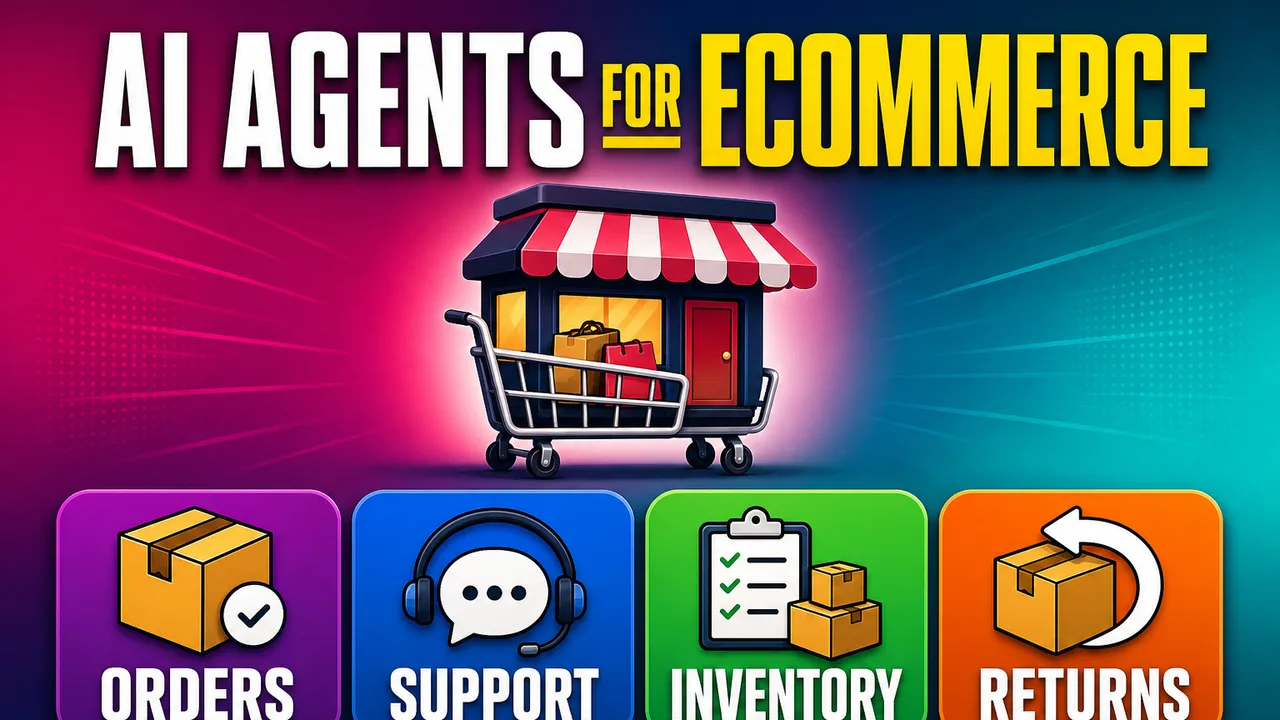
AI agents for e-commerce are most useful when they connect product, order, customer and policy data into one controlled workflow. An online store should not start with a general "AI shopping assistant." An online store should start with a specific workflow: support triage, order lookup, return handling, product Q&A or retention follow-up.
Definition: An e-commerce AI agent is an automation system that reads store context, uses approved tools and helps complete customer or operations workflows.
Example: An e-commerce AI agent can read a shipping complaint, check order status, retrieve the return policy, draft a reply and escalate refund exceptions.
Key takeaway: Start with store workflows that repeat often, have trusted data and can keep risky actions under human approval.
Business impact: E-commerce AI agents reduce manual lookup work, speed up support and make customer handoffs more consistent.
What should an e-commerce AI agent automate first?
An e-commerce AI agent should automate the workflow where store data is already structured and customer volume is high. Order status, return eligibility, product questions and support triage are usually better first candidates than open-ended shopping advice. These workflows have clear inputs, known data sources and measurable outcomes.
Shopify's Admin API documentation describes the Admin API as a way to build apps and integrations that extend the Shopify admin, which is exactly the kind of controlled system access an e-commerce AI agent needs. The agent should not guess from memory; the agent should call approved tools that read current product, order and customer data.
The Yowox Store Agent Map
The Yowox Store Agent Map groups e-commerce AI use cases by risk and data readiness. Low-risk, high-data workflows should come first. High-risk workflows can still use AI, but the AI agent should draft, summarize or recommend instead of acting autonomously.
| Workflow | Data needed | First autonomy level |
|---|---|---|
| Order status | Order and shipping events | Draft or auto-reply |
| Product Q&A | Catalog, specs, policies | Draft or answer with citations |
| Returns | Order, return window, policy | Recommend, then approve |
| Retention | Purchase history, issue history | Draft offer or task |
| Inventory exceptions | Inventory and fulfillment rules | Alert, then review |
How can AI agents improve support?
AI agents improve e-commerce support by removing lookup work from repeated tickets. A support agent can classify the issue, retrieve order context, check policy, draft a response and prepare an escalation summary. This is stronger than a generic chatbot because the e-commerce AI agent is grounded in store data and constrained by store policy.
The support workflow should preserve human approval for sensitive cases. Refund exceptions, chargeback threats, lost high-value orders and angry customers should not be handled by a fully autonomous reply on day one. For the support-specific rollout ladder, see How to Automate Customer Support With AI Agents.
How can AI agents handle orders?
AI agents can handle order operations by reading order status, shipping events, inventory state and customer history, then preparing the next action. A common workflow is: customer asks where the order is, the AI agent retrieves status, checks whether the package is late, drafts a reply and escalates if the carrier data is missing or the order value is high.
Order workflows need strict action boundaries. Reading status is low-risk. Updating an address, issuing a replacement or promising compensation is higher-risk. The first version should separate "answer from current data" from "change the order."
How can AI agents answer product questions?
AI agents can answer product questions when the product catalog is clean, current and structured. The e-commerce AI agent should retrieve product specs, size guides, compatibility rules, ingredients, shipping restrictions or warranty terms from the catalog and policy sources. If the answer affects safety, medical use or regulated claims, the AI agent should escalate or use approved copy only. See also How avatarin built a 24/7 retail agent with GPT-Realtime.
Product Q&A is strongest for stores with complex catalogs. The AI agent can ask clarifying questions, narrow options and show why a product matches the customer's need. The goal is not to hallucinate a salesperson; the goal is to make the catalog easier to navigate.
How can AI agents support returns and retention?
AI agents can support returns by checking order date, return window, product condition rules and customer history, then preparing a recommendation. The e-commerce AI agent can also detect retention opportunities: repeated shipping issues, poor product fit, VIP customer frustration or a churn signal after a bad support experience.
Retention should stay controlled. The AI agent can draft an apology, suggest a replacement or prepare a discount recommendation, but policy exceptions should have approval rules. This keeps margin, fairness and customer trust under human control.
What should an e-commerce AI agent measure?
An e-commerce AI agent should measure support time saved, first-response time, resolution time, draft acceptance rate, order-lookup time, refund exception rate, customer satisfaction and repeat purchase impact. The store should also track mistakes: wrong policy answer, wrong product claim, unnecessary escalation or missed high-risk case.
Use a baseline before automation. Count how often each ticket type appears and how long manual handling takes. After launch, compare the same workflows. For the measurement model, see How to Measure ROI of an AI Automation Project.
What is a safe first e-commerce project?
A safe first e-commerce AI project is a supervised order-status and support-triage agent. The workflow reads the customer message, retrieves order data, checks policy, drafts a reply and escalates exceptions. The store keeps approvals for refunds, replacements and policy exceptions.
Once that workflow works, expand into product Q&A, return recommendations and retention tasks. E-commerce AI agents work best when the store grows one trusted workflow at a time instead of launching a broad assistant with unclear authority.
Start with one measurable workflow: fewer manual lookups, faster replies or better return handoffs.
Frequently asked questions
What can AI agents do for e-commerce stores?
AI agents can help e-commerce stores with product questions, order status, return requests, support triage, review analysis, retention workflows and internal operations. The best use cases connect the AI agent to reliable store data: catalog, inventory, order status, shipping events, customer history and policy documents. A store should not start with a generic chatbot. A store should start with one measurable workflow where the AI agent can read the right context and reduce manual work.
Should an e-commerce AI agent handle refunds automatically?
An e-commerce AI agent should usually draft or recommend refund actions before it handles refunds automatically. Refunds touch money, policy exceptions and customer trust, so the first version should retrieve order data, check the return policy and prepare a human-readable recommendation. Automatic refunds can come later for narrow, low-risk cases with clear rules, such as unopened returns inside the policy window and under a defined order value.
What data does an e-commerce AI agent need?
An e-commerce AI agent needs product catalog data, inventory, order status, shipping events, return policy, customer history, support tickets, discount rules and allowed actions. The AI agent should retrieve facts from the system that owns them. Product details should come from the catalog, shipping status from the carrier or order platform and refund rules from the current policy. Without trusted sources, the AI agent will answer quickly but unreliably.
What is the safest first AI agent for an online store?
The safest first AI agent for an online store is usually an order-status or support-triage agent. These workflows repeat often, use clear data and can start with draft-only output. The AI agent can summarize the customer issue, retrieve order context, draft a reply and escalate exceptions. This removes manual lookup work without giving the AI agent broad authority to change orders, issue refunds or promise policy exceptions.
How do you measure e-commerce AI agent ROI?
Measure e-commerce AI agent [ROI](/tools/ai-automation-roi-calculator/) with ticket deflection quality, first response time, resolution time, manual lookup time saved, edit rate on AI drafts, return-handling speed, repeat purchase rate and customer satisfaction. Do not count only automated replies. A reply that creates a confused customer or wrong refund costs more than it saves. The useful metric is completed work with fewer errors and faster customer resolution.
Alex
Founder & Lead AI Writer
Alex is the founder of Yowox and lead AI writer since 2024, breaking down complex information into clear, actionable insights for thousands of readers every day. Alex has built AI automation systems for businesses since 2024, focusing on AI agents, workflow automation, and business process optimization.
Save hours. Save thousands.
Practical guides, real workflows, and the latest AI and automation news that matters — straight to your inbox.