 By Alex
 OpenClaw vs Hermes Agent: Security, Usage, and Migration
The latest OpenClaw-versus-Hermes Agent debate is less about GitHub stars than security exposure, real usage, architecture, and the migration gap between the two projects.
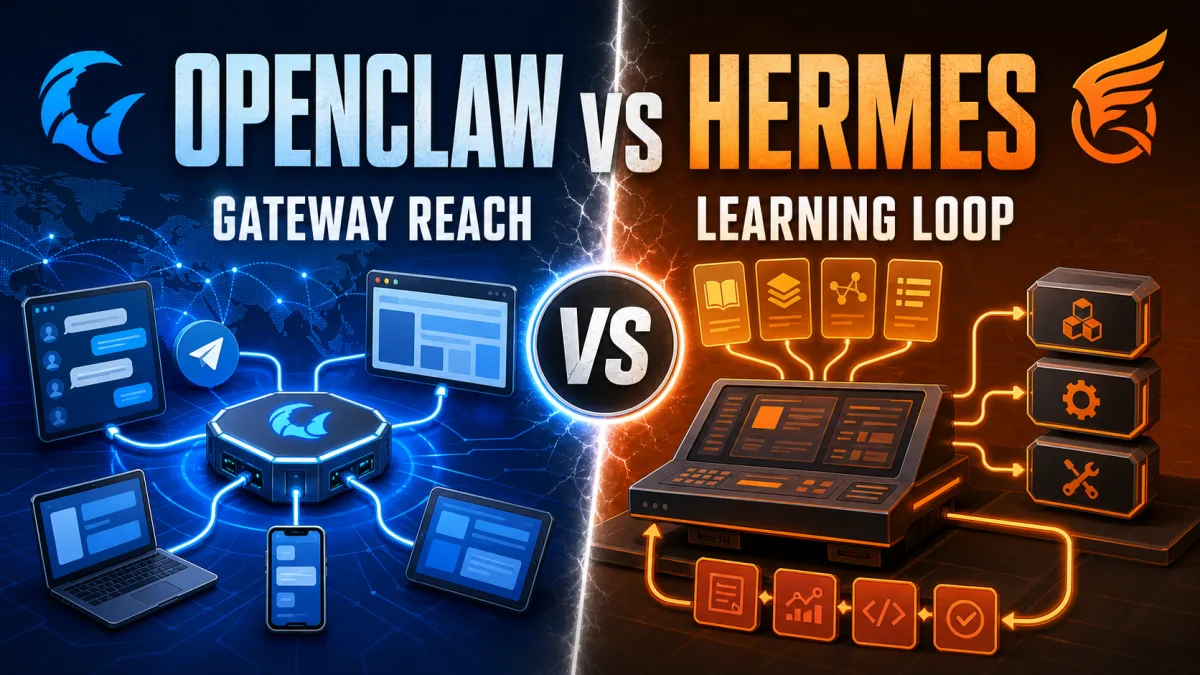
The latest OpenClaw-versus-Hermes Agent debate is not really a popularity contest. It is a choice between two operating models: OpenClaw puts a long-lived Gateway, channels, nodes, and extensions at the center, while Hermes Agent puts an evolving agent, reusable skills, memory, and execution backends at the center. A new Towards AI comparison makes the security timeline and the difference between attention and usage the story, not footnotes.
Definition: OpenClaw is a channel-and-Gateway-centered agent platform; Hermes Agent is a self-improving agent framework centered on tools, memory, skills, and execution.
Example: A messaging-heavy deployment may value OpenClaw's Gateway and integration surface, while a research or operations workflow may value Hermes Agent's reusable procedures and cross-session continuity.
Key takeaway: GitHub stars show public attention, but they do not establish real workload, security, or operator fit.
Business impact: Teams should choose the gap they can operate—OpenClaw's security and extension exposure, or Hermes Agent's thinner day-one integration surface—before connecting either system to real credentials.
What does the latest OpenClaw versus Hermes Agent story add?
The Towards AI comparison reports that OpenClaw reached roughly 345,000 GitHub stars by early April 2026, while Hermes Agent passed 160,000 by late May. The same article also reports nine OpenClaw CVEs disclosed across four days in March, including a critical issue scored 9.9, alongside earlier security findings and exposed instances. Those figures are the source's account, not an independent Yowox audit, so readers should treat them as a timeline to verify against current advisories rather than a permanent scorecard.
The important news value is the pairing of growth with operational risk. OpenClaw's popularity creates a large target and a large extension ecosystem; Hermes Agent's quieter growth gives it less public scrutiny as well as a smaller marketplace-style supply-chain surface. For an operator, the useful next step is to inspect current versions, access controls, installed skills, and network exposure—not to infer safety from a star count.
Why do GitHub stars and token usage tell different stories?
GitHub stars measure public interest, while inference volume is closer to retained operational use. The source comparison cites a May 21 snapshot in which OpenClaw had about 373,616 stars and Hermes Agent about 160,175, yet Hermes Agent was reported to process roughly 458 billion tokens per day versus OpenClaw's 173 billion. Those numbers describe one published snapshot, not a benchmark, but they support a useful distinction: a smaller installed base can still drive heavier recurring workloads per deployment.
That distinction changes how a buyer should evaluate adoption. Use stars and package downloads to estimate ecosystem breadth, documentation attention, and the probability that an integration already exists. Use workload evidence, reliability tests, and cost measurements to estimate whether a deployment will stay active. Neither metric alone proves that one agent is better.
How do the security postures differ?
OpenClaw's current documentation describes a Gateway that should be treated as a trust boundary, with explicit guidance for authentication, pairing, allowlists, group mention gating, plugin control, and security audits. The OpenClaw security guidance also warns that a single Gateway is not a hostile multi-tenant boundary. That matters whenever messages, extensions, browser sessions, and credentials share one runtime.
Hermes Agent documents a defense-in-depth model that includes command approval, tool controls, container isolation, messaging authorization, profiles, and pre-execution scanning. The Hermes security documentation describes these controls as layers rather than as a guarantee. A clean public CVE record, as reported by the source article, is therefore a current observation—not proof that a newer project has already received the same adversarial scrutiny as a much larger target.
The practical baseline is the same for both systems: keep the gateway private or allowlisted, separate personal and public identities, deny tools that the workflow does not need, use a dedicated browser profile, sandbox untrusted work, review skills and plugins, and rotate credentials after suspicious activity. Sandboxing reduces blast radius; it does not decide who may message the agent or which secrets the model can use.
Is OpenClaw's Gateway or Hermes Agent's learning loop the better architecture?
OpenClaw's architecture is optimized for reach. Its official architecture guide describes one long-lived Gateway owning messaging surfaces, typed WebSocket control-plane clients, and paired nodes that declare capabilities. This makes OpenClaw a natural fit when the product requirement is one operational hub coordinating channels, clients, devices, and agents.
Hermes Agent's architecture is optimized for iteration. Its agent can retain curated memory, create reusable skills, delegate work, and use different terminal or execution backends. That makes Hermes Agent a natural fit when the product requirement is an assistant that learns a team's procedures rather than a Gateway that primarily routes conversations and device actions. Related reading: Hermes Agent Adds Three Ways to Join Buzz.
OpenClaw and Hermes Agent differ in what they keep stable: OpenClaw's official architecture documentation centers the Gateway around identities, sessions, channels, and nodes, while Hermes Agent's official feature documentation centers reusable skills, curated memory, delegation, and execution backends. For a team choosing between them, test one channel-and-node workflow against one recurring skill workflow before granting either system broader access. See also Hermes Agent playbook: why repetition beats clever prompts.
For a broader background on the category, see what an AI agent is. For the longer platform-level guide already on Yowox, see Hermes Agent vs OpenClaw and the OpenClaw Gateway guide. Those pages provide evergreen context; this news item focuses on the new security, usage, and migration discussion.
What does moving from OpenClaw to Hermes Agent actually involve?
The hermes claw migrate command is a transfer aid, not a trust decision: the Hermes migration guide documents importing OpenClaw configuration, while the source comparison recommends checking skills and credentials before switching. Use the importer only after inventorying extensions, mapping every credential to the skill or channel that can access it, revoking suspect tokens, and comparing missing integrations in a restricted test environment.
hermes claw migrate
The migration command can reduce repetitive work, but it cannot make an unfamiliar skill trustworthy or create a direct equivalent for every integration. Run OpenClaw and Hermes Agent in parallel only with separate credentials, workspaces, browser profiles, and narrow permissions. Keep production traffic on the known-good path until the replacement passes the same task, failure, and security checks.
Which trade-off should an operator accept?
OpenClaw is the stronger starting point when a team needs broad messaging and device reach immediately and has the discipline to patch, audit, and govern a large extension ecosystem. Hermes Agent is the stronger starting point when a team values reusable procedures, curated memory, and an agent that can improve through repeated work, while accepting that some integrations may need to be built or adapted.
The honest conclusion from the source story is conditional rather than absolute. OpenClaw's scale is real, but scale expands both utility and exposure. Hermes Agent's usage signal and security defaults may look attractive, but less scrutiny and a thinner integration surface are real uncertainties. Start either platform in a private, disposable environment with synthetic data. Connect real credentials only after the chosen system's trust boundary, tool policy, extension provenance, and recovery process are clear.
Frequently asked questions
Is OpenClaw more popular than Hermes Agent?
OpenClaw has the larger public footprint in the comparison covered here, especially when measured by GitHub stars, package installs, and ready-made integrations. That visibility measures attention and ecosystem size, not necessarily retained usage, security, or fit for a particular deployment. The practical question is whether you need OpenClaw's channel and extension breadth now or Hermes Agent's learning-oriented workflow and smaller default surface.
Does Hermes Agent have a better security record than OpenClaw?
The source article reports a much heavier recent vulnerability timeline for OpenClaw and no publicly disclosed agent-specific CVEs for Hermes Agent at the time of writing. That is not proof that Hermes Agent is universally safer: OpenClaw has received more public scrutiny, and both systems can reach credentials, files, browsers, networks, and messaging accounts. Treat the record as a reason to inspect defaults and exposure, not as a permanent security ranking.
Can I migrate from OpenClaw to Hermes Agent?
Yes. Hermes Agent documents the hermes claw migrate command for importing an OpenClaw setup. Migration still requires an audit: review installed skills, identify credentials, revoke tokens that may have crossed an untrusted extension boundary, check which integrations have no direct equivalent, and run both systems in a restricted test environment before switching production traffic.
Which should a small team choose?
Choose OpenClaw when broad messaging coverage, a long-lived Gateway, paired devices, and ready-made extensions are the immediate requirement. Choose Hermes Agent when the priority is a terminal-native assistant that builds reusable skills, retains curated memory, and can move across execution backends. In either case, start with one private channel, synthetic data, minimal tools, and no production credentials.
Alex
Founder & Lead AI Writer
Alex is the founder of Yowox and lead AI writer since 2024, breaking down complex information into clear, actionable insights for thousands of readers every day. Alex has built AI automation systems for businesses since 2024, focusing on AI agents, workflow automation, and business process optimization.
Save hours. Save thousands.
Practical guides, real workflows, and the latest AI and automation news that matters — straight to your inbox.