 By Alex
 Hermes Agent vs. OpenClaw: Which Self-Hosted AI Agent Should You Run?
A practical, security-first comparison of Hermes Agent and OpenClaw across memory, skills, channels, tools, multi-agent routing, sandboxing, deployment, and day-to-day operator fit.
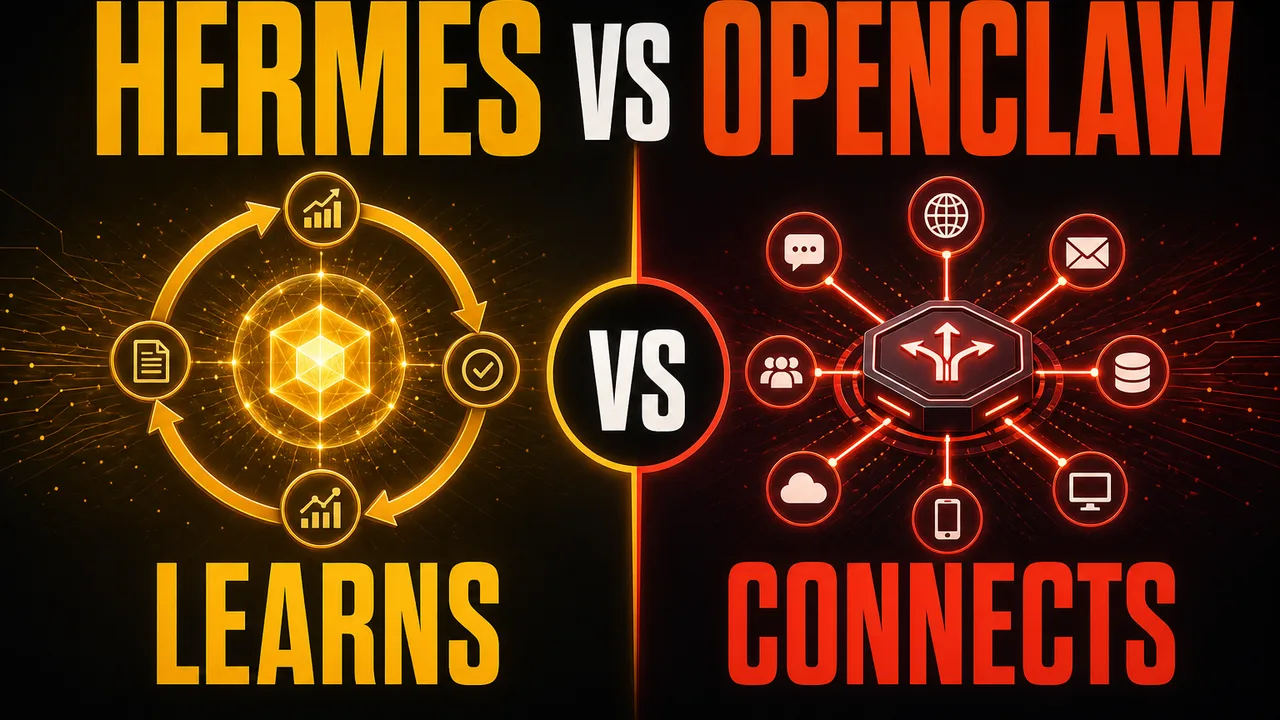
Hermes Agent and OpenClaw solve a similar problem from different directions: turning a language model into a persistent, tool-using assistant that can live on infrastructure you control. Hermes Agent starts with the agent’s learning loop, memory, skills, and execution environment. OpenClaw starts with the Gateway: channels, sessions, device nodes, routing, and operational control.
That distinction is more useful than a feature-count race. Both platforms can connect to messaging surfaces, call tools, run scheduled work, and operate across multiple agents. The decision is about the center of gravity: do you want the system to become better at your procedures, or do you want a dependable control plane that reaches your conversations and devices?
Definition: Hermes Agent is a self-hosted, provider-agnostic AI agent framework with persistent memory, skills, tools, delegation, and a multi-platform messaging gateway.
Example: A Hermes session can research a topic, save a reusable skill, remember a preference, delegate parallel subtasks, and continue the workflow from Telegram or a terminal.
Key takeaway: OpenClaw emphasizes gateway reach and explicit channel/device operations; Hermes Agent emphasizes learning, procedural memory, and flexible execution backends.
Business impact: Both can automate real work, but both also create an operator-grade security boundary around credentials, files, browsers, channel accounts, and model tools.
What is the real difference between Hermes Agent and OpenClaw?
Hermes Agent is designed around a self-improving agent loop. Its official documentation highlights agent-curated memory, autonomous skill creation, skill improvement during use, cross-session recall, multiple execution backends, delegation, and broad provider support. The platform can run from a local terminal, a remote machine, a container, or a messaging gateway, so the agent itself remains the primary product.
OpenClaw is designed around a long-lived Gateway. Its architecture documentation describes one Gateway owning messaging surfaces, control-plane clients connecting through a typed WebSocket API, and nodes connecting with explicit capabilities for actions such as Canvas, camera, screen recording, and location. OpenClaw’s agent is therefore part of a larger communication and device-control system.
Neither framing is intrinsically superior. Hermes Agent is more compelling when continuity means “the assistant learns how I work.” OpenClaw is more compelling when continuity means “the assistant is reachable everywhere and can coordinate channels, clients, and paired nodes.”
Hermes Agent vs. OpenClaw at a glance
| Dimension | Hermes Agent | OpenClaw |
|---|---|---|
| Primary center of gravity | Self-improving agent and execution environment | Long-lived messaging and device Gateway |
| Memory model | Persistent user/session memory plus curated procedural skills | Session continuity, workspace context, and configurable agent state |
| Skills | Agent-created, reusable, portable skills compatible with AgentSkills conventions | Skills and plugins with a strong operational/supply-chain emphasis |
| Channels | 20+ messaging and communication integrations documented by Hermes | Broad channel ecosystem with Gateway-owned routing |
| Multi-agent model | Independent profiles plus delegated and parallel subagents | Multiple agents with separate workspaces, state, sessions, tools, and sandbox policies |
| Tools | 60+ built-in tools, MCP, web, browser, terminal, file, code execution, media, cron | Channel, filesystem, browser, exec/process, node, cron, gateway, and plugin tools |
| Execution isolation | Local, Docker, SSH, Daytona, Singularity, Modal, and configurable approvals | Gateway host plus opt-in per-agent/session sandboxing through Docker, SSH, or OpenShell |
| Best first use case | Personal coding, research, operations, and workflows that improve over time | Channel-first personal assistant, device control, and multi-surface automation |
| Main operational risk | Powerful host access and evolving skills need careful policy boundaries | Gateway credentials, channels, nodes, plugins, browser control, and sandbox escape paths need careful policy boundaries |
This table is a decision map, not a benchmark. The platforms change quickly, model choice affects results, and the same feature can behave very differently under a narrow read-only policy versus unrestricted host access.
Which platform has the better memory model?
Hermes Agent has the clearer advantage when “memory” means reusable knowledge about the operator and their workflows. Its documentation separates persistent memory from skills: memory can retain user preferences and cross-session facts, while skills preserve procedures that the agent can reuse and improve. Hermes also supports FTS5-backed session recall and optional integrations such as Honcho for user modeling.
The distinction matters in practice. A transcript says what happened in one conversation. A skill can encode how to perform a recurring operation next time. For example, a one-off deployment conversation may become a reusable release checklist, while a personal preference can remain a compact profile fact rather than being repeated in every prompt.
OpenClaw’s strength is not that it lacks continuity. OpenClaw stores agent state, workspaces, session transcripts, credentials, and routing metadata, and its multi-agent design gives each agent its own state directory and session store. Its model is closer to durable operational context: the Gateway knows which agent, channel, peer, workspace, and tool policy should handle a request.
Choose Hermes Agent when you want a learning loop. Choose OpenClaw when you want reliable continuity across channels and isolated operational identities. If a workflow needs both, you can run them as separate trust boundaries and connect them through a narrow API or messaging surface rather than giving one system unrestricted control of the other.
How do Hermes skills compare with OpenClaw skills and plugins?
Hermes Agent treats skills as procedural memory. The agent can create a skill after solving a complex problem, improve it when a workflow changes, and load it again in future sessions. The system also documents an open, portable skills format and a Skills Hub, which makes skills closer to reusable operating knowledge than to ordinary extensions.
OpenClaw also supports skills, but its documentation puts more emphasis on precedence, installation, plugins, and trust. A workspace skill can override a bundled skill, and plugins run in-process with the Gateway. OpenClaw therefore treats the extension layer as a supply-chain surface: review skills, restrict who can modify them, use explicit plugin allowlists, pin versions where possible, and inspect code before activation.
The practical difference is emphasis. Hermes makes the skill lifecycle part of the agent’s learning story. OpenClaw makes the extension lifecycle part of Gateway operations and security. Neither should be granted blind trust: a Markdown skill can influence a powerful agent, while a plugin can execute runtime code with Gateway privileges.
If you are building a team-wide catalog of repeatable procedures, Hermes Agent’s self-improvement loop is attractive. If you are operating a channel gateway with carefully reviewed integrations, OpenClaw’s explicit plugin and policy posture is attractive. In both cases, keep privileged skills out of public or untrusted sessions.
Which platform is better for Telegram and multi-channel messaging?
Both Hermes Agent and OpenClaw can turn messaging apps into agent interfaces, but OpenClaw makes the Gateway abstraction more explicit. OpenClaw’s Gateway owns provider connections, emits typed events, exposes a WebSocket API to clients, and routes requests to agents and sessions. It is a natural fit for an operator who wants one daemon coordinating Telegram, WhatsApp, Discord, Slack, WebChat, and paired devices.
Hermes Agent provides a similarly broad messaging gateway. Its official documentation lists Telegram, Discord, Slack, WhatsApp, Signal, Matrix, Mattermost, email, SMS, DingTalk, Feishu, WeCom, Weixin, QQ Bot, Yuanbao, BlueBubbles, Home Assistant, Microsoft Teams, Google Chat, and other integrations. Hermes is particularly attractive when the messaging surface is simply another way to reach the same evolving agent.
The choice comes down to what must remain stable. OpenClaw offers a strong channel-and-device control-plane mental model: clients connect to the Gateway, nodes announce capabilities, and side-effecting requests use typed protocol messages and idempotency keys. Hermes offers a strong agent-and-workflow mental model: the same tool-enabled assistant can work through chat, terminal, scheduled jobs, webhooks, and delegated subagents.
For a private Telegram assistant, either platform can work. For a communications-heavy deployment with several accounts, nodes, and control-plane clients, OpenClaw deserves the closer look. For a personal automation assistant whose Telegram chat is only one entry point, Hermes Agent may feel more coherent.
How do their tools and execution environments differ?
Hermes Agent exposes a broad tool ecosystem through configurable toolsets. The official feature list includes web search and extraction, browser automation, filesystem and terminal access, code execution, vision, image generation, video, text-to-speech, MCP, memory, delegation, cron, messaging, and platform-specific integrations. Its execution backends can place work locally, in Docker, over SSH, or on remote/serverless environments such as Daytona and Modal.
OpenClaw provides a similarly consequential tool surface, but its vocabulary is tightly connected to the Gateway: exec, process, filesystem tools, browser control, nodes, Canvas, cron, sessions, channels, and Gateway configuration. A paired node can represent a phone or computer with capabilities such as camera, screen, location, or system actions. That is powerful because the agent can operate where the user is, but it makes node pairing and browser profiles operator-level decisions.
The difference is not “one has tools and the other does not.” It is the default workflow around those tools. Hermes is optimized for an agent that can move between coding, research, system administration, and automation backends. OpenClaw is optimized for an agent that can act through a connected control plane and a set of deliberately paired surfaces.
A useful test is to list the first five tools your workflow needs. If they are terminal, file, web, code execution, delegation, and MCP, Hermes Agent’s model may be the more natural fit. If they are messaging, browser, node actions, Canvas, Gateway, and channel operations, OpenClaw’s model may fit better.
For business automation, avoid enabling every tool on day one. Start with the minimum set, add explicit approvals for irreversible actions, and create a separate reader agent for untrusted web pages, email, files, or group content.
Which platform has the stronger sandboxing story?
OpenClaw has unusually explicit sandbox documentation. Its sandboxing guide separates mode, scope, backend, and workspace access. Sandboxing can be off, applied to non-main sessions, or applied to all sessions; it can be scoped per agent or session; and it can use Docker, SSH, or OpenShell. Workspace access can be none, read-only, or read/write.
OpenClaw also documents conservative Docker defaults such as no network egress, a read-only root filesystem, dropped capabilities, blocked sensitive bind paths, and a separate sandbox browser. The Gateway itself remains on the host, while selected tool execution moves into the sandbox. Elevated tools are an explicit escape hatch and should be treated as a privileged operator capability.
Hermes Agent takes a more backend-oriented approach. Its terminal tool can use local, Docker, SSH, Daytona, Singularity, or Modal backends, and its security model includes command approvals, tool enable/disable controls, container isolation, profiles, and configurable execution timeouts. This gives Hermes flexibility across local machines, VPS deployments, and remote compute, but it also means the operator must understand which backend is active and which tools remain on the host.
OpenClaw is the better fit if you want a clearly documented, per-agent/per-session sandbox matrix at the Gateway layer. Hermes Agent is the better fit if your execution topology matters as much as the sandbox itself—for example, moving work to a remote SSH host or a serverless environment. In either platform, sandboxing is not authorization: it does not decide who may message the agent, which credentials the model can use, or whether a browser profile is already logged into a sensitive account.
What do their security models imply for real deployments?
The most important security similarity is that neither platform should be treated as a harmless chatbot. A tool-enabled agent may read files, run commands, browse authenticated accounts, call networks, modify state, schedule future work, and send messages. Prompt injection can arrive through an untrusted webpage, document, email, attachment, group chat, or pasted log—not only through a malicious direct message.
OpenClaw is unusually direct about its trust model: one Gateway is intended for one user or trust boundary, not for mutually adversarial users sharing one agent. Its security guidance recommends identity-first controls such as DM pairing and allowlists, mention gating in groups, narrow tool profiles, sandboxing, protected browser profiles, plugin allowlists, and openclaw security audit after changes.
Hermes Agent has the same fundamental responsibility, with different controls. Its command approval modes can require manual confirmation or use a smarter approval path; toolsets can be disabled; profiles isolate configuration, sessions, skills, and memory; gateways can authorize messaging platforms; and terminal execution can move into container or remote backends. Hermes’ profile model is particularly useful when personal, work, and public agents need separate state.
For either platform, the hardened baseline is straightforward:
- keep the Gateway private or tailnet-only;
- pair or explicitly allowlist direct messages;
- require mentions in groups;
- use a dedicated browser profile;
- keep secrets out of workspaces and prompts;
- sandbox untrusted sessions;
- deny shell, browser, filesystem-write, node, Gateway, and cron tools unless needed;
- pin and review skills, plugins, and dependencies;
- use a strong, instruction-hardened model for tool-enabled work;
- log, rotate, and audit credentials after suspicious activity.
Security is not the feature that makes the choice for you. It is the constraint that makes either choice viable.
Which platform is easier to operate?
Hermes Agent is likely to feel easier to an engineer who starts in a terminal and thinks in terms of agents, tools, skills, providers, and profiles. Its CLI exposes setup, model selection, gateway management, tools, skills, MCP servers, cron, profiles, auth pools, memory, plugins, and diagnostics. The project also offers a desktop installer and a documented path from a local conversation to a messaging gateway.
OpenClaw is likely to feel easier to an operator who starts from channels and wants a single Gateway daemon with a Control UI, typed protocol, device pairing, explicit routing, and a security audit command. The architecture gives the deployment a concrete shape: one Gateway, connected clients, paired nodes, agents, sessions, and tools.
Hermes Agent has more “agent workbench” surface area. OpenClaw has more “gateway operations” surface area. Neither is zero-maintenance: updates can change provider behavior, model APIs, channel integrations, plugin dependencies, sandbox images, browser behavior, and security defaults. Treat installation as the beginning of an operating model, not the end of configuration.
What should a small business choose?
A small business should choose Hermes Agent when the main automation opportunity is knowledge-intensive work that improves through repetition: coding support, research, operations runbooks, content production, data analysis, and internal workflows. Hermes is especially compelling when a team wants provider flexibility, reusable skills, persistent memory, and multiple isolated profiles without adopting a separate orchestration stack for every workflow.
A small business should choose OpenClaw when the main automation opportunity is channel-first: a controlled assistant that receives requests through messaging, coordinates multiple identities, uses paired devices, and needs a clearly defined Gateway and sandbox policy. OpenClaw’s operational documentation is valuable when the deployment will be exposed to multiple channels and device surfaces.
Neither should receive unrestricted production credentials at the start. Create a staging workspace, use synthetic data, make outbound actions approval-bound, and measure failure modes before granting access to CRM systems, inboxes, cloud accounts, payment systems, or production hosts.
Can you run Hermes Agent and OpenClaw together?
Yes, but combining them should be an intentional architecture rather than a reflexive “use both” answer. One safe pattern is to make one platform the channel-facing reader and route approved tasks to the other through a narrow interface. Another is to use separate hosts and trust boundaries: OpenClaw handles messaging and device reach, while Hermes handles a private research or coding workspace.
Do not give both Gateways the same broad credentials, browser profile, home directory, and unrestricted shell. That creates two orchestration layers around one large blast radius, making incident analysis harder rather than adding safety. Keep the interface between them small: structured task requests, explicit result payloads, scoped webhooks, or a dedicated queue.
For most users, choose one platform first. Running both becomes reasonable when the communication plane and the learning/execution plane genuinely have different ownership, lifecycle, or security requirements.
The decision framework: reach, learning, or control?
Use this three-question framework before installing either platform:
- Where does the work begin? If it begins in a terminal, repository, research folder, or runbook, Hermes Agent is a natural starting point. If it begins in Telegram, WhatsApp, a browser dashboard, or a paired phone, OpenClaw is a natural starting point.
- What should improve over time? If the answer is procedures, preferences, and reusable agent behavior, Hermes Agent’s memory and skills are central advantages. If the answer is routing, channel coverage, device capabilities, and per-agent operational policy, OpenClaw’s Gateway model is central.
- Where is the hard boundary? If the boundary is an execution backend or workspace, compare Hermes’ local/container/SSH/serverless options. If the boundary is a Gateway, agent, node, channel, or sandbox session, compare OpenClaw’s policy hierarchy.
For a deeper dive into each side of this comparison, see Hermes Agent Explained and the OpenClaw guide. For a broader foundation on how tool-using assistants differ from ordinary chatbots, see What Is an AI Agent?. For teams deciding how to assemble an automation stack, AI Automation Stack Explained provides the surrounding model, integration, and workflow context.
Final verdict
Hermes Agent is the better choice for operators who want a personal agent that learns their procedures, accumulates curated memory, creates reusable skills, delegates work, and can move across providers and execution backends. OpenClaw is the better choice for operators who want a channel-first Gateway with explicit routing, device nodes, a typed control plane, per-agent policies, and a deeply documented sandbox and security model.
The strongest choice is not the platform with the longest feature list. It is the platform whose default architecture matches the boundary you can actually operate. Start with one trusted channel, one small workspace, one carefully chosen model, and the narrowest useful tool policy. Then test whether the system saves time without turning your credentials, filesystem, browser, and communications into one uncontrolled agent surface.
Frequently asked questions
Is Hermes Agent better than OpenClaw?
Neither is universally better. Hermes Agent is the stronger fit when the main requirement is an agent that accumulates curated memory, creates and improves reusable skills, delegates parallel work, and can run through many providers and terminal backends. OpenClaw is the stronger fit when the main requirement is a polished, channel-first gateway with a defined WebSocket control plane, device nodes, extensive channel routing, per-agent policies, and deeply documented sandboxing. The right choice depends on whether your highest-value problem is agent continuity and learning or communication reach and gateway operations.
Can Hermes Agent and OpenClaw use the same AI models?
Both systems are orchestration layers rather than foundation models, so model compatibility depends on the configured provider and endpoint. Hermes Agent documents support for Nous Portal, OpenRouter, OpenAI, Anthropic, local models, and many other providers. OpenClaw similarly connects to model providers through its agent configuration and focuses on routing, tools, channels, and sessions. Compare the provider authentication, context handling, tool-calling behavior, and operating cost for the models you actually plan to use instead of choosing based only on the platform name.
Is either platform safe for a public group chat?
A tool-enabled agent should not be treated as safe for a public group merely because it runs on a private server. Both platforms require explicit access control, narrow tools, protected credentials, and a clear trust boundary. OpenClaw explicitly states that one Gateway is not a hostile multi-tenant boundary and recommends pairing or allowlists, mention gating, sandboxing, and audits. Hermes Agent also provides command approvals, container isolation, tool controls, profiles, and gateway authorization. For untrusted groups, use a separate restricted agent with no shell, filesystem, browser, or control-plane tools.
Which platform should a developer try first?
Start with Hermes Agent if you want a terminal-native personal agent that can evolve its procedures and memory while you work. Start with OpenClaw if you want to begin from messaging channels, a Gateway daemon, device connectivity, and explicit channel or node routing. In either case, use one private channel, one small workspace, no production credentials, and a read-only or sandboxed tool profile before expanding the deployment.
Alex
Founder & Lead AI Writer
Alex is the founder of Yowox and lead AI writer since 2024, breaking down complex information into clear, actionable insights for thousands of readers every day. Alex has built AI automation systems for businesses since 2024, focusing on AI agents, workflow automation, and business process optimization.
Save hours. Save thousands.
Practical guides, real workflows, and the latest AI and automation news that matters — straight to your inbox.