 By Alex
 Grok 4.6 Targets Long-Running Agents and Visual Work
Grok 4.6 is xAI's new model for long-running agents, coding, knowledge work, and interactive applications, with API access starting at $2 per million input tokens.
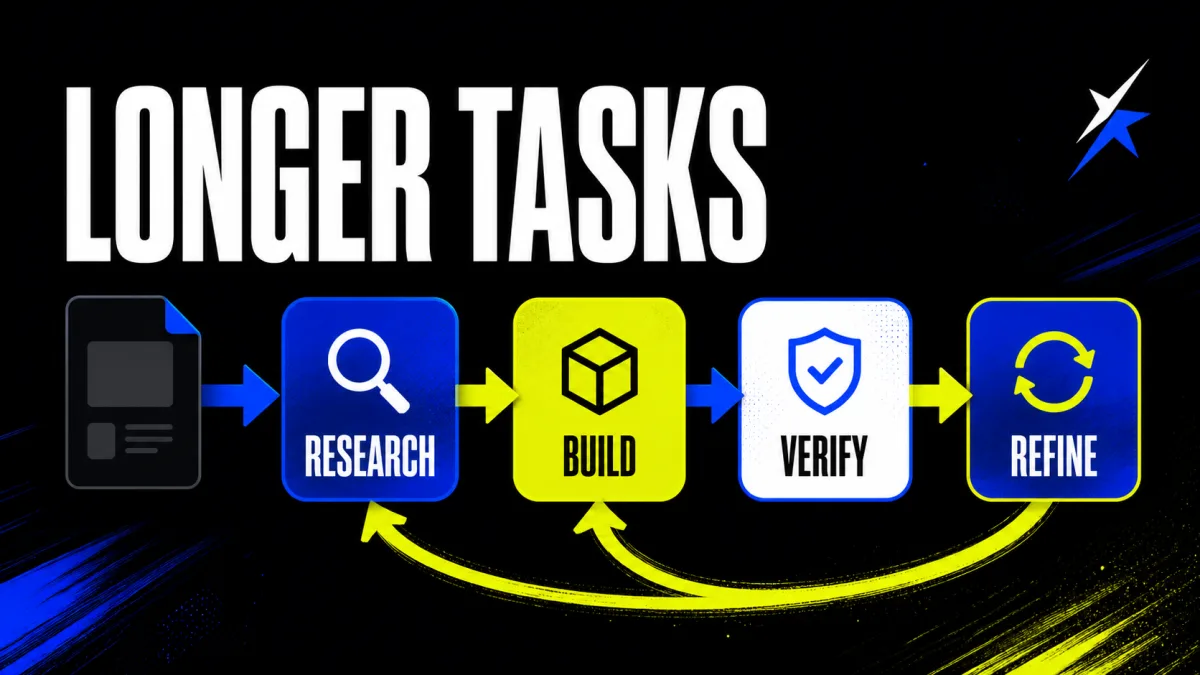
Grok 4.6 is xAI's new model for long-running agents, coding, knowledge work, and interactive visual projects. In its August 12 announcement, xAI says Grok 4.6 is designed to stay with a complex task across many steps—from researching a topic and analyzing information to working through a codebase or turning an idea into a polished application.
Definition: Grok 4.6 is a general-purpose model tuned for longer agent trajectories, coding, knowledge work, and interactive visual applications.
Example: A Grok 4.6 workflow can research an unfamiliar domain, structure an application, implement its core interactions, and refine the result through several feedback rounds.
Key takeaway: The release emphasizes sustained execution and iteration rather than only one-shot answers.
Business impact: Teams evaluating Grok 4.6 should measure completed tasks, verification quality, and cost per run—not just prompt-level response quality.
What is Grok 4.6 designed to do?
Grok 4.6 is designed to sustain work across multiple steps, according to xAI's release description, and the target tasks include research, information analysis, software engineering, and application building. The model's stated value is continuity: it can keep a task context while moving from investigation to implementation and then refinement. For an operator, the practical test is whether Grok 4.6 can complete a defined workflow with fewer restarts and less manual steering than the team's current model.
Grok 4.6 also targets interactive and visual work, not only text and code, according to xAI's own examples. xAI says Grok 4.6 produces stronger first passes on visual and interactive projects than it typically saw with Grok 4.5, including a first-pass structure and visual language for an application. Teams testing this claim should provide a concrete product brief and evaluate the resulting interface after several revisions rather than judging a static screenshot.
How does Grok 4.6's training support longer agent runs?
Grok 4.6 received a longer supplemental training run than Grok 4.5, with model-generated data for reasoning and advanced technical concepts, engineering data, and an improved optimizer and training recipe, xAI says. The company then used Grok 4.5 to regenerate supervised fine-tuning trajectories across reasoning efforts, agent harnesses, STEM, software engineering, and knowledge work before filtering problematic traces. The useful implication for a team is that Grok 4.6 is trained around multi-step behavior, but the relevant acceptance test remains reliable task completion in the team's own environment.
Grok 4.6 is trained with reinforcement-learning tasks covering knowledge work, general coding, kernel optimization, web development, and computer-aided design, according to xAI. That task mix is broader than a coding-only evaluation and gives the model a stated reason to be tested outside an IDE. A sensible pilot therefore includes one coding workflow, one research or analysis workflow, and one visual or interactive build task.
Can Grok 4.6 turn a product idea into a working application?
Grok 4.6 is intended to turn a broad product idea into a working first version, based on xAI's reported internal testing, by researching an unfamiliar domain, structuring the application, implementing core interactions, and refining the result through feedback. xAI also says it observed more self-testing and verification on longer trajectories. The practical takeaway is not that every generated application is production-ready; it is that Grok 4.6 may be useful for producing a substantial first pass that a human team can evaluate and iterate.
Grok 4.6's visual-project claim is strongest when the task has a concrete product brief and a visible feedback loop, because xAI describes the model as establishing structure and visual language in one pass and then improving it. A team should define the required screens, interactions, data boundaries, and acceptance checks before the run, then record which parts Grok 4.6 verifies itself and which parts still require human review.
How does Grok 4.6 compare on xAI's published evaluations?
xAI reports that Grok 4.6 matches GPT-5.6 Sol on the Artificial Analysis Intelligence Index, a composite of nine benchmarks, with both listed at 61 in the release table. The same table lists Fable 5 Max at 62 and Grok 4.5 High at 56. Because xAI notes that third-party figures come from published system cards or benchmark leaderboards, the index is useful as a release snapshot, not a universal substitute for testing a team's own workload.
| Evaluation | Grok 4.6 High | Grok 4.5 High | GPT-5.6 Sol Max | Fable 5 Max |
|---|---|---|---|---|
| AA Intelligence Index | 61 | 56 | 61 | 62 |
| GDPVal-AA v2 | 1753 | 1526 | 1728 | 1741 |
| CursorBench v3.2 | 69.9% | 66.7% | 67.2% | 70.5% |
| DeepSWE v1.1 | 65.9% | 54% | 73% | 70% |
| FrontierCode v1.1 (Extended) | 61.3% | 56.6% | 60.6% | 63.6% |
| APEX-Agents | 57.5% | 47.1% | 56.7% | 59.2% |
| Terminal-Bench v3.0 | 26% | 15.7% | 34.6% | 34.1% |
| APEX-SWE | 56.4% | 53.6% | — | 58.8% |
| AA-Briefcase | 1577 | 1313 | 1502 | 1574 |
| Harvey LAB (Vals) | 15.8% | 12.9% | 2.5% | 11.3% |
The table shows why Grok 4.6 should not be described as the winner of every coding benchmark. Grok 4.6 is ahead of Grok 4.5 on each listed row where both have a score, but the release also shows GPT-5.6 Sol Max and Fable 5 Max leading several individual evaluations. Teams comparing models should select the benchmark closest to their workflow, reproduce the task conditions where possible, and track the full cost of successful completion.
What safety information did xAI publish?
Grok 4.6's safeguards were improved and calibrated alongside the model's capabilities, xAI says, with a safety stack intended to support legitimate use cases such as vulnerability patching, engineering design, and AI research. xAI describes the release as having its widest-ever pre-deployment suite for capability and safeguard calibration, plus post-deployment and third-party testing. The concrete operational takeaway is to treat those statements as the vendor's safety description and add organization-specific red-team tests before granting an agent access to sensitive systems.
Where can teams access Grok 4.6?
Grok 4.6 is available in Cursor and Grok Build, through the API, and through partners including OpenRouter, Vercel, and Cloudflare, according to xAI. xAI also says Cursor and Grok Build include twice the normal usage for the first week after release. Developers choosing an access path should decide first whether they need an interactive coding environment, a hosted integration, or direct API control over prompts, tools, logging, and budgets.
Grok 4.6 API pricing starts at $2 per million input tokens and $6 per million output tokens, while xAI says the fast variant costs twice as much. A long-running agent can make many model calls, so the relevant business metric is cost per completed workflow rather than cost per isolated request. Start with a capped pilot, log token use and retries, and compare the result with the workflow's current human effort.
What should teams test first?
Grok 4.6 is best evaluated as a workflow component, not as a leaderboard number, because xAI's central claim concerns long-running agents that research, act, verify, and iterate. Start with one bounded task that has a clear input, a small tool set, and an observable definition of done; record completion rate, human interventions, verification failures, latency, and cost. This is the same distinction that separates an AI agent from a chatbot: the useful result is a completed task, not merely a plausible reply.
Grok 4.6 should be compared with Grok 4.5 on the same prompts, tools, budgets, and acceptance checks, because the two models share a product lineage and xAI presents the newer release as an improvement for longer and more visual work. Teams can also compare the experiment with the Grok 4.5 launch and inspect the surrounding Grok Build agent harness. The decision should follow measured workflow performance, not the launch claim alone. Background: Grok Bot Gives AI Teammates Their Own Computer. Related reading: Grok Bot Tutorial: Build a Cross-App AI Team. See also Grok Bot turns AI teammates into 24/7 operators. Background: Grok Imagine Image 2.0 makes image editing practical.
The practical conclusion
Grok 4.6 is a release focused on sustained agent behavior, broader knowledge work, and stronger first passes on interactive visual projects, according to xAI's published announcement. Its benchmark table shows a stronger release snapshot than Grok 4.5 across the listed shared evaluations, but it does not establish one model as the winner for every task. For operators, the right next step is a controlled pilot that measures completed work, verification, interventions, and total token cost before a wider rollout.
Frequently asked questions
What is Grok 4.6?
Grok 4.6 is xAI's latest model, released on August 12, 2026, with a stated focus on long-running agents, knowledge work, coding, and interactive visual applications. xAI says Grok 4.6 can stay with a complex task across many steps, research unfamiliar domains, work across a codebase, and refine a first version of an application through feedback. The release is an agent and product-workflow update, not only a single-turn chatbot benchmark launch.
Where can I use Grok 4.6?
Grok 4.6 is available in Cursor and Grok Build, as well as through the API and partners including OpenRouter, Vercel, and Cloudflare, according to xAI's launch announcement. xAI also says Grok Build and Cursor include twice the usual usage for the first week after launch. Teams should choose the access route based on the workflow they need to test: an interactive coding surface, a partner integration, or direct API control.
How much does Grok 4.6 cost?
Grok 4.6 pricing starts at $2 per million input tokens and $6 per million output tokens. xAI says a fast variant costs twice as much. The effective cost of an agent run will also depend on how many steps, tool calls, retries, and model outputs the workflow uses, so a token price alone is not a complete operating-cost estimate. Teams should measure cost per completed task on a representative workflow before scaling usage.
Is Grok 4.6 the best coding model?
xAI's published evaluation table does not show Grok 4.6 winning every listed benchmark. It reports the highest score among the four compared models on some evaluations, while another model leads on others; for example, the table lists Grok 4.6 at 65.9% on DeepSWE v1.1 and 26% on Terminal-Bench v3.0, versus higher scores from competitors on both rows. The useful conclusion is narrower: Grok 4.6 is positioned as a broad agentic model, so teams should test it on their own coding and knowledge-work tasks rather than infer a universal winner from one leaderboard.
What is new in Grok 4.6 compared with Grok 4.5?
Grok 4.6 builds on Grok 4.5 with a longer supplemental training run, a revised optimizer and training recipe, curated model-generated reasoning data, and reinforcement-learning tasks across coding, knowledge work, web development, kernel optimization, and computer-aided design. xAI also highlights stronger first passes on visual and interactive projects and more self-testing on long trajectories. These are the release's stated improvements; independent teams still need to verify how much they matter in their own applications.
Alex
Founder & Lead AI Writer
Alex is the founder of Yowox and lead AI writer since 2024, breaking down complex information into clear, actionable insights for thousands of readers every day. Alex has built AI automation systems for businesses since 2024, focusing on AI agents, workflow automation, and business process optimization.
Save hours. Save thousands.
Practical guides, real workflows, and the latest AI and automation news that matters — straight to your inbox.