 By Alex
 Grok Bot Gives AI Teammates Their Own Computer
SpaceXAI's Grok Bot beta gives AI teammates a cloud computer, access to existing apps and the ability to finish multi-step work across inboxes, tools and websites.
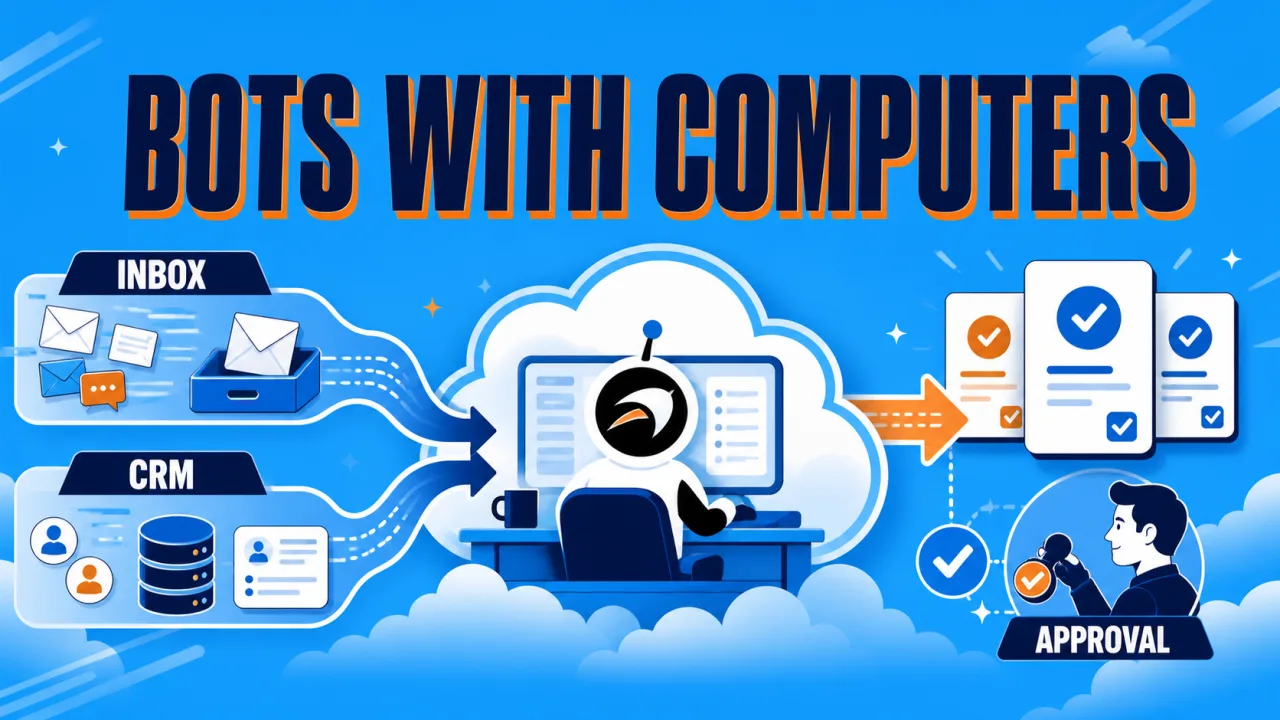
SpaceXAI's Grok Bot beta gives AI teammates their own cloud computer, access to the tools people already use, and the ability to keep working after the user steps away. The official announcement describes Bots that can sign into apps, operate across websites and inboxes, complete multi-step jobs, and return when a decision or approval is needed.
The product is therefore positioned as more than a chat window. Grok Bot combines a conversational interface with an execution environment: a Bot receives a task, acts inside a computer, observes what happens, and continues until the work is finished or requires human judgment. That is the operational distinction between a chatbot and an AI agent, and it connects to the broader agent harness pattern in which a model is surrounded by tools, context and execution controls.
Definition: Grok Bot is SpaceXAI's beta system for delegating real work to AI teammates with their own cloud computer.
Example: A Bot can research sales accounts, prepare personalized drafts, update a CRM, or reproduce a product bug across the tools where that work actually happens.
Key takeaway: Grok Bot is designed to finish tasks inside existing applications instead of stopping at a suggested next step.
Business impact: The model promises less manual coordination, but teams still need clear approval boundaries for actions that send messages, change records or affect operations.
What is Grok Bot built to do?
Grok Bot is built for delegated, end-to-end work rather than one-turn answers. SpaceXAI says users can message a Bot like a colleague, hand off a job, and return to the same thread from desktop or phone; the Bot keeps working in the background on its own computer. For an operations team, that means starting with an outcome—such as preparing follow-ups or processing an inbox—rather than designing every automation step first. Related reading: Grok Bot Tutorial: Build a Cross-App AI Team. More on this: Hermes Bot Mode Turns Profiles Into Named Teammates.
The announcement says Grok Bots can sign into the tools a team already uses and work across apps, websites and inboxes, including systems without a clean API or MCP connection. That capability matters when the required work lives behind a graphical interface: the practical test is whether the Bot can place the finished result in the actual system, not merely describe what a human should do next.
SpaceXAI also says Grok Bot can remember conversations and learn how a person prefers work to be done. A user can show a Bot a workflow, let it watch the steps, correct it, and ask it to run the routine again later. The source frames this as a gradual handoff: the Bot starts with guidance, records the workflow, and becomes more independent as the user gains confidence.
Which workflows is SpaceXAI showing?
SpaceXAI's internal examples cover sales, growth and marketing, operations and finance, product, engineering and community work. The examples are useful because they show the intended unit of automation: a connected chain of actions that crosses tools, not a single isolated API call.
- Sales outbound: A Bot researches accounts, scores contacts for intent, drafts email and LinkedIn messages in a seller's voice, and prepares drafts for approval.
- Operations and finance: A Bot helps seat new hires and process invoices received in Gmail.
- Product and engineering: A Bot reproduces a bug in the product UI, files the ticket, and hands the fix to another debugging Bot.
- Pipeline operations: A Bot keeps CRM and org-chart information organized, flags stalled work, and prepares a weekly scoreboard.
These examples come from the product announcement, so they describe the workflows SpaceXAI is highlighting rather than independent evidence of performance. A team evaluating Grok Bot should test the same kind of chain in a disposable workspace: give the Bot a narrow goal, synthetic data and explicit approval requirements, then inspect where it pauses and where it acts without asking.
How can multiple Grok Bots coordinate?
Grok Bot is designed for several specialized Bots working in parallel. SpaceXAI describes a chief-of-staff Bot coordinating specialists for inbox management, expenses, recruiting, bug fixes and operations, so a user does not have to act as the relay between every agent.
The announcement says Bots can message one another, share context in threads, and coordinate in group chats. One Bot can pass work to another, assign ownership and bring the user in for judgment calls. This is a multi-agent pattern: separate workers handle distinct lanes while a coordinating agent keeps the project aligned.
The benefit is parallelism, but parallelism also makes ownership important. Before using multiple Bots on a live process, define which Bot can create drafts, which can change records, which can send external messages, and which can only report. A team should also decide where the human approval point sits; otherwise, adding more Bots can multiply unclear handoffs instead of removing them.
What changes when a Bot has its own computer?
A cloud computer changes the failure mode of automation. A Bot with its own environment does not need the user's laptop to remain open, so a long task can continue while the user is away. SpaceXAI says this is why early users experience Grok Bot more like a teammate: the Bot can keep a task moving instead of waiting for another prompt after every step.
The same design expands the security boundary. A Bot that can sign into websites may encounter private information, authenticated sessions, destructive controls or untrusted instructions embedded in a page. The announcement emphasizes completion and approval, but it does not provide a full public security model for every workflow. Operators should therefore treat the cloud computer as a privileged workspace: use the narrowest accounts, avoid shared production credentials during evaluation, and require approval before irreversible actions.
This distinction also separates Grok Bot from a conventional workflow builder. The user can describe a task conversationally rather than first assembling a fixed sequence of triggers and actions. That lowers setup friction, but it shifts more responsibility toward testing the Bot's interpretation, tool choices and stopping behavior.
Who can try Grok Bot now?
SpaceXAI says Grok Bot is in early beta and is available on desktop and iOS to SuperGrok Heavy, Cursor Ultra and Cursor Teams Premium subscribers. Enterprise users can join a waitlist for future access. The announcement does not describe a general public free tier or a complete enterprise rollout, so access should be treated as an eligibility-dependent beta rather than a broadly available automation platform.
For an eligible user, the suggested starting point is small: download the app, create one teammate, and hand off a bounded task. A good first task has a clear output, reversible actions, synthetic or low-sensitivity data, and a human review step. A bad first task involves unrestricted access to production systems, ambiguous authority or external messages that cannot be recalled.
What should teams watch next?
Grok Bot's central promise is that AI agents can move from producing advice to completing work inside the same applications as human operators. The beta will show whether that promise holds beyond carefully selected internal examples. The important signals are not only how often a Bot finishes a demo workflow, but how reliably it handles exceptions, asks for approval, preserves context, and leaves an auditable trail.
The product also raises a practical architecture question: how much autonomy should one teammate receive before a company splits the work across several narrowly scoped Bots? SpaceXAI's own examples point toward specialization and coordination. That can make ownership clearer when each Bot has one lane, but it requires permissions, escalation rules and a way to inspect inter-Bot handoffs.
Grok Bot is an early beta, so its real business value remains to be established through controlled use. The announcement makes the direction clear: a team of AI agents with computers, app access, persistent conversations and the ability to work in parallel. The next test is whether those agents can be trusted with ordinary work without turning convenience into an uncontrolled operational surface.
FAQ
Is Grok Bot an AI agent or a chatbot?
Grok Bot is presented as an AI-agent product because it can receive a goal, use a computer, operate across tools, observe results and continue working. Its interface is conversational, but the announced product behavior extends beyond generating an answer. The Bot is intended to complete a task and return for approval when human judgment is needed.
Does Grok Bot require APIs for every application?
No. SpaceXAI says Bots can work across apps, tools and websites, including platforms without a clean API or MCP connection. That is one of the reasons the product gives each Bot its own computer. The exact reliability and permission behavior for a particular application still needs to be tested in the beta.
Can Grok Bot replace a human team?
The announcement describes Bots as teammates that handle selected work, not as a guarantee that human teams can be removed. SpaceXAI repeatedly frames human involvement around judgment calls and approvals. In practice, replacement claims would require independent evidence about accuracy, exception handling, security and operating cost for a specific workflow.
Is Grok Bot generally available?
No. SpaceXAI describes Grok Bot as an early beta and lists access for SuperGrok Heavy, Cursor Ultra and Cursor Teams Premium subscribers on desktop and iOS, with an enterprise waitlist. Availability can change as SpaceXAI expands the product.
Frequently asked questions
What is Grok Bot?
Grok Bot is SpaceXAI's beta product for assigning real work to AI teammates. Each Bot has its own computer in the cloud, can sign into tools and apps, and can continue working across websites, inboxes and other software. Users can message a Bot from desktop or iOS, then return to the same conversation later.
What makes Grok Bot different from a chatbot?
Grok Bot is designed to complete multi-step work inside a computer environment, not only return a text answer. SpaceXAI says Bots can work across tools that may not have a clean API or MCP connection, remember workflow context, and return when a task needs human approval. That makes the product closer to a delegated digital teammate than a conventional chat interface.
Can multiple Grok Bots work together?
Yes. SpaceXAI says users can run several Bots in parallel, assign specialist roles, let Bots message each other and share context in threads, or place them in group chats. The announcement describes examples such as inbox, recruiting, expense, operations and bug-fixing Bots coordinated by a chief-of-staff Bot.
Who can access Grok Bot?
The announcement says Grok Bot is in beta and available on desktop and iOS to SuperGrok Heavy, Cursor Ultra and Cursor Teams Premium subscribers. Enterprise users can join a waitlist for future access. Availability and eligibility may change as the beta expands.
Alex
Founder & Lead AI Writer
Alex is the founder of Yowox and lead AI writer since 2024, breaking down complex information into clear, actionable insights for thousands of readers every day. Alex has built AI automation systems for businesses since 2024, focusing on AI agents, workflow automation, and business process optimization.
Save hours. Save thousands.
Practical guides, real workflows, and the latest AI and automation news that matters — straight to your inbox.